Monday, May 9, 2022

Big Change While Preserving Brand Identity: 1953-54 Buick Specials and Supers / Roadmasters

I wrote here about how Oldsmobile strongly preserved brand identity when General Motors made an especially drastic redesign for its B-body line for the 1954 model year.  Today's post deals with brand identity practiced by Buick on both 1954 B- and C-bodies.

As I noted in the linked post, "General Motors' 1954 redesigned B- and C-body Oldsmobiles, Buicks and Cadillacs were sensationally futuristic when they were announced in the Fall of 1953...  Those cars were lower, more squared off than previous models and, especially, they featured panoramic or wraparound windshields -- a feature mostly seen on Dream Cars and special, low-production luxury convertibles."

Unless noted, images below are of cars listed for sale.  Aside from frontal views, photos are of four-door sedans so as to compare like-with-like.

Gallery

B-body Buick Specials

1953 Buick Special
GM's 1951-1953 B-bodies had comparatively rounded features.  The hood is high and the fenderline low, being well below the passenger compartment beltline.  The chrome Sweepspear on the side was a strong Buick identifier for a number of years, as were the vertical grille bars.

1954 Buick Special
The redesigned B-body was lower.  Fenders were higher, merging with the beltline.  Hoods were not much higher than the fenders.  The Special's Sweepspear is narrow and extends over the rear wheel opening.  Also retained are the three "portholes" on the front fender, another strong Buick characteristic since the late 1940s.

Rear quarter view.  Nothing much at the rear that's traditional Buick.

The main carryover from 1953 is the stacked, two-element taillight configuration.  Small details, but useful for the 1953 to 1954 body transition.


C-body Buick Supers and Roadmasters

1953 Buick Super - Worldwide Auctions photos
C-body Buicks featured lower, more curvaceous fenders than seen on B-bodies.  Other Buick brand-related details are similar.

1954 Buick Roadmaster - RM Sotheby's auction photo
The hood is higher than on the Special, but lower than for 1953.  The fenderline runs slightly below the beltline.  In other words, a less-dramatic 1953-1954 difference.  Sweepspear treatment is the same as on the '54 Special.

Rear quarter.

1954 Buick Roadmaster - Stateville NC newspaper photo
Again, the main rear carryover has to do with the taillights.

1953 Buick Roadmaster Riviera
Buicks for 1953 were given headlight assemblies that would carry over to 1954, a shrewd tactic.

1954 Buick Roadmaster Riviera
The '54s featured the same upper grille frame shaping and similar hood sculpting, the latter a long-term Buick feature.  The bumper is similar, grille bars are thinner and more numerous.

Thursday, May 5, 2022

Giugiaro's Alfa Romeo Alfetta GT

Around the early 1970s, master stylist Giogetto Giugiaro created several production designs with anglar features and airy passenger compantment greenhouses.  One of the best was for the Alfa Romeo Alfetta GT coupé (scroll down for information on that Alfetta model).

Some background on Alfetta GT design antecedents by Giugiaro can be found in this book (cover above).  It's in Italian, but photos and caption details might be useful for readers not familiar with the Italian language.

Below are images of early Alfetta GTs.  As best I can tell, all are via Alfa Romeo.

Gallery

This (cropped) photo was used for the book cover above.  The book image was flipped; note that the gas filler cap is on the left side of the car.  An interesting detail is the triangular louvered air vent that follows the rear side window profile -- broken linear continuation helps unify a design composition.

Glimpses of the front and rear of the newly announced 1974 Alfetta GT.  Note the gas filler cap door on the silver car.

I'm not a fan of quad headlights, but Giugiaro did a fine job of dealing with them in the frontal composition.

Rear quarter with bold rear and turn/backup light assemblies.  Although the general appearance is angular, that is most pure on the greenhouse.  Much of the design is comprised of gently rounder surfaces.

This is probably a 1976 model, the photo showing the sheetmetal sculpting.  The air exhaust vent abaft of the side window suggests this is a GT, but the grille is like the more powerful GTV.

A 1976 GTV.  These had a solid plaque abaft of the side window and a set of grille openings just above the  bumper.

Monday, May 2, 2022

Big Change While Preserving Brand Identity: 1953-54 Oldsmobile Super 88 and 88

General Motors' 1954 redesigned B- and C-body Oldsmobiles, Buicks and Cadillacs were sensationally futuristic when they were announced in the Fall of 1953.  Well, I thought they were sensational when I saw them in a set of advertisements in a fat edition of the Saturday Evening Post magazine.

Those cars were lower, more squared off than previous models and, especially, they featured panoramic or wraparound windshields -- a feature mostly seen on Dream Cars and special, low-production luxury convertibles.

While making this drastic change from previous GM design language, styling supremo Harley Earl and his crew did their best to retain brand identify details, a smart marketing strategy.  This and follow-on posts deal with those retained characteristics.

I begin with 1954 Oldsmobiles compared to 1953.  Olds had greater brand-specific detail carryover than Buick or Cadillac.

All cars pictured below were listed for sale on the Internet.

Gallery

1953 Oldsmobile Deluxe 88 4-door sedan
Model year 1951-53 B-body cars were more rounded then angular, something of a Harley Earl trademark.  The hood is high, the fenderline well below the passenger compartment beltline.  The windshield is a curved, one-piece affair, but not more than trivially panoramic.

1954 Oldsmobile Super 88 4-door sedan
1954 B-bodies were lower and more block-like.  The fenderline and beltline are the same.  The hood does not rise far above the front fenders.  And there is a wraparound windshield.  Yet the car clearly is an Oldsmobile.

1953 Oldsmobile Super 88 Holiday Coupe
Now for 1953-1954 comparisons.  Brand-identification features include the side trim and front-end details.

1954 Oldsmobile 88 Holiday Coupe
One carryover is the chrome slash on the front fender.  The J-shape part of rear fender ornamentation is retained.  So is the shape of the front wheel well opening.

Rear quarter.

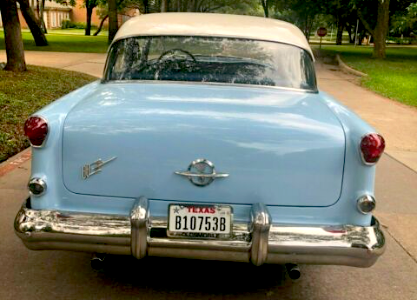
Tail light assemblies and backup lights are similar.  Retained is the Oldsmobile globe-with-ring on the trunk lid.

Now for the car's face.

1954 Oldsmobile 88 2-door sedan
The hood ornament is about the same, as is the globe-and-ring.  The shape of the grille opening is retained, as are the horizontal grille bar and the oval decorations placed on either end.  Other details differ, but those mentioned are strong enough to carry the message "Oldsmobile."

Rear.

The 88 rocket on the trunk lid was restyled, but its placement was retained.  Very little overall  difference as seen from this perspective.

Thursday, April 28, 2022

Why the 1938 Graham's "Shark Nose"?

A late 1930s design that always interested me -- I saw a few around Seattle when I was elementary school age -- was that of the 1938-39 model 96 and 97 Graham.  Officially, the style was called Spirit of Motion, but popularly it was referred to as the Shark Nose or words to that effect.

I wrote a whimsical take on its similarity to an Army Air Corps bomber here.

Its principal designer was Amos Northup (1889-1937), who was in charge of the Murray body company's stying section: more information here.  As mentioned there, Northup slipped on Ice, fell, and died of head injury a few days later.  Consequently, the Graham design was finalized by others, though Northup's theme was retained.

In the Gallery below, I suggest that his theme was gestating in the form of his redesigned 1937 Willys cars.  Further, I speculate that a side (or intentional?) effect was creating a longer hoodline on what otherwise might have been a stubby-looking design similar to those of other, similar size, cars on the market.

Unless noted, images are of for-sale cars.

Gallery

A Graham and Similar Size 1938 Sedans

1938 Chrysler Royal
Its wheelbase is 119 inches (3023 mm).

1938 Buick Special
The wheelbase for this Buick and the following two examples is 122 inches (3099 mm). Its hood is comparatively long because it had to house an in-line eight cylinder motor, rather than a shorter six-cylinder engine.

1938 Packard Six - Mecum auction photo
This entry-level Packard's hood seems shorter than those on the other similar-size cars.

1938 Pontiac Eight

1938 Graham
Wheelbase is 120 inches (3048 mm), 25 mm longer than the Chrysler and 50 mm shorter than the other cars.  Note the longer hood, both actual and as a proportion of the car's length.

Some Grahams Plus a Willys

1937 Willys - advertising image
Willys was redesigned for 1937.  Northup's hood/grille ensemble thrusts forwards, though not as dramatically as on the 1938 Graham.  Headlight assemblies are atop the fenders, another feature used on the Graham.

1937 Willys
Willys' hood would have been extremely short had Northup not thrust it forwards.

1938 Graham
Front quarter view emphasizing the hood and headlights.  One might estimate how much shorter the hood would have been had it truncated near the radiator.

1938 Graham walkaround
The front end is dramatic in a Moderne, sort of streamlined way.  I rather like it.

The front is stretched in what might be called an artificial manner.  But that makes the car less stubby looking.

The Graham's rear is conventional late-1930s.

Monday, April 25, 2022

Low-Level 1930 French Headlights

Nowadays headlight heights above the road are regulated.  That didn't seem to be the case in France during the 1930s.  Whereas most French cars had headlights placed fairly high relative to their grilles and fenders, there were some cases where they were closer to the ground.

This styling fad ended around the 1937 model year, aside from some Puegeot lines.  Their 302s and 402s were essentially pre- World War 2, and 202s were built for a few years after.

Examples of French cars with low-mounted headlights are shown below.

Gallery

1935 Renault Nervasport
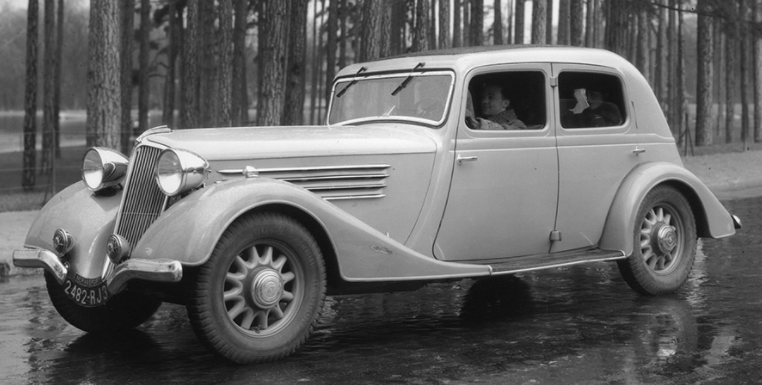
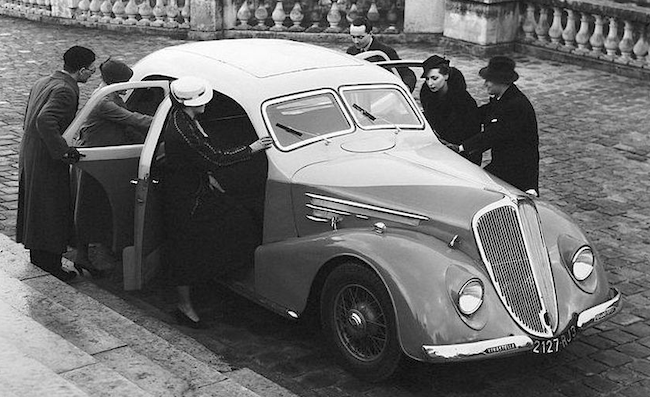
Here is an example of headlight placement on a Renault, the leading French manufacturer.  Compare to the automobiles pictured below.

1930 Bucciali TAV 30 La Marie Torpédo Sport Type Cannes by Saoutchik - Bonhams photo
Bucciali was an especially exotic French brand.  Here is an early instance of low headlights.

1933 Panhard 6CS Coupé
An early example, this by an important French manufacturer.

1935 Avions Voisin C25 Aérodyne - Gooding photo
Voisin was a builder of exotic, expensive cars.

1935 Peugeot 401 Cabriolet
An important French carbuilder.  1934 401s had normal headlight placement.  For 1936 the 401 gave way to the 402 that was clad "Fuseau Sochaux" style.

1937 Peugeot 302 "Fuseau Sochaux"
Peugeot 302s appeared for 1937 with the same styling theme as the 402.  Headlights were distinctively placed behind the grille for models 202, 302 and 402.  They are not as low as seen on the 401 in the previous image -- but they aren't very high either.

1935 Vivastella Grand Sport - factory photo by Robert Doisneau
Low-mounted headlights were on Renault's most expensive lines for the 1935 and 1936 model years.

Thursday, April 21, 2022

Some Postwar Delahaye Sedans

A few years ago I wrote about 1949 Delahaye cars with "pontoon" fenders by carrossier Guilloré.  This was one aspect of the firm's attempt at keeping up with post- World War 2 styling trends that were largely driven by General Motors and other American carmakers.

Unfortunately, Delahaye was undercapitalized and, being a builder of upscale cars, received little benefit from France's Plan Pons that favored production of entry level automobiles.  So motors, chassis, and other engineering details were pre-war.  And this yielded long hoods and comparatively short passenger compartments while American cars were getting shorter hoods and longer trunks and rear overhang.

Shown below are four-door sedan designs by Letourneur & Marchand, illustrating how difficult putting postwar features on prewar chassis could be.  The Delahaye 148 L (for Léger) cars are probably 1948 models, though one of my best sources on French automobiles claims they first appeared in the Fall of 1949.

Gallery

1948 Delahaye 148 L Berline - by Letourneur et Marchand - likely a for-sale image
This design was used for a small "production" run by the coachbuilder.  Unlike Delahaye's prewar custom sedan bodies from its various carrossiers, the beltline below the windows did not curve downward.  This made the car look more postwar.  The front fender extend across the forward door, terminating at the aft door cutline, an awkward touch.  However, the doors are hung on the B-pillar creating a front "suicide door" that at least lacked the complicated fender-related hinging that an A-pillar attachment would have required.

1948 Delahaye 148 L Berline - by Letourneur et Marchand - for-sale photo
Probably the same car as in the previous image.

The "notch-back' is somewhat in line with General Motors' thinking, though the curved backlight window is a little small by contemporary American standards.  Perhaps a matter of French car window glass forming technology compared to that in the USA.

1948c Delahaye 148L Berline - by Letourneur et Marchand - Hyman photo
This car, found in the USA, features wire wheels.  It lacks the chrome rock guard on the rear fender.  The front fenderline is more horizontal than that of the other 148 L.

1949c Delahaye 148 L 4-door by Letourneur et Marchand
Here Letourneur & Marchand placed a "pontoon" fender on a 148 L.  Slab-sided to begin with, the long expanse between the front door cutline and the wheel opening exaggerates the slabiness.  More modern, more ugly.

1949 Delahaye 135 M 2-door coupé - Dyler photo
Probably by Guilloré, whose designs I featured in the first link above.  Perhaps Letourneur & Marchand were reacting to cars like these when the sedan in the previous image was built.