Showing posts with label Porsche. Show all posts

Monday, June 2, 2025

1951 Porsche 356 Walkaround

For the past 75 year or so, most Porsche coupés have featured the same general appearance -- something otherwise unheard-of in the realm of automobile styling.

Matters have been somewhat complicated over that span with the addition of Porsche mid-engine sports cars and even some sport coupés powered by front-located fluid-cooled motors.  The traditional Porsche sports car has an air-cooled motor located abaft of the rear axle line.  The earliest, 1948 through 1965, model was the 356.  It was supplemented in 1964 and shortly replaced by the 911 series that continues until this day with the same general coupé styling theme.

The design of the 356 is credited to Ferry Porsche, who dealt mostly with engineering and business matters, and Erwin Komenda, who handled the appearance.

Today's post is a walkaround of an early production Porsche 356.  Some background on the 356 series from Wikipedia is here.  I posted on the evolution of 356 series design here.

This post's featured car is a Porsche 356 "Pre-A" coupé built by Reutter.  Photos below are via BaT Auctions.

Gallery

There not being a front-located motor, the trunk is at the front end.  And its lid was sloped downwards for aerodynamic reasons -- not a practical solution for luggage carrying capacity.  Fender fronts are higher than the nearby trunk lid.

Although modified somewhat in recent decades, the fenderline falls away from a peak above the front wheel hub.  The profile is fastback, though there also were a few exceptions over time.

Backlight windows are mounted rather high due to the engine compartment below.

The hood-mounted air intake seems rather small, but it wasn't significantly enlarged until the early 1960s -- so it must have functioned well enough.

Fenders, passenger greenhouse, and the engine compartment smoothly blend together.

Porsche coupés were never "hardtops," always having a functioning B-pillar.

The front bumper of this car sags at the edges -- not a standard feature.  The windshield is two-segment flat glass.  My linked post above mentions how 356 windshields changed over time.

Plain fronts are a problem for stylists.  Eventually 356 bumpers became more massive and were mounted a little higher.  These treatments made frontal appearance less stark.

Monday, July 22, 2024

Classic Porsche 986 Boxster, Non-Classic 718 Boxster

I probably confess much too often that I once owned a Porsche 914.  It was powered by a Volkswagen motor located between the back of the driver's seat and the rear axle.  That qualified it as a "mid-engine" car.

Porsche's next mid-engine production car was the Boxster roadster launched in 1996 and its Cayman coupé variant marketed for the 2006 model year.  The Wikipedia entry for those is here.

Today's post compares the Boxster's original design with that currently in production.  Photos of the 1996 Porsche 986 are of a car listed for sale.  Those of the circa-2016 Porsche 718 are from Porsche or its publicity contractors.

Gallery

1996 Porsche 986 Boxster
A pleasant, functional design including bits of characteristically Porsche details such as the headlight assemblies.  If I had had the money to buy one, I would have been greatly tempted. 

2016 Porsche 718 Boxster
Details aside, the basic body is not much different from the original.  But those details matter, and not necessarily in a good way.  The overall effect is more crisp thanks to tighter-radius curving and rectangular openings below the bumper.  The earlier design flows better.

The only questionable detail here is the side air intake.  Its location and size were probably largely determined by engineering considerations.  And its curved shape in is tune with body curvatures.  Somehow, I want something different, yet don't quite know what.

A much larger intake here, blended into the body by sculpting.  But the side sculpting detracts from the purity found on the 1996 design.  I think the wheel openings for the larger-diameter wheels are too large aesthetically, though they're probably justified for performance reasons.

The only styling-purity flaw here is that the aft trunk/engine access lid's aft cutline does not relate to the tail light assemblies.

That defect is somewhat cured here at the cost of increased detail fussiness in conformity with recent styling fads.  Though it could have been worse.

Thursday, August 10, 2023

1972 Maserati Boomerang Concept

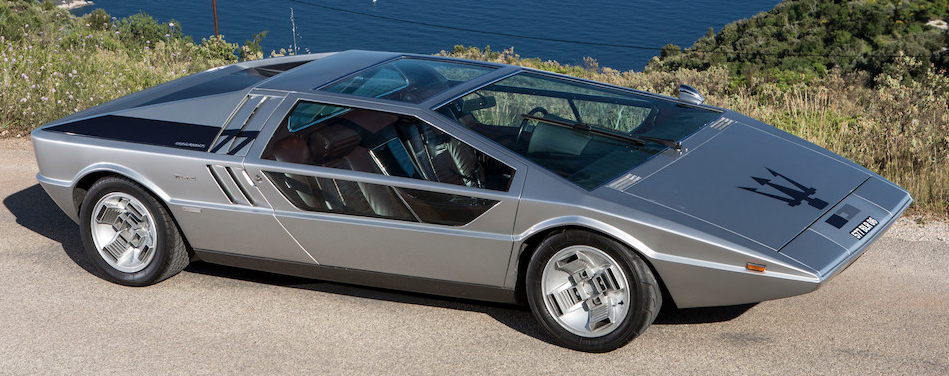
The 1972 Maserati Boomerang concept car (Wikipedia entry here) was one of several wedge-shaped designs that appeared in those days.  Styling was by Giurgetto Giugiaro, and the car was built by his Italdesign firm.

The Boomerang -- I have no idea why that name was selected, because it doesn't look like a boomerang -- was more practical than some of the other concept cars with wedge shaped front ends.  That's because it was 42 inches (1070 mm) high, compared for instance to the 1970 Ferrari Modulo whose height was 36.8 inches (935 mm).

The Boomerang still exists, and was auctioned for $3.7 million in 2015 by Bonhams, the source of the Boomerang images below.

Gallery

The Boomerang's design seems fussy in this side view, though Giugiaro's use of repeated angles helps maintain its angular theme.  That lower side window is problematic, though the upper one seems too narrow and, especially, highly placed to afford the driver adequate vision.  Lowering the beltline a trifle and eliminating the lower window might have fixed that problem and cleaned up the design as well.

The 1970 Porsche Tapiro concept by Giugiaro that pioneered features of the Boomerang.  It's a more attractive design.

Overhead side view revealing the amount of glass surrounding the passenger compartment.

The shape of the lower windows emphasizes the reverse angular tension created by the engine air intakes behind the doors -- a nice touch that adds clutter yet reduces potential blandness.

Like the Porsche 914 based Tapiro, the Boomerang is a mid-engine car.  It's hard to tell if that dark painted area on the sail panel is helpful or simply visual clutter.

Angularity is found on this frontal view as well as from side views.

The rear is nicely composed.

Monday, June 12, 2023

Porsche 928 Walkaround

About six years ago I wrote about the 1978 Porsche 928 here, but didn't have much to say about its design.  So it's about time for a Walkaround post.

Wikipedia offers this background material.  Tony Lapine was Posrche's styling chief at the time the 928 was developed.  Wikipedia credits Wolfgang Möbius as being most involved with its design, though Lapine surely played an important role.

Interestingly, Lapine cites Giugiaro's 1963 Chevrolet Corvair Testudo concept car as an influence for the 928.

It seems that the 928's front-mounted, water-cooled V-8 motor concept was decided on due to fears that cars with air-cooled, rear-mounted motors would be banned in the near future via government legislation.  So Porsche need to have an alternative available, just in case.  Porsche 911 sales were weakening at the time, and that was another reason for trying something different.

Porsche 928s were priced higher than 911s, and that kept sales counts down.  So did the drastic power train change -- something that upset many Porsche fans and potential buyers: "Real Porsches must have read-mounted, flat, air cooled engines!"

That said, 928s and variations were produced for many years despite their comparatively low sales, while today's Porsche sports cars continue to have air-cooled motors mounted at the rear or middle.

Photos of the subject car are via Bring a Trailer auctions.

Gallery

As mentioned in two of the above links, this 1963 Chevrolet Corvair Testudo concept car (RM Sotheby's photo) helped inspire Tony Lapine when he was directing styling of the 928.  The Testudo was built by Bertone and designed by the young Giorgetto Giugiaro, his first design project where he had a free hand, according to the Testudo link.  No doubt that was because it was a concept car, not a production model.  Oddly, the Corvair had a power train similar to that of the classic Porsche 356s and 911s, and not the 928.

Porsche 928s looked distinctly different from classic 356 and 911 models.  No doubt that was intentional, given the drastic power train difference.  Lapine probably thought he was establishing a new design language for the brand.  If that was the intention, I don't think it was strong enough or distinctive enough to have the long-term carrying power of the earlier Porsche theme.

As for Testudo similarity, I sense it mostly on the curved front fenderline that becomes the beltline at the door.

From this perspective, the most distinctive elements are the after side windows and backlight window with the narrow C-pillar connecting them.

Rear design is clean, with the elements relating to one another -- note how the hatchback side cutlines are repeated by the inner edges of the tail light assemblies.  Present-day rear end designs usually lack this coherence.

Also noteworthy is the complete lack of brightwork on this car.

Thanks to the wide B-pillar (a pseudo-"Targa" ?) and fastback motif, the after part of the design is "heavier" than, say, a notchback or bustle back alternative might have been.  That said, the fastback segment is nearly flat, not curved, so the potential visual weight is lessened.

All this considered, the Porsche 928 has a fine, professional design.  Though not, in my judgment, an exciting design.

Headlights pivot upwards when turned on, creating aerodynamic disturbance.  The sort of thing I experienced with my '71 Porsche 914.

Monday, March 20, 2023

1970-Vintage Concept Cars with Wedge-Shape Front Ends

Around 1970, several Italian-designed concept cars appeared featuring wedge-shaped front ends.  They also were low: a few extremely so.  Some will be featured in later posts here, but for now, a brief introduction.

In chronological order, the cars are: 1968 Alfa Romeo Carabo by Bertone, Marcello Gandini designer; 1969 Ferrari 512 S Berlinetta Speciale by Pininfarina, Paolo Martin designer; 1970 Ferrari Modulo by Bertone; 1970 Lancia Stratos Zero by Bertone; 1970 Porsche Tapiro by Italdesign; and 1972 Maserati Boomerang by Italdesign, the famed Giogetto Giargio being Italidesign's founder and chief designer.  Gandini was responsible for all the Bertone designs shown here.

All of these cars were of the mid-engine configuration, where the motor was located behind the passenger compartment and ahead of the rear axle line.  An engine mounted at the front would be too tall to allow for the frontal wedge shape.

Images below are mostly publicity photos from the car companies or coachbuilders.

Gallery

1968 Alfa Romeo Carabo by Bertone
The first important design of this type.

1969 Ferrari 512 S Berlinetta Speciale by Pininfarina
Like the car above and the two shown below, rear wheels are larger than front wheels.

1970 Ferrari Modulo by Bertone
The colors were reversed not long after this photo was taken.

1970 Lancia Stratos Zero by Bertone - RM Sotheby's auction photo
Perhaps the least practical of the lot.

1972 Porsche Tapiro by Italdesign
Based on the production VW-Porsche 914/6.

1972 Maserati Boomerang by Italdesign - Bonhams auction photo
An evolution of the Tapiro.

Thursday, November 5, 2020

Porsche 356 Speedster

I'm not sure if there is any officially recognized Golden Age of Sports Cars.  In my case -- probably a generational thing -- the Golden Age was roughly 1948 to 1960.  Regardless, it was the time when European sports cars were often fairly affordable and began appearing in significant numbers in the USA.

Entry-level was owned by MG TC, TD and TF models.  The next market notch was exemplified by Triumph TR-2s and TR-3s, followed by the Austin Healey and Jaguar XK120 and its derivatives.  And from Germany came the Porsche 356 series of coupés and cabriolets.  But the most interesting Porsche was a rakish version of the Cabriolet: the 356A Speedster.

The main visual difference between 356 Cabriolets and Speedsters was the Speedster's lower windshield.  Also, it had a skimpier canvas top than the Cabriolet's, which had a traditional substantial German retractible top.  Speedsters also featured a thin chrome strip along the side, though some Cabriolets had that too.

Being a roadster with a minimal top, Speedsters were not fully practical all-climate all-weather cars.  But who cared?  They were seriously sporty, and that's what mattered in the late 1950s and matters now for car collectors.

Gallery


Publicity photo of a 1955 356A Speedster.

Factory side vew.

Here is an advertisement by Hoffman, importer of Porsches to the USA.

Bonhams auction photo of a 1956 356A Speedster.

Front view of a 1957 Speedster via Bonhams, as are the next two images.

Rear view

Right side view.

Top-up right side view of a 1955 Speedster with its canvas top raised, Mecum auction photo.

Here is a for-sale 1959 Porsche 356 Convertible D for comparison.  Note the taller windshield and the bulky German top.

Also for comparison is this image via RM Sothebey's of a 1956 356A Porsche Coupé.

Thursday, September 10, 2020

2021 Porsche Targa 4

A body style found on Porsche sports cars since the late 1960s is the Targa, a semi-convertible incorporating a substantial roll-bar and, usually, a fixed glass rear window.   Some early Targas featured a "soft" (non-glass) rear window that could be lowered.

Recently, Porsche announced its latest Targa, the 2021 Targa 4 (Car and Driver link here).

This post compares the new Targa (factory images) with examples of first-generation Targas.  The Porsche 911 series and derivatives since production began in 1963 retain the general feeling of the original Ferry Porsche design even though the cars' proportions were gradually altered over the years.  The same can be said for the Targa, as can be seen below.

Gallery

2021 Porsche Targa 4

1970 Porsche Targa - Barrett-Jackson auction photo
The Targa concept includes a wide, metal-finished roll-bar, a fixed rear window (backlight in stylist jargon), and a detachable roof spanning the roll bar and the windshield frame.  The roll bars feature three parallel grooves on the sides, as can be seen in this image and the one above.

2021 Porsche Targa 4

1969 Porsche 911 T Targa - Mecum auction photo
Though the shapes differ in detail, the Targa spirit is retained.

2021 Porsche Targa 4

1969 Porsche 911 T Targa - Mecum photo
The Targa feature is less apparent in frontal views.

2021 Porsche Targa 4
The rear of the new Targa 4 is where major differences appear.  Compare this photo to the one below.  The Targa 4 has an aggressive rear air intake that both retains the location of the original while fitting the more sculpted current body shaping.  The band below it is a variation on today's styling clichés, as is the sculpting below.

1969 Porsche 911 S Targa - Coy's auction photo
The cleaner original rear shaping and detailing.