Showing posts with label Lexus. Show all posts

Monday, February 19, 2024

2019-Vintage Comparison: Toyota Camry, Toyota Avalon and Lexus Es

Different automobile brands or models sharing the same basic body structure is nothing new.   General Motors was doing that by the 1930s.  I find it interesting from both brand-identification and styling standpoints.  What it boils down to is the efforts of styling staffs to be creative, given technical and marketing restrictions.

For this post, I've chosen to feature a fairly recent Toyota Motor Corporation platform used for some of its most important brands sold in North America.  Those cars are the Toyota Camry, Toyota Avalon, and the Lexus ES.

More specifically, the Camry is the model introduced for the 2018 model year, the Avalon is the 1919 model (the final one, as Avalons were discontinued after 2022), and the 2019 Lexus ES.  The links each note that these cars share the same platform.

Toyota has the financial punch to invest in tooling for a comparatively large number of detail variations on the basic form, which makes today's presentation even more interesting because the designs are superficially quite different.

The Avalon and Lexus have a 113.0 inch (2870 mm) wheelbase, whereas the Camry's wheelbase is 111.2 inches (2820 mm).  I need to note that the Avalon was the Toyota brand's upscale North American model while the Camry is Toyota's best-selling sedan in that market.

Gallery

2018 Toyota Camry
First, some side-views.

2019 Lexus ES
The difference in length lies between the B- and C-pillars: note the wider rear door.  The Lexus' roofline has a different taper than the Camry's.  Door handles are in the same relative positions, but most side sheetmetal differs.

2019 Toyota Avalon
As noted, same wheelbase as the Lexus.  Roof curve is the same, but the Avalon is a six-window car, unlike the others.  The door handles and beltline seem the same as the Lexus'.  Again, differing side sheet metal.  Greenhouses forward of the B-pillar are virtually the same for all three

2018 Toyota Camry
The three cars have differing sheet metal, trunk lid cutlines, and even backlight windows.

2019 Lexus ES

2019 Toyota Avalon
Rear bumper impact areas seem the same on the cars.

2018 Toyota Camry
Note the "knock-knee'd" grille structure theme that echoes ...

2019 Lexus ES
... the Lexus brand's upside-down back-to-back Lexus "L" theme used since the mid-2010s.

2019 Toyota Avalon
All three cars feature similar shaping in the vicinity of the fender fronts, also hood profiles.  However, the Avalon's grill lacks the pinched theme seen above.

2021 Toyota Camry
Interestingly, the 2021 Camry facelift dropped the pinched look, replacing it with wide, horizontal bars à la Avalon.

2018 Toyota Camry
Some frontal views for comparison.  All three have their brand symbol placed high and centered.  Hood cut lines are similar.

2019 Lexus ES
I hate this grille theme, distinctive though it is.
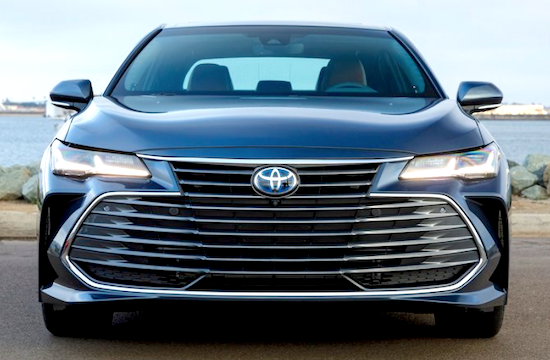
2019 Toyota Avalon
There is a subtle, wide "V" theme in the central grille area formed by subtle shaping of the horizontal bars.  The framing is unrealistically large.  But too-large grille elements have been on Audis for many years and are recently found on some BMW models.

Monday, November 9, 2020

Tiny Lexus UX Crossover SUV

Toyota's high-end Lexus brand continues its model proliferation.  A fairly recent addition to the US market is the Lexus UX crossover SUV based on Toyota's recent GA-C Global Architecture platform.

This post was inspired by the fact that I saw a Lexus UX on the road not long ago, not having been aware of such a thing.

I consider the UX a curiosity.  For one thing, it seems odd that a luxury brand would have such a small vehicle in its lineup because it cheapens the brand's image regardless of the small vehicle's qualities.  (Yes, Mercedes-Benz has lesser series such as its "A."  But M-B has long produced a large market spectrum of cars, unlike Cadillac for instance.)

Although it is considered a kind of SUV, the UX is an example of those androgynous SUV-cum-hatchback sedan body types such as the Subaru Crosstrek.

Clarity is lacking on several dimensions.  Could the mighty Toyota have made a small marketing mistake?

Gallery

This side view shows the not-quite SUV profile.  Given the aft slope, the car's hauling capacity becomes somewhat reasonably only when the back seats are lowered.  As is now usual for Lexus and many Toyota models, there is plenty of questionable sheet metal sculpting.  The shapes seen here are mostly randomly placed and poorly integrated.  That wedge on the lower body is nothing but a styling cliché.  The dark wheel opening frames suggest the car might be a rugged outdoors rough-country machine, even though the other details suggest luxury Lexus: more confusion.

The front is dominated by that back-to-back Lexus "L" theme that turns off a number of folks including Yr. Faithful Blogger.

Rear styling is busy, but slightly better composed than found on other Japanese cars.

Monday, October 12, 2020

Styling a New Luxury Car Brand: Lexus

So you want to launch a totally new luxury car brand.  One detail to be decided is the car's styling.  And surely Toyota stylists and management glanced at designs of the new car's intended or possible competition.  How different or similar should it look?

The Lexus (Wikipedia entry here) was launched in the USA for the 1990 model year and was a great success that has continued since.

The subject of this post is Lexus styling compared to some potential competitors in production while it was gestating.  Perhaps other brands were evaluated in addition to the set shown below, but those pictured were surly among those studied.  They tend to have similar wheelbases to that of the 1990 Lexus LS 400 (2814 mm, 110.8 inches).

Gallery

1985 Cadillac Sedan DeVille
Since the US market was key to Lexus market planning, Cadillacs were evaluated.  The current Caddy in the Lexus size range was the Sedan DeVille that appeared for the 1985 model year.  Its styling continues the angular "three box" theme popular during the 1970s and '80s.

1988 Lincoln Continental Sedan
The other major American luxury car with a similar wheelbase was the Lincoln Continental that was announced around the time Lexus styling was nearly locked in.  Ford Motor Company began introducing rounded styling a few years earlier, though this Lincoln retains the large glass areas of the three-box era.

1987c. BMW 7 Series E32
German luxury cars were selling well in the USA, so BMWs were probably evaluated.  The 7 Series sedan, like the Cadillac and Lincoln, retains three-box styling.

1985c. Mercedes-Benz W124
But the key potential competition was Mercedes-Benz.  The 1985 model year line of W124 cars were more beveled that the others and featured a wide C-pillar that gave a formal touch to the design.

1990c. Lexus LS 400
So perhaps is isn't surprising that the 1990 Lexus LS 400 sedans might have borrowed more from Mercedes-Benz than the other luxury rivals.  Perhaps the main difference was that it was more rounded.

Thursday, August 9, 2018

Lexus GS Designs 20 Years Apart

Let's compare Lexus GS models of 20 years ago and now.  Shown below are images of 1998-generation GS 300s listed for sale along with factory photos of a 2016-generation GS F.

The GS 300 was a clean, attractive, aerodynamically efficient design.  In the late 1980s into the early 2000s, wind tunnel tested cars tended to be styled in a soft, somewhat "organic" manner with comparatively few straight or angular details.  In some cases designs seemed too soft, though the GS 300 did not go that far.

The current GS is representative of current styling fads where angles and edges predominate.  This is often found in extreme form on various Toyota products, including the Lexus brand.

I've made my choice as to which is the more pleasing design.  Examine the photos below and make up your own mind.

Gallery


Front quarter views, the GS 300 is in the upper image, the GS F in the lower.


Rear quarter views.

Monday, May 14, 2018

Rogues Gallery of Busy Grilles and Front Ends

I've been hammering away for a while now about the current fashion for overly decorated designs.  I think an important reason for this fad or fashion is government fuel efficiency regulations that have driven engineers and stylists to wind tunnels in the pursuit of high aerodynamic efficiency.  The result is car bodies with nearly identical basic shapes, and this has led to the use of excessive ornamentation and aerodynamically irrelevant body surface sculpting as means to establish brand and model identification.

Another -- probably lesser -- reason is the normal pendulum swing from one extreme to another that is common where fashion is concerned.

This post presents examples of overly-busy looking grilles and front end ensembles on American cars of the 1950s, an era noted for extravagant styling themes.  Then recent and current examples are shown, illustrating that we now seem to be in a period even more extreme than the '50s.

The 1950s images are of cars for sale.  The others are manufacturers' publicity photos.

Gallery

1950s American Examples

1950 Buick
Classic overstatement that was toned down for the next model year.

1952 Packard 400 Patrician
This is a modernized version of the traditional Packard grille intended to better blend with post- World War 2 styling trends.  The sculpting is rather Rococo, but the overly decorated part is the "teeth" that thankfully disappeared on the 1953 facelift.

1958 Buick
If the decorations on the face of the hood were eliminated, the design would be a lot more coherent.

1959 DeSoto
A three-level grille-bumper ensemble, each level having a separate theme.

1959 Dodge
This design approaches the confusion seen in some of the recent images below.


Current and Recent Examples


2015 Nissan Juke
A small car with intentionally funky styling.

2016 Nassan Maxima
The Nissan badge and its chrome nest serve as brand-wide identification.

2017 Lexus IS
Variously termed as "hourglass," "spindle," and (by me) "back-to-back Lexus Ls, this has been a Lexus theme for several years now.  And, as seen farther below, Toyota seems to be adding it to its mass-market brand.

2017 Renault Mégane sedan
That enduring, yet somewhat inexplicable Moebius-diamond symbol reinforces an already somewhat cluttered design.

2018 Audi A8
Audi pioneered the theme of draping the grille over the front bumper.

2018 Genesis
Count the textures on the face of this Genesis by Hyundai.

2018 Honda Accord
This car has some interesting sculpting, but it gets carried a little too far on the front end.  The sweeping element atop the grille and its details do not relate well to what is below.

2018 Hyundai Sonata
This design is cleaner than most shown here.  But the faddish fake air intakes flanking the grille add to the clutter.

2018 Infiniti Q50
An odd, droopy look to the front.

2018 Toyota Camry
As mentioned above, Toyota's mainline American sedan is now getting a Lexus-like frontal design.  The hood face, the faux air intakes flanking the actual grille and the dark, two-level apparent grille segment do not work well together.

Monday, September 26, 2016

Lexus NX = Toyota RAV4 Huge Facelift

Toyota's Lexus Brand has done well for many years with its RX series crossover SUV.  But management felt there was room in the brand's lineup for a smaller, less-expensive crossover.  Voila!! the 2015 Lexis NX crossover (more information here).

In order to create this new model economically, Lexus went to Toyota's RAV4 to form the basis for the NX body.  The result is a SUV with the same wheelbase as the RAV, but slightly longer, wider and higher.  Also, as many of Lexus' new styling theme details as possible were crammed onto the RAV's basic structure.

Gallery

Two NXs are shown here sporting the spiky, angular look Lexus deems necessary for brand identification.  I find it an overly-contrived visual mess of superficial detailing.

This is a 2013 Toyota RAV4 posed almost the same as the NX in the previous image.  The windshield and cut lines for the hood, front strike panel and front door are the same or very nearly so for both cars.

Here we see various creases and cut-lines converging on the tail light assembly.  This is a sensible way to tie design elements together, but I think there are too many of those elements.  The side treatment of the tail light assembly is well into cliché territory, looking very similar to that of the current Nissan Maxima, for instance.  Sculpting on the trunk panel repeats the double-L (for Lexus) theme of the grille, an especially awkward bit of styling.

The additional length and height of the NX, as compared to the RAV, can be seen in these rear views.  The RAV has less overhang and its roofline is more curved.  The NX has a higher belt line, resulting in smaller side windows.  Rear doors and the gas filler doors are in the same positions in both cars, though cut lines differ.

This NX side view features the sheet metal folds and planes that catch and emphasize light originating above the car.  Because there are so many of these light-catching details, the overall impression is busyness.

The RAV4 looks dull by comparison, and could have used a higher belt line anchor at the front and perhaps a horizontal character line about two-thirds up the doors.  Otherwise, it's a superior design to the frantic NX.

Thursday, May 14, 2015

Fussy Styling: Lutz and I Agree

Loyal Readers have probably noticed that I fairly often grumble about the current fashion of baroque or rococo styling.  But it's comforting to have one's ideas reinforced by respected persons.

It seems that the latest Road & Track magazine (June 2015) features some remarks by famed Car Guy Bob Lutz on the matter.  It's on his end-of-the-book page "Go Lutz Yourself" where a Portland, Oregon reader asks "Why do so many cars seem overstyled these days?"

To which Lutz replied: "'Not a surface left untouched' seems to be a design tendency today.  I also find it deplorable.  The Lexus LF-SA concept at the Geneva auto show looked like an origami swan done by a waiter in a Japanese restaurant.  I think it's seen as visual excitement, but usually, it's just awful and superimposed on cars that are so wrong in basic proportion, the result is about as attractive as a 400-pound woman in a Mardi Gras costume."

That said, here are some examples.

Gallery

2015 Lexus LF-SA concept car
This is Lutz's bête noire.

2012 Hyundai Veloster

2011 Nissan Juke

2014 BMW i3

Note that all the examples shown above are small cars, which are indeed the worst offenders.  A large car offers a broader canvas for sculptural and ornamentation overkill, whereas a small car with the same frills content serves to concentrate and exaggerate the resulting mess.