Showing posts with label Lancia. Show all posts

Monday, October 13, 2025

Count Mario Revelli di Beaumont: Independent Stylist

When researching this post dealing with the 1937 Alfa Romeo 6C 2300B Berlinetta by Pinin Farina, I discovered that the car's stylist was a member of Italy's nobility -- Conte Mario Revelli di Beaumont, and not Pinin Farina himself.  In that post I noted:

"According to the carrozzieri-italiani.com web site, the stylist was Conte Mario Revelli di Beaumont, an independent designer who produced designs for a variety of coachbuilding firms.  Background on Ravelli in English is here.  His Italian language Wikipedia entry is here, and his entry in French is here, noting that in the second half of the 1930s he worked with Pinin Farina and Bertone."

He was highly competent, working for major Italian coachbuilding firms (though apparently not Touring) as a freelance designer.  I haven't found why he seemingly never was exclusively employed by a single Italian firm.  (Though postwar, he spent some time at General Motors.)  Perhaps, due to his ancestry and status, he already had sufficient outside sources of income to offset inactive periods between design gigs.

As for me, I'm a bit embarrassed that I wasn't aware of him, though I must have passed over his name when researching various designs.  Because now, researching him, I find all sorts of mentions of him on the internet.  C'est la vie, I suppose.

By the way, another useful reference on Mario Revelli (1907-1985) is "Mario Revelli: The Most Prolific Car Designer You’ve Never Heard Of" here.

Below are some 1934-1950 designs with which Revelli is associated.

Gallery

1934 Lancia Augusta Coupe Aerodinamica by Stabilimenti Farina - photo via Lopresto Collection

1938 Fiat 1500 Berlinetta Aerodinamica by Ghia
Headlight assembles seem similar to those on the "Sharknose" 1938 Graham.  The grille design also has an American feeling.

1941 Fiat 1500C Coupe by Bertone, completed c.1945 - photo via Museo Nicolis

1936 Lancia Astura III Tipo Bocca Cabriolet by Pinin Farina- RM Sotheby's photo
One of Revelli's most outstanding designs.

1942 Alfa Romeo 6C 2500 SS by Bertone - photo via Montesquieu-Volvestre
Variant of the Fiat 1500 above, but completed earlier.

1950 Simca Huit-Sport Cabriolet by Stabilimenti Farina - photo via carrozzieri-italiani.com
Revelli had no trouble adjusting to postwar styling trends.

1937 Alfa Romeo 6C 2300B Pescara Berlinetta by Pinin Farina - unidentified auction photo
Subject car of the post mentioned above.

1938 Fiat 1500 Berlina - RM Sotheby's photo
Unlike some of the cars pictured here, the Fiat 1500, launched in 1935, was produced in large numbers.   Note the aerodynamic features that were nearly contemporaneous with those of the ill-fated (in terms of sales ) 1934-37 Chrysler Airflow.  Revelli had a strong interest in Aerodynamics.

Thursday, September 12, 2024

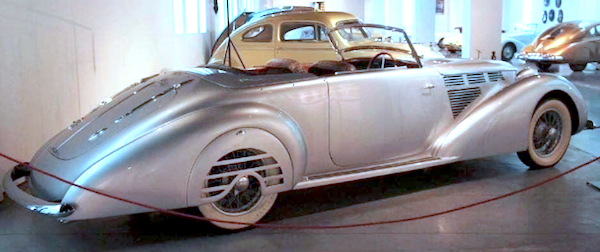
1939 Lancia Astura "Málaga" by Pinin Farina

Italy's Lancia firm's model portfolio in the 1930s ranged from small sedans to long-wheelbase luxury cars. One of the latter lines was the Astura.  Some Asturas were sedans, but the most stylish were cabriolets, especially those designed by Pinin Farina.  Iwrote about some of those here.

One of the best-known Farina Astura cabriolets has been called the "Málaga" Astura.  That's because it has been displayed at the Museo Automovilistico y de la Moda in Málaga, Spain, based on the collection of the Portuguese João Manuel Magalhães.

Gallery

1936 Lancia Astura Cabriolet Series III "Tipo Bocca" by Pinin Farina - RM Sotheby's photo
An earlier Farina Astura cabriolet.  This post's feature car differs mostly at the front end and the aft fender spats.  Though also note that door hinging is reversed.  It also seems to have a longer wheelbase.

1939 Lancia Astura Cabriolet "Málaga" by Pinin Farina
This photo and the one below were taken by me in 2018 at the museum.  The others are from sources I cannot presently identify.  That black line across the image is a wire serving as a warning device to keep viewers away from the cars on display.  Note the horizontal divider on the windshield -- the upper segment pivots down forward.

The prow of the engine compartment is sharper, more aggressive than on previous versions.  Some date this car to 1938, but its grille design is in line with some 1939 Asturas such as the Berlina built for Galeazzo Ciano.  The museum's information card at the time I visited had this as a 1939 model.

Showing some of the rear end.  Much of the trunk is probably devoted to housing the spare tire.  The openings on the aft fender spats might (1) be for style only, (2) provide more air for brake cooling, or (3) might be for both.  Though if cooling was very important, then no spats should be there.

The design is especially attractive seen from the side.  Though the spat openings detract slightly aesthetically, they add visual interest.

Thursday, August 15, 2024

Zagato's Quirky Lancia Flavia Sport Coupé

For some reason, I tend to remember the outstanding Italian car designs, forgetting all the inferior ones.  But while researching photos for blog posts, I sometimes encounter odd Italian designs that I can't ignore.  Such is the case with today's subject, the mid-1960s Lancia Flavia coupé by Zagato.  Its designer was Ercole Spada.

Accoring to the first link above, 626 Zagato Lancia Flavia Sports were made -- a surprisingly large number, considering the quirky design.

Gallery

1949 Alfa Romeo 2500 SS Panoramica by Zagato
I wrote about Panoramicas here.  More photos at the link, but note here the windows curving into the roof.  This was before Spada's time at Zagato, but there must have been something in Zagato's air that led to...

1966 Lancia Flavia 1800 Coupé by Zagato - Gallery Aaldering photos
...that strange side window curving into the roof.

The basic shape is smooth and rounded; note the large-radius curve atop the fender.

If that side window hadn't curved in the roof, the design would have been pleasant, though not striking.

Interesting use of a concave backlight window and its blending into the trunk lid.

Larger wheels would have looked nicer, but what you see here was what Spada had to work with.

The grille wapping over the frontal hood cutline is a non-functional echo of the wrapover side window concept.  And then there are those hated (by me) quad headlights.

For a little context on the Zagato design, this is a 1965 Lancia Flavia 1800 Coupé by Pininfarina - BaT Auctions photo.

Monday, May 22, 2023

1970 Lancia Stratos Zero Concept

The competition was tough, but I think the most extreme of the circa-1970 Italian wedge-front concept cars was the Lancia Stratos Zero built by Carrozzeria Bertone and designed by Marcello Gandini.

Some other wedge-front concept cars were the 1968 Alfa Romeo Carabo by Bertone (also designed by Gandini), the 1970 Ferrari Modulo by Pininfarina, and the 1972 Maserati Boomerang by Italdesign (Giorgetto Giugiaro).

The Stratos Zero was so extreme that it would be barely marginal as an everyday sports or grand touring car due to entry-egress difficulties and outside visibility limitations for the driver.  I imagine that little thought was given to the possibility that it would ever enter production.

That said, I think it was the most interesting sculptural composition of the bunch noted above.

In the Gallery below, images of the Stratos Zero with bronze paint might be via RM Sotheby's.  I'm not sure of the image source of the silver-finish paint scheme variation.

Gallery

The Stratos Zero as it would appear if you encountered it parked.

Its layout is mid-engine.  Rear wheels are considerably larger than the front wheels.

Being a concept car, trivial matters such as bumper protection are ignored.

Besides the large, nearly-flat windshield, there are small side windows.  The lower one is essentially useless functionally, but helps the design composition a little.

Left side view.

This is where one can enter or leave the car.  The steering wheel would have to pivot to allow entry.

All movable panels are open.  The large, triangular one is for engine access.

Monday, March 20, 2023

1970-Vintage Concept Cars with Wedge-Shape Front Ends

Around 1970, several Italian-designed concept cars appeared featuring wedge-shaped front ends.  They also were low: a few extremely so.  Some will be featured in later posts here, but for now, a brief introduction.

In chronological order, the cars are: 1968 Alfa Romeo Carabo by Bertone, Marcello Gandini designer; 1969 Ferrari 512 S Berlinetta Speciale by Pininfarina, Paolo Martin designer; 1970 Ferrari Modulo by Bertone; 1970 Lancia Stratos Zero by Bertone; 1970 Porsche Tapiro by Italdesign; and 1972 Maserati Boomerang by Italdesign, the famed Giogetto Giargio being Italidesign's founder and chief designer.  Gandini was responsible for all the Bertone designs shown here.

All of these cars were of the mid-engine configuration, where the motor was located behind the passenger compartment and ahead of the rear axle line.  An engine mounted at the front would be too tall to allow for the frontal wedge shape.

Images below are mostly publicity photos from the car companies or coachbuilders.

Gallery

1968 Alfa Romeo Carabo by Bertone
The first important design of this type.

1969 Ferrari 512 S Berlinetta Speciale by Pininfarina
Like the car above and the two shown below, rear wheels are larger than front wheels.

1970 Ferrari Modulo by Bertone
The colors were reversed not long after this photo was taken.

1970 Lancia Stratos Zero by Bertone - RM Sotheby's auction photo
Perhaps the least practical of the lot.

1972 Porsche Tapiro by Italdesign
Based on the production VW-Porsche 914/6.

1972 Maserati Boomerang by Italdesign - Bonhams auction photo
An evolution of the Tapiro.

Thursday, December 8, 2022

Bristol 401 Origin and Walkaround

This post contains speculations regarding the design of the Bristol 401 coupé.  Bristol automobile history mavens are encouraged to correct me in comments if I got things wrong.

In 2013 I briefly wrote about Bristol's sporty 401-403 models.  Since then, more information and photos have appeared on the Internet, so I figure it's time for an update.

The Wikipedia entry for the 401 is here.  Christie's auctioneers had a protoype 401 by Touring Superleggera up for bid and wrote:

"It is a result of the collaboration between the Bristol Aeroplane Co. and Carrozzeria Touring of Milan.  Constructed and designed in Italy, the bodies benefitted from the considerable experience for which the Italian coach building company was renowned.  The engine was built by Bristol to an original BMW design, the licence for this having been obtained in the form of compensation for war damage.  This particular car was built by Touring for the Bristol factory as a prototype and was expected to compete in the 1948 Mille Miglia but was unfortunately not finished in time.  The car was however displayed on the Touring stand at the Geneva Motorshow of 1949.  Bristol had invested a great deal of time and money in this project, matching Touring's light weight "Superleggera" concept with Bristol's own experience in aerodynamics.  Unfortunately the original idea of commissioning Touring to build 200 cars fell through in the end."

It seems that a badly deteriorated Touring 401 was found on a French farm, and its body was recreated by Touring, as mentioned here.

From this point, it seems best to move to the Gallery and discuss images, rather than rely purely on wordage.  Walkaround views are via Gallery Aaldering, a Dutch firm, the subject 1951 Bristol 401 having left-side steering.

Gallery

According to a long-lost Web source, this was supposed to be a 1938 Lancia Aprilia by Touring.  Actually, it was displayed at the 1947 Paris auto show and appears to be the original version of the Bristol 401 body design.

This is the 1947 Touring prototype of the Bristol 401.  It is almost the same as the Lancia in the previous image.  Its grille is the two-nostril BMW style used by Bristol.  The beltline drops closer to the top of the rear fender than on the Lancia and closer than other 401s.  Note the smooth sides of the fenders, something different from other Touring Bristol prototypes.  The front fenderline is more curved than production versions.

Front view of the 1947 prototype, posed with Touring's boss Felice Bianchi Anderloni.  Note the BMW-like grille even at this early stage.

I don't have a source for this photo.  The car's body is by Touring, so it's probably a prototype or possibly an early custom 401.

This is the 401 with the recreated body Touring built.  These cars featured sculpted ridges aft of the wheel openings.

Now for walkaround views of a 1951 production Bristol 401.

The front fenderline is straighter than on the cars in the previous images.

Vision to the rear was limited.

Trunk space was also restricted thanks to the tapered passenger compartment greenhouse.

The greenhouse is tall and the windows are large, a fashion more of the 1960s and 70s than the early 1950s.

Most of the busy detailing is at the front, making a nice contrast with the rest of the car.  All told, a pleasing design.

Monday, September 6, 2021

1950s Passenger Car Round Rear Wheel Openings

The late-1930s car body transition to more streamlined, envelope-type shapes served to eliminate once-common fully-exposed rear wheels.  At first, rear wheel openings might be covered by "spats."  By the 1940s and beyond, rear wheels usually were at least partly exposed, but not completely.  And when they were not fully covered, openings were not round.

Round openings follow the "form follows function" belief system of early modernist architects and industrial designers.  They usually look nice, and are seen occasionally today on cars such as the 2005 and later Chrysler 300 sedans.

There were only a few early-mid 1950s American examples of round rear wheel openings on passenger cars.  These are the subject of this post.  Sports cars are not dealt with.  Images are of cars for sale unless noted.

Gallery

1950 Lancia Aurelia B10
A number of Italian sports cars from around 1950 had round rear wheel openings, but these were rare on sedans.  The Lancia pictured here does have them.

1951 Chrysler K-310
Chrysler's Virgil Exner was a fan of Italian automobile styling, and used round wheel openings on this, his first concept car.

1953 Packard Caribbean
Packard's Caribbean convertible was one of the first American production passenger cars to have rounded openings.  But only for the 1953 model year.

1953 Buick Skylark - Mecum auction photo
Buick's sporty line-leading convertible for '53 was the Skylark.  It too has round rear wheel openings.

1954 Buick Super Riviera hardtop coupe - Mecum
General Motors launched a sensational (at the time) futuristic 1954 redesign for Oldsmobiles, Buicks and Cadillacs.  Only Buick hardtops and convertibles received round openings.

1955 Buick Century 4-door hardtop
When Buick offered a four-door hardtop the following year on Specials and Centurys, they too got round openings.  The same applied in 1956 on Super and Roadmaster four-door hardtops.

1955 Imperial 4-door sedan
Chrysler's Imperial brand cars all had round rear wheel openings for the 1955 and 1956 model years.  As best I can tell, the only American four-door sedans of that era with that feature were Imperials.