Showing posts with label Hudson. Show all posts

Thursday, March 12, 2026

Seriously Rounded 1936-38 Hudsons and Terraplanes

In America, the 1930s saw the transformation to all-steel car bodies.  Sheet metal stamping technology limitations and perhaps a desirability to compactly stack stamped parts led to car designs featuring large-radius curved surfaces.

This styling variation reached its peak around 1935 or 1936 with new designs in the form of cars such as '35 Pontiacs and Oldsmobiles, along with '36 Buicks and Hudsons.  The latter is the subject of this post because I judge Hudson's styling ever-so-slightly more rounded than the General Motors variety.  That's mostly due to the shape of Hudson's grille.

Note that Terraplane offered what amounted to re-branded, less-expensive, shorter Hudsons.  For model year 1938, the formerly separately-branded Terraplanes became Hudson-Terraplanes, and for 1939 the name Terraplane was abandoned.

Examples of Hudson and Terrplane body types are presented below.  Unless noted, images are of cars listed for sale.

Gallery

1936 Hudson Sedan
This viewing angle shows the roundedness of the sedan body.  Items such as fenders and catwalk fronts  might be expected to be rounded in the mid-1930s.  The front fender seen here are quite wide, typical of that era in the USA.  What is less expected is how rounded the passenger compartment greenhouse is -- the curved roof shape and the window profiles.  Also note how the body sides tuck under towards the running board.  This appears light, contrasting with the body above the beltline that seems heavy by comparison.

1936 Terraplane Deluxe Touring Sedan - Burns & Co. Auctions photo
The rounded window profiles are seen better here.  The profile of the hood's front / fencer's mask grille is hinted.  Note the rounded rear wheel opening.  This was found on 1936 models and replaced by a smaller opening for 1937.

1936 Terraplane Touring Brougham
More rounding: after roof line, backlight window profiles, bulged trunk lid.

1937 Terraplane Utility Coupe
Terraplanes, had shorter wheelbases that accentuated rounding when seen in side views.  The smaller wheel openings at the rear result in more rounded fender sheet metal, creating a heavier appearance.

1937 Terraplane Super Convertible Brougham - Broad Arrow Auctions photo
Rear wheel openings are skirted.  The fender-mounted spare tire adds to the rounded theme.

1938 Hudson Terraplane Touring Sedan
This model year saw the first of Hudson's facelifts that kept its designs somewhat competitive through the 1947 model year.  For '38, the main change was the abandonment of the fencer's mask grille -- though the central chrome sweep theme was carried over.

Thursday, January 1, 2026

More on Hudson's 1936 to 1947 Basic Body Evolution

Nowadays, a car body can remain in production for many years -- decades, even.  For example, the Chrysler 300 sedan was offered model years 2005-2023.  And the Volkswagen Beetle's postwar production run was 1946-2003.  But American carmakers from the 1930s into the 1960s tended to keep a basic design in production for two to four model years.

An exception was Hudson.  A new design was launched for 1936 and that body remained in production through the 1947 model year.  Due to World War 2, there were no 1943-45 models, but that body was retained for a net nine model years.  I posted about that here.

The present post is a footnote to the previous one.  It displays side views of Hudson sedans revealing the retention of the expensive-to-modify passenger compartment, while other parts were cleverly facelifted over the years.  Side views of Hudsons were sometimes hard to find.  Also, Hudson had a variety of models over those years that had different wheelbases.  Some models had wheelbase variations from year to year.  So to help gauge effects of facelifts and model differences, I'm supplying wheelbase data in the captions below.

Gallery

1936 Hudson Custom Eight - car-for-sale photo
The new design.  Its wheelbase is 120 inches (3048 mm).  The previous design also had large, tall windows.  That might have been fine for passengers, but impeded stylists from creating sleek appearance.  In contrast, the windshield is short.

1937 Hudson Custom Six Touring Sedan - Daniel Schmitt photo
The wheelbase is 122 inches (3099 mm).  This photo was taken using a somewhat wide-angle lens (note distortion of tires), so the car looks a bit longer than it should.  I couldn't find another suitable side view.  Manufacturer's model names did not consistently follow this, but a "town sedan" in those days had a small, internal trunk, whereas a "touring sedan" featured an "attached" trunk visible at the rear.  Note that the front door is hinged on the A-pillar, unlike in 1936.

1938 Hudson Terraplane - Wikimedia Commons photo
This model's wheelbase was 117 inches (2972 mm), the shortest shown here.  Most of the 1938 facelifting had to do with the grille and front end.

1939 Hudson Country Club Eight Touring Sedan - Worldwide Auctioneers photo
Another 122 inch wheelbase.  This was Hudson's most expensive model.  Some were built on a longer wheelbase.  Again, the front was facelifted.  Fender design is also changed, along with the aft end (wider "D-pillar" zone).

1940 Hudson Super Six - car-for-sale photo
Its wheelbase is 118 inches (2997 mm).  Town sedan style aft end.  Another front end facelift, including the forward part of the front fenders.  Compare the hood to, say, the 1937 version.

1941 Hudson Commodore Eight - car-for-sale photo
Wheelbase is 121 inches (3073 mm), and is the same for the cars shown below.  Visible here are reshaped fenders and a revised rear quarter window profile.  More important, the trunk has been blended to the body as a bustle-back; that was an important step to make Hudsons look as contemporary as possible, given the 1936 body structure.  Due to the war, changes were minimal after this.

1942 Hudson Commodore Eight - car-for-sale photo
The after part of the front fender is reshaped, and the rear fender looks like that from 1940.  Doors are reshaped at the bottom to cover the running board (General Motors was doing this as early as the 1938 Cadillac Sixty Special).

1946 Hudson Super Eight - car-for-sale photo
Until around 1949, it was a "seller's market" in postwar America.  Absence of 1943-45 cars created strong demand for new cars, so prewar designs were continued by all carmakers for a while.  Hudsons for 1946 and 1947 were essentially the same as '42s aside from a new (in '46) grille design.  Postwar redesigned Hudsons appeared for 1948.

Thursday, October 23, 2025

1949 American Quasi-Fastback Designs

By "quasi-fastback" (A technical term that I just conjured up from mostly thin air) I'm referring to 1949-vintage cars having passenger compartment rooflines that taper downwards to fairly short trunk lids.  That concept might be clarified in the Gallery images below.

In the early, pre- entry of the USA to World War 2 years, fastback designs were thought to be the wave of the future.  (By "fastback," in that era, it's where the aft roofline essentially smoothly tapers downwards to the rear bumper.  Not all examples did exactly that, the curving terminating perhaps a short distance above the bumper.)

Fastback cars were popular in the early postwar years, so General Motors, especially, along with Nash, Packard, Plymouth, and Lincoln had some or all (Nash had all) fastback models in their portfolios.  But by around 1950, fastback cars rapidly fell out of favor with the buying public.  The last example from that era that I'm aware of is the 1952 Chevrolet Fleetline two-door sedan.

As I've mentioned in other posts dealing with fastbacks, I think the main reason why notchback designs became dominant was because they provided more room in their trunks than did comparable-size fastbacks.

The "quasi-fastbacks" discussed here featured notchback-size trunk capacity along with above-the-beltline fastback-style rooflines.  This style too was abandoned, the last in production were on 1954 Hudson Hornet and Wasp 4-door sedans.

Unless noted, images below are of cars listed for sale.

Gallery

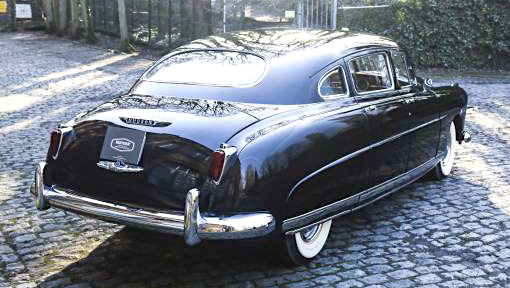
1949 Hudson Commodore Six
Husdons were redesigned for the 1948 model year, but 1949 models were nearly identical.  Here the trunk lid is quite short and not boxy.  Nevertheless, the effect is that of a fastback whose profile had been interrupted.

1949 Lincoln Cosmopolitan Sport Sedan - Mecum Auctions photo
The passenger compartment profile is less fastback than Hudson's, though the sense of it is still clear.  The trunk profile is much more notchback here.  Despite detail differences, this car and the Hudson above echo one another to some degree.

1949 Lincoln Sport Sedan
This is the entry-level Lincoln.  Its profile is more similar to the Hudson's than is the Cosmopolitan's.  However, this is a four-window greenhouse, not a six-window as in the previous two images.

1949 Mercury Sport Sedan
Mercury and the basic Lincoln shared the same bodies for model years 1949-1951.  The Mecury's wheelbase was a bit shorter (compare the distances from the front wheel openings to the forward door cutlines)

1949 Dodge Wayfarer - BaT Auctions photo
There were no 4-door Wayfarer sedans.  The wheelbase is shorter than that for standard Dodges.  The rear profile is more similar to Mercury/Lincoln than to the Hudson and the Cosmopolitan.

Monday, July 28, 2025

Railton: Hudsons with English Clothes

England's Railton (Wikipedia entry here) marketed cars 1933-1940.  It was a niche brand, producing 1,460 cars based on Hudson chassis' and eight or six cylinder motors with custom coachwork made in England.

The earlier eight-cylinder models were essentially upper-class hotrods with, at the time, plenty of horsepower (100, later 113) and comparatively light weight.  Which might justify the use of Reid Railton's name for the brand, Railton having designed land speed record-breaking cars.

I suppose those imported Hudson components were tariffed on top of transatlantic transportation expenses, though there was some compensation in that bodywork was farmed out to less-prestigeous, less-expensive coachbuilding firms.  Another expense for buyers was the horsepower tax.  The formula for Hudson motors having three-inch cylinder bore diameters was 18.8, meaning a very high tax rating.

As for the coachwork, Railtons were generally attractive in the British context of their time.  Based on photographic evidence, it appears that Railton furnished hoods and grilles, Rolls-Royce fashion, though it's also possible that coachbuilders were ordered to follow specifications for those parts.  It seems that Railton usually sought the cheapest bodies to offset Hudson-related expenses.

Below is a chronological sampling of Railton bodies.

Gallery

1934 Railton Drophead Coupe by Berkeley - HandH Auctions photo
Bentley-like mesh grille guard.  Forward louvers are intake, not outlet.  Cowling "scuttle" shape is peaked, echoing the the grille framing.

1935 Railton Straight Eight Light Sports - car-for-sale photo
Fenders do not extend down to the rear, making me wonder how useful they were outside racing events.  There are louvers along what appears to be chassis framing.  This might actually be related to the exhaust system, though a similar Railton's exhaust was strung below frame-level.  It seems from web images that while this Railton variant was basically the same, cars I examined did not have identical detailing.  Also, I have no information regarding the coachbuilder.

1935 Railton Eight Special Saloon by Carbodies - Bonhams Auctions photo
Railtons featured nice, long hoods (bonnets) to house their long Hudson eight-cylinder motors.  The rest of the body seen here is nondescript.

1936 Railton Eight Mk. II Drophead Coupe by Coachcraft - Bonhams
Nice, clean, English-style design.  Coachcraft was a smaller, low-budget coachbuilder, but was responsible for more Railton bodies than other vendors.  Chief designer was Geoffrey Durtnal.  London's Coachcraft was unrelated to the Hollywood Coachcraft of the 1940s and 1950s.

1937 Railton Straight Eight Cobham Sports Saloon by Coachcraft - HandH
Now for a mini-walkaround of an attractive four-door saloon.  The grille design has been sharpened, with a vertical divider strip added.

Interesting two-tone paint scheme that helps highlight the long hood.  Flow-through of the hood fold to along the upper edge of the paint divider to the top of the vertical side of the trunk is continuous, and a very nice professional styling feature.

Large "touring car" type trunk.  Modeling of the aft of the passenger compartment greenhouse and the trunk is similar, another professional touch that adds thematic unity to the design.

1939 Railton Eight Claremont Drophead Coupe - car-for-sale photos
A late Railton, coachbuilder unknown to me, though the fender fronts are similar to the car's in the precious images, suggestive of Coachcraft.

Tidy rear, though the folded-down top (hood) is rather messy.

Monday, April 21, 2025

1941 American Grilles and Front Ends

In my book "Automobile Styling: From Evolution to Fashion" and elsewhere, I state that the period roughly 1930 (or thereabouts) to 1949 saw car design changing from boxy bodies with discrete elements such as fenders, headlights, etc. to bodies where such elements merged into what some call "envelope" bodies.  I usually cite the 1949 Ford as exemplifying the end of that evolution.

By the 1941 model year, most of the evolution had taken place.  Fenders were still distinct, though largely blended to the main body.  Moreover, car designs were no longer awkward, as they were earlier in the transition period.  An important factor was advances in technology -- sheet metal stamping, curved glass formation, especially -- that allowed stylists' speculative sketches to become implemented in production.

Today's post presents grille designs of the major 1941 model year automobile brands.  Until the late 1930s, grilles had vertical formats that coincided with the radiators paced behind them.  But by 1941, nearly all grilles had horizontal formats, a matter of fashion, nearly as much as technology.

Gallery

1941 Cadillac 62 - BaT Auctions photo
This is a classic grille design that influenced Cadillac styling for many years.  Part-architectural (the rectangular grille elements) and part Egyptian (those wings above the Cadillac crest), the overall composition is excellent.  Well, those round things (horn covers?) below the headlights would have looked better if they had been smaller.

1941 Buick Special - car for sale photo
Next down the General Motors hierarchy are Buicks.  Plenty of bold grille bars.  Note the frame shape -- Chevrolet's (see below) is similar.  And even Plymouth's has a hint of this.

1941 Oldsmobile 98 - Broad Arrow Auctions photo
Headlights are closer to the centerline.  Plenty of grill bars, many at right-angles to the others.  A very busy frontal design replaced by something even more odd for 1942.

1941 Pontiac DeLuxe - car for sale photo
An awkward photo, but included because it shows the red paint in the central details (most other Internet images show grilles where the paint has been worn away).  Pontiac's Silver Streaks on the hood are echoed below the headlights.  The overall effect is more coherent than Oldsmobile's.

1941 Chevrolet Special DeLuxe - car for sale photo
GM's entry-level brand's front mimics Buick's, as noted above.  Like Pontiac, there is red detailing in the central, vertical bar.  And there's more in pinstripe mode on the horizontal bars.

1941 Chrysler Royal - Mecum Auctions photo
Chrysler's grille is simple, though this photo does not show that, in plan view, the bars curve forward to meet at the lower extension of the hood prow.

1941 DeSoto DeLuxe - car for sale photo
This grille set the DeSoto vertical-bars grille theme that was continued through the 1955 model year.

1941 Dodge Custom - car for sale photo
A rather contrived frontal design.  Two segments divided by a painted central element.  Upward frame curves that blend with the headlight assemblies.

1941 Plymouth DeLuxe - car for sale photo
Very rounded frame aside from the painted central element that blends into the hood design.  Horizontal chromed prow strips as on DeSoto.

1941 Lincoln-Zephyr - Mecum
Another example of hood-prow blending.  This makes more sense when view at an angle -- not head-on as seen here.

1941 Mercury - car for sale photo
Central prow plus side openings.  Similar to the Chrysler Corporation brands shown above.  However, this composition is relatively simple while the framing relates to surrounding body sculpting.  Basically, a nice solution.

1941 Ford Super DeLuxe - car for sale photo
Three openings here.  Unlike many of the designs pictured above, there's no solid central element.  Instead, the central part is a vertical opening with a hole for a starter crank.  I suppose the shapes of the flanking openings are rounded to reflect the rounded shape of the main car body.

1941 Packard Clipper - Mecum
Another vertical central grille opening with flank openings.  But the composition is better than Ford's.  Plus, the top of the vertical framing carries on Packard traditional grille frame theme, an important marketing consideration.

1941 Hudson DeLuxe - car for sale photo
Similar in sprit to the Chrysler grille.  Hudson's body dates from 1936, but was heavily facelifted to keep it fairly up-to-date.

1941 Graham Hollywood - car for sale photo
Hupmobiles shared the same body and grille, though the upper zone lacked the chrome seen here.  This grille was applied to the1936-37 Cord body design, not in line with cars seen here that have recent body designs.

1941 Nash 600 - Mecum
Lots of grille bars along with a bold, chrome bow strip.  Very architectural, but pleasant.

1941 Studebaker Commander - car for sale photo
Yet another two-element grille.  Long before BMW grilles became famous.  Simple, something Raymond Loewy usually favored.

1941 Willys Americar - car for sale photo
Smaller than most '41 American cars.  Simple grille design with no central separation.

Monday, May 13, 2024

1948 Hudson Sedan Walkaround

The last true standard-size Hudson design was launched for the 1948 model year, and continued in production into 1954.  Some Hudson Motor Company history is here.

Those '48 Hudsons were distinctly different from competing brands.  Besides a streamlined-appearing shape, they were lower than competing cars in part due to the use of unitized bodies rather than conventional body-on frame.  For example, 1947 Hudson height was 68 inches (1727 mm), the new, competing 1948 Oldsmobile 98's height was 63.8 inches (1621 mm), and the 1948 Hudson Commodore was only 60.375 inches (1534 mm) high.  All these cars had road clearances of approximately 8 inches (203 mm).

The Gallery below features walkaround views of a line-leader Hudson Commodore sedan along with images of other cars mentioned above.

Gallery

1947 Hudson Commodore Sedan - for-sale photo
The previous Hudson design.  At its core is a 1936 model year body that experienced many facelifts over the years.  Its grille design has some features that were carried over to the 1948 model (horizontal bars and the upper frame theme).  Otherwise, all was changed.

Factory photo of a 1948 Hudson Sedan
General view of a '48 Hudson.

1948 Oldsmobile 98 - factory photo
An example of styling leader General Motors' redesigned for 1948 C-body 4-door sedans.  This was the new postwar American industry norm.  The new Hudsons were quite different.

1948 Hudson Commodore sedan - for-sale photos
Now for the walkaround.  As mentioned, the grille theme retained some features from 1947 Hudsons.

Postwar American redesigns featured flow-through fenderlines.  The result sometimes resulted in a slab-sided appearance.  Hudson's low height eliminated that possibility.

Even so, stylists took a few steps to visually reduce a slab look.  The fenderline is slightly below the passenger compartment greenhouse beltline.  Also, there is a character line crease partway down the fender.  The result is that the side looks sleek.

Rear ends were simple in those days.

The backlight window has curved glass, but its area is not very large because curved glass technology was not quite ready for larger sizes.  Note the curved plan form of the passenger compartment roof.

The broad chrome strip along the base of the body might have helped to draw viewers' eyes downward, helping to give Hudsons a low appearance.

Again, glass forming limited the windshield to two sections and not a unrestricted panorama.  The Oldsmobile pictured above also had a two-piece windshield.