Showing posts with label Vauxhall. Show all posts

Monday, July 20, 2026

Vauxhall's L-Series Facelifted Prewar Cars

When World War 2 ended in the Summer of 1945, carmakers in the victorious countries struggled to begin making cars again instead of war-related products.  Aside from essentially new companies such as the USA's Kaiser-Frazer, manufacturers started building prewar designs with varying amounts of facelifting.

There were exceptions, but new designs essentially did not appear in America until the 1948 and (especially) 1949 model years.

General Motors' British subsidiary Vauxhall did not introduce new designs until mid-1951.  It made do with a major facelift for 1948.  The Wikipedia entry for Vauxhall is here.  Scroll down to "1940s" for some background for today's post.

I find it interesting that GM used unit-bodies for its mainline Vauxhall models starting in 1937.  (It didn't introduce unit bodies on its American lines until 1960's Chevrolet Corvair.)  So the 1948 facelift and renaming of its models had to deal with a body structure that was expensive to greatly modify.

Details are in the Gallery captions below.

Gallery

Pre-war Vauxhall Unitized Body - General Motors image
This is what Vauxhall stylists and body engineers had to work with.

c.1946 Vauxhall Twelve-Four - car-for-sale photo
Warmed-over prewar design.  The most obvious change is its grill bars are oriented horizontally rather than vertically.  Wheelbase is 101.25 inches (2572 mm).

1949 Vauxhall Wyvern - car-for-sale photo
Its replacement model.  It and the Velox have a 97.75 inch (2483 mm) wheelbase, as did prewar Ten-Four models.  The Wyvern's doors and A- and B-pillars are the same, indicating that much of the basic unitary body was retained.  Note that the forward curve lines of the rear fenders are the same in both designs.  Otherwise, fenders are more "suitcase" style, as seen on 1941-vintage cars from several American carmakers.

c.1946 Vauxhall Twelve-Four - car-for-sale photo
Front quarter view.  Note the windshield.

1950 Vauxhall Velox L-Type - car-for-sale photo
It was retained in the facelift for structural reasons.  What's changed is forward of the cowling/A-pillar.  The new design is in the spirit of circa-1942 American styling.  The result is a car seeming different, not really English, but more "modern."

c.1946 Vauxhall Twelve-Four - car-for-sale photo
Rear-quarter.  Very 1930s.

1950 Vauxhall Velox L-Type - car-for-sale photo
The aft part of the passenger compartment unibody structure was altered to create this more rounded shape.  The trunk (boot) is greatly enlarged.  The spare tire is now stored under the trunk's floor: note the access panel above the bumper.  Also changed is the backlight window.

1939 Vauxhall Ten-Four - car-for-sale photo
To tidy things up, before-and-after side views of cars with the same 97.75-inch wheelbase.

1951 Vauxhall Velox L-Type - car-for-sale photo
The changes resulted in a much more up-to-date (for the late '40s) profile.

Thursday, September 9, 2021

General Motors Conceptual Twins: Opel Kapitän vs. Vauxhall Velox and Cresta

For many years General Motors rotated some American stylists through its European subsidiaries Opel (in Germany) and Vauxhall (in England).  Therefore, it isn't surprising that some Opel and Vauxhall models had similar apprearances that include more than a dash of Detroit automobile fashion.

The subjects of today's post are the short-lived (1958-59) Opel Kapitän P1 and the 1957-1959 versions of the Vauxhall Cresta PA and Vauxhall Velox PA.  Also included are images of similar Chevrolet and Buick features.

Unless noted, images below are factory-sourced or are of for-sale cars.

Gallery

1958 Opel Kapitän P1
Significant features include panoramic (wraparound) windshields and backlight windows, along with C-pillars that blend into the beltline.

1959 Vauxhall Velox PA - Vauxhall Heritage photo
The slightly smaller Vauxhall has similar windows, but the C-pillar is narrower and fails to blend.  That said, it appears that the cars might have shared some structural elements.

1958 Opel Kapitän P1, for-rent photo
The Kapitän's backlight is a one-piece affair.

1959 Vauxhall Cresta PA
Whereas Vauxhall's had three-segment backlights.

1957 Oldsmobile
Note the similarity to this American GM design's backlight.

1962 Vauxhall Cresta PA - for sale in Australia
Later Vauxhall PAs received one-piece backlights.

1958 Opel Kapitän P1, image via Autobild
Now for some comparative side views.  The Kapitän's wide C-pillar is similar to that of ...

1957 Buick Roadmaster Hardtop Sedan
Buick Super and Roadmaster hardtop sedans of the 1957 model year had this window design, also some Cadillacs.

1959 Vauxhall Velox PA
Whereas the Vauxhalls' C-pillars are similar to those on ...

1958 Chevrolet Biscayne Sedan
1958 Chevrolet and Pontiac four-door sedans had this window treatment.

Thursday, July 2, 2020

Cadillac Catera's Siblings

One of the labels I attached to this post is "Badge Engineering" -- where different car brands are based on the same basic body and differences are trivial.  That's essentially true of two of the three cars discussed here, but slightly less true of the third.

That third car is Cadillac's Catera model that I wrote about here.  At the time I didn't show the Opel Omega that it was based on, hence the current post.

Further background on the Camera that offered by General Motors for model years 1997-2001 can be found here.

At the time, GM owned Germany's Opel firm and England's Vauxhall, the latter selling rebadged Opels with right-side steering. The Wikipedia entry on the Opel (and Vauxhall) Omega is here.

Cateras were based on the Omega B1 (1994-1999) and Omega B2 (1999-2003) that had few exterior differences.  Even though Cateras were built in Opel's Rüsselsheim factory, they were modified to satisfy presumed American tastes for a sporty Cadillac.  Unfortunately for GM, the basic Opel body was given only minor changes, and didn't strike potential Cadillac buyers as being enough like a "real Cadillac" to bother buying: sales averaged less than 20,000 per model year.

Gallery

General view of a Catera.

Rear quarter view.  Note the broad sweep across the trunk lid between the tail lights.  The tail light segments not on the lid are Opel's, but the chrome strip, reflector strip and brake light band are for the Catera only.

Front view showing the Camera grille.  The grille pattern and crest are Cadillac features, and the low, chin air intake zone is also Catera's.

Here is a similar view of an Opel Omega.  Very few differences from the Catera.

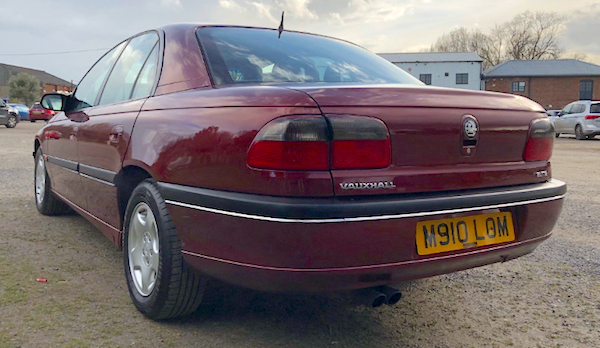
Rear Omega view.  The main difference is the simpler trunk lid features.

Front quarter view of a Vauxhall Omega.  Its grille fits in the Opel's opening.  Otherwise, there are no visible exterior differences: true badge engineering.

The same can be said for the Vauxhall's rear in this "for sale" photo.

Monday, February 16, 2015

Vauxhall Velox and Cresta: Wraparounds Front and Rear

The two major American styling fads of the 1950s were panoramic (or wraparound, as they were called at the time) windshields and tail fins.  Wraparound windshields appeared on low-volume Oldsmobile and Cadillac convertibles for the 1953 model year, then were on all the redesigned 1954 Olds, Buick and Cadillac cars.  Nearly all the rest of American cars added wraparounds by the end of the 1955 model year.  Large tail fins became a major styling element on the 1957 Chrysler Corporation line, but were previewed in a subdued way on the '56s.  Before that, small fins were on Cadillacs starting in 1948 and Pontiacs by 1953 had little limps on their rear fenders that some people might call fins.

Vauxhall, in England, was a General Motors subsidiary in the late 1950s (and remains so).  Which is why Vauxhall's Cresta and its more upscale mate Velox got a strong dose of GM styling when they were redesigned for 1957. Background on Velox is here and Cresta here.

I'll walk through the details in the captions below.

Gallery

1957 Vauxhall Cresta - side
The new design was very American, very up-to-date.  Note the low hood and high fender line.  The tail fins are discrete compared to Chrysler's offering that year.  But I want to focus on the passenger compartment windows on what stylists call the "greenhouse."  The windshield is a wraparound, with A-pillars leaning forward from their base.  The rear windows ("backlights" in stylist-speak) have a wraparound arrangement as well, but the C-pillars lean backwards in a kind of echo or mirror image of the windshield treatment.  This style was used on some GM American cars at about the same time.

1958 Vauxhall Cresta
Another view of the Cresta.  It's a pretty tidy design aside from the awkward headlamp ensemble.  But it doesn't seem very British.

1958 Vauxhall Velox - rear 3/4 view
Those are huge tail lights that look vulnerable to damage in the most minor of rear-end accidents.  Take note of the three-piece rear window.  In the late 1940s and early 50s, initial versions of panoramic backlights had three pieces separated by thin dividers.  The reason had to do with the state of the art of mass-production curved automobile glass.  For a reason I find very hard to understand, GM styling supremo Harley Earl returned to three-piece backlights, but with thick dividers for 1957 Oldsmobiles, most '57 Buicks and the new Crestas and Veloxes as well.  Observe that the top of the central window does not quite align with the forward edge of the side units -- a curious flaw not present on the American cars.  (This also can be noticed on the first photo, above.)

1958 ca. Vauxhall Cresta - front 3/4 view
The front of the earlier Cresta.  The top is rounded like its new American GM conterparts.  The grille and bumper combination is unobjectionable, but not exciting.  As noted above, the treatment of the lights seems awkward.

1962 Vauxhall Velox grille
The final year for the PA body.  The grille has been enlarged, yet still makes no serious statement.  And nobody bothered to improve the headlamp treatment.

1960 Vauxhall Cresta - side
Here we see an American-Style two-color paint job.  This photo also illustrates the symmetry of the front and rear fenestration that is now emphasized by one-peice backlight glass -- a nice improvement.

1958 Chevrolet Bel Air
Here is an American car by GM for comparison.  This Chevy features the same sort of windshield-backlight treatment as the Cresta in the previous photo.

1957 Oldsmobile - rear window (backlight) treatment
This is how Earl's odd three-piece backlight looked on an American car.  Note that forward edges of the center and side windows seem better-aligned than on the Vauxhall.

Thursday, July 25, 2013

Vauxhall's Concave Accents

In the early days of the automobile industry, a number of manufacturers tried to establish stylistic iconography so as to make their cars instantly recognizable.  Examples include Rolls-Royce's "tombstone" radiator/grill ensemble and Packard's red hexagons on wheel hubs and hubcaps.  This worked fairly well from around 1910 into the early 1930s when automobile hoods, headlamps, bumpers and fenders were the major visual elements of the car's front end, and they were physically distinct.   Blending of these elements began in earnest starting around the 1934 model year, and by 1950 most cars had so-called "envelope bodies" where all those bits except the bumpers were integrated into one mass.  This usually made it difficult to maintain distinguishing iconography.

A case in point is the British brand Vauxhall (Wikipedia entry here).  Before 1910, Vauxhall came up with the idea of placing tapered, concave depressions on each side of the hood where it transitions from horizontal to vertical.  Visually, these seem to be scooped out from the hood mass.  British car styling being conservative and World War 2 having dealt a serious blow to the economy, Vauxhall cars didn't receive fully envelope-styled bodies until the early 1950s.  Nevertheless, these concave streaks continued on Vauxhalls until the 1957 model year began their disappearance.

Gallery

1909 Vauxhall

1920 Vauxhall D Type

1927 Vauxhall Type 30-98
These Vauxhalls are from the era when exterior components were separate units.  The tapered depression is clearly seen on the 1920 and 1927 vehicles.

1936 Vauxhall Big Six

1939 Vauxhall advertisement
By the mid to late 1930s, Vauxhall bodies were becoming increasingly rounded, yet stylists still had no difficulty incorporating the traditional hood accents.

1948 Vauxhall Wyvern or Velox
Vauxhall's first post-war body retained a tall hood that could support the accents (which were embellished by chrome plating).  But there was now a disconnect with the grille which was horizontal and low.

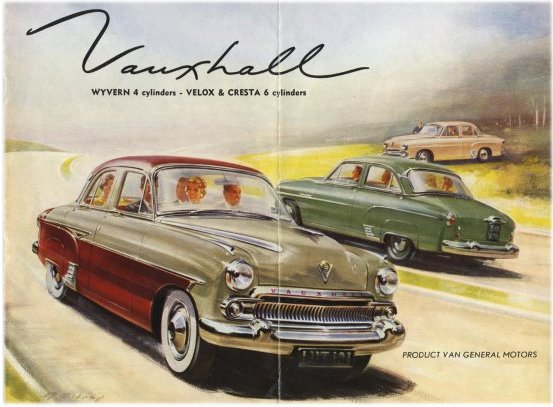
1955 Vauxhall brochure cover
Another complete body restyling appeared in the mid-50s, the transition to the envelope type being completed.  The hood was now lowered, leaving less room for the accents.  Another complete restyling came in the form of the 1957 Vauxhall Victor whose hood was lower than the fender tops.  There being no place for the accents, they finally disappeared.