Showing posts with label Renault. Show all posts

Thursday, July 2, 2026

Renault Dauphine Walkaround

In the late 1950s, Americans became more accepting of small (by our standards) foreign cars.  British sports cars were appearing in noticeable numbers by the early '50s in Washington State, where I grew up.  By mid-decade, Volkswagen Beetles were on the scene, later supported by clever advertising.  So other marques decided to enter that expanding, potentially huge, automobile market.

One such entry was Renault, at the time owned by the French government.  Its car was the Dauphine, produced 1956-1967.  At first, Dauphines sold fairly well, buyers perhaps thinking they were a more modern, and therefore better, car than the VW.  Sadly for Renault, Dauphines proved to be under-powered and unreliable under American driving conditions and sales collapsed.  They sold better elsewhere, hence the long production run.

I wrote about the Dauphine here.  The post includes some French publicity photos.

The first link above notes that Dauphine's styling was derived from that of the Renault Frégate, produced 1950-1961.  Comparative side-views are presented below, along with a Dauphine walkaround set.

Gallery

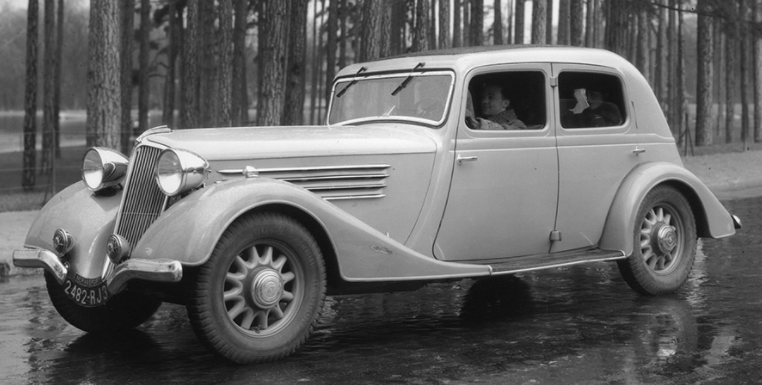
Renault Frégate - photo via zorblogauto
Frégates had the conventional engine-front, drive wheels rear, layout.  The wheelbase was 110.2 inches (2800 mm).

1959 Renault Dauphine - BaT Auctions photo
The Dauphine's wheelbase was 89.3 inches (2267 mm), its motor and driving wheels at the rear, á la VW Beetle.  Aside from the backlight window and some door cut-lines, the passenger compartment closely resembles that of the Frégate.  Perhaps some components were shared.

1962 Renault Dauphine - Bilweb Auctions photo set
A rather awkward-looking design, not uncommon for Renault.

The side air intake for the radiator aligns with the aft door cutline, a useful simplification.

Additional air vents are at the rear.

The engine hood has some sculpting, and the profiles of those air vents have curved shaping.  I think that such a small car would have justified a slightly narrower, more rectangular, shape for the vents, relating better to the aft hood cutline.

By today's standards, the car seems too narrow.  But more width would have required more weight and more engine power, lifting the car from its intended market segment.

The passenger compartment greenhouse seems bulky due to its heavy window framing.  But that was probably the best Renault could do in terms of sheet metal forming at the time the Frégate was developed (late 1940s).

The lack of a front radiator grille made for a bland design -- a limitation of today's electricity-powered cars.

Like the rear engine compartment hood, the frontal trunk lid has some central sculpting.  The bumper is shaped to conform to maximal European license plate shapes.

Dashboard view.

Monday, May 18, 2026

Renault's 1998 Vel Satis Concept Car

Automobile styling has been "internationalized" for several decades.  Back when I was young, American cars looked American, British cars usually seemed British, Italian cars Italian, and so forth.  Those distinctions were fading by the 1960s, in part because Italian designers such as Pinin Farina and Giovanni Michelotti were hired by the likes of Nash and Triumph to style production cars.  By the 1970s the great Giorgetto Giugiaro's ItalDesign firm had its hand in the design of cars from as far away as South Korea.

One rear-guard attempt to preserve a national design feeling was France's Vel Satis executive car by Renault.  In 2013 I wrote "Renault's Not-So Vel Satis Adventure" that dealt briefly with it and its concept version.

The man behind the design was Patrick Le Quément, who became Renault's Vice President, Corporate Design in 1987.  As this Wikipedia link notes, although Le Quément was French-born, he was raised and educated in England.  Much of his early car styling experience was at Ford's British subsdiary as well as in Germany at Volkswagen.

That said, his early efforts are Renault had to do with creating a French look to Régie Nationale des Usines Renault styling.  An important part of that was the Vel Satis concept car's design.

By the way, Wikipedia notes: "The name Vel Satis is a portmanteau of Velocity and Satisfaction."

By the time the concept car appeared, the "Frenchness" of the Citroën Traction Avant and DS 19 was well as Peugeot's 1930s 302s and 402s was long past.  I suppose the concept's 1989 Frenchness lies in the fact that the design was different, distinct, compared to what was common at the time.  And yes, some details seem to be examples of French la logique.

Photos below are all probalby via Renault.

Gallery

Frontal air intakes seem too small, and I don't notice a chin-level intake.  That said, it was powered by a transverse-mounted V-6 motor that required a radiator.  Perhaps it wasn't driven long enough to overheat.  Or else there was a hidden source of air to cool the radiator.

Rear styling has a completely different theme from the frontal.

Simple fender line.  Largely flat sides.  Round wheel openings.  Very basic design components.

This profile image shows the rather odd (French?) proportions.  Long, slanted hoodline and frontal overhang.  Minimal rear overhang and a chopped-off roofline at the rear that contrasts with a rounded lower rear body.  That rounding corresponds to the round aft wheel opening.

This shows the passenger greenhouse sculpting.  The crease begins at the fender front, becomes the A-pillar, then flattens and transitions to side window upper framing, and finally wraps around to become upper framing of the backlight window.  Interesting, maybe French la logique.

The short, rounded aft body is echoed by the curved backlight with its contrasting flat roof.  The trunk lid is necessarily tiny.

View of the car in fairly normal lighting.  An interesting design, more intellectual than attractive.

Thursday, August 17, 2023

Early V-Windshields on Closed-Body Cars

The 1930s was the decade when automobile design changed most profoundly.  Bodies became more integral, where formerly discrete elements such as headlights and fenders were merged, step-by-step, into the main car body shape.  Related was the fashion of streamlining, whereby car bodies became more aerodynamically efficient than before.

In many respects, the "streamlining" was more notional than actual, though some details changes did make for a modest improvement.

Today's subject is the V-shape, two-glass-pane windshield.  These had appeared by 1930 on some roadsters and other models with retractable/removable fabric tops.  But it wasn't until the 1934 model year that V'd windshields were on volume-production cars with closed (fixed-top) bodies.

It took several years before such windshields became the dominant type in the USA; brands such as Dodge and Plymouth didn't have them until they were given a major facelift for 1939.  Europe was even less receptive.  As best I can tell without digging very deeply, no factory-body Italian cars had them in the 1930s.  The only French brands mass-producing V'd windshields were Peugeot and Matford.  I found only one English example so far.  Germany had several brands with them on some models by the late '30s: Adler, BMW, Horch, Opel and Wanderer.

I am no expert regarding aerodynamics, so what follows is conjectural.

Windshields with slight V-ing and little slant are not much more efficient than flat, vertical windshields.  Even sharper V-angles do comparatively little if the slope is slight.  So slope matters more than V-ing.  Windshields that combine strong slope and some V might be more aerodynamically efficient than slope without the V, though I suspect the difference is small, and dependent on the overall shaping of the front of the passenger compartment greenhouse.

All that said, let's take a look.  Below are examples of the earliest adapters in the USA, France, UK and Germany.

Gallery

1934 Chrysler Airflow CU Coupe - Barrett-Jackson Auctions photo
The famous Chrysler Airflow design was wind-tunnel tested.  Windshield slope appears to be around 45 degrees.  The amount of V is not large, but the result, back in those flat window glass days, was a quasi-rounded forward plan-view shape of the greenhouse.

1935 Oldsmobile Eight 2-door sedan - for-sale-car photo
General Motors redesigned a body used on Pontiac, Oldsmobile, and some Chevrolet models.  Windshield slope was slight, and so was V-ing, so what we find has more to do with styling fashions than actual streamlining.  LaSalle's also got V'd windshields.

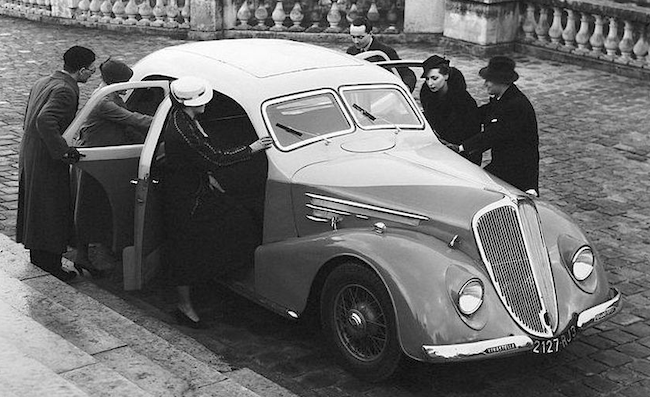
1935 Renault Vivastella Grand Sport - photo by Robert Doisneau for Renault
This Renault has similar windshield characteristics to those of the Airflow.  There also was a Nervastella version.  Interestingly, the V'd windshield was abandoned for 1936 and beyond.

Peugeot 402 - factory photo
The 402 line was introduced in the October 1935 Paris automobile show and remained in production until 1942.  Above is a '38 "Légere" model.  Windshield slope is perhaps 30 degrees from the vertical.

1937 BMW-Frazer-Nash 4-door saloon - for-sale-car
This design first appeared for the 1936 model year.  Frazer-Nash imported right-hand drive BMWs to the UK.  Not much V, and the slope is about 30 degrees, as best I can tell.

1937 Humber Snipe Imperial Limousine - Brightwells Auctions photo
This design also first appeared for the 1936 model year.  Very slight V, and the slope seems less than 30 degrees.

Monday, April 25, 2022

Low-Level 1930 French Headlights

Nowadays headlight heights above the road are regulated.  That didn't seem to be the case in France during the 1930s.  Whereas most French cars had headlights placed fairly high relative to their grilles and fenders, there were some cases where they were closer to the ground.

This styling fad ended around the 1937 model year, aside from some Puegeot lines.  Their 302s and 402s were essentially pre- World War 2, and 202s were built for a few years after.

Examples of French cars with low-mounted headlights are shown below.

Gallery

1935 Renault Nervasport
Here is an example of headlight placement on a Renault, the leading French manufacturer.  Compare to the automobiles pictured below.

1930 Bucciali TAV 30 La Marie Torpédo Sport Type Cannes by Saoutchik - Bonhams photo
Bucciali was an especially exotic French brand.  Here is an early instance of low headlights.

1933 Panhard 6CS Coupé
An early example, this by an important French manufacturer.

1935 Avions Voisin C25 Aérodyne - Gooding photo
Voisin was a builder of exotic, expensive cars.

1935 Peugeot 401 Cabriolet
An important French carbuilder.  1934 401s had normal headlight placement.  For 1936 the 401 gave way to the 402 that was clad "Fuseau Sochaux" style.

1937 Peugeot 302 "Fuseau Sochaux"
Peugeot 302s appeared for 1937 with the same styling theme as the 402.  Headlights were distinctively placed behind the grille for models 202, 302 and 402.  They are not as low as seen on the 401 in the previous image -- but they aren't very high either.

1935 Vivastella Grand Sport - factory photo by Robert Doisneau
Low-mounted headlights were on Renault's most expensive lines for the 1935 and 1936 model years.

Thursday, July 15, 2021

Three Surprisingly Similar 1975-Vintage European Cars

I recently wrote about the design similarity of the Volkswagen Passat (B1) (produced 1973-81) and the Renault R20/R30 (produced 1975-84) -- see the comments for information on the Renaults design ancestry.  In today's post I add the Simca 1307 (produced 1975-86) to the mix.

To a considerable degree the appearance of these cars from three different manufacturers was due to the styling fashion of the time -- angular, "three-box" formats featuring large windows.  The key origin design for the cars discussed here was that of the Audi 80 B1 (Audi Fox in the USA) that entered production in 1972.  Its designer most likely was Giorgetto Giugiaro, as noted in the German language Wikipedia entry here.

Design of the Renault R20/R30 is credited to Gaston Juchet, that of the Simca 1307 (also Talbot 1510) to Englishman Roy Axe.  That said, one might not be criticized for thinking that all three designs came from the pen of Giugiaro.

Some comparative images are presented below.

Gallery

1973 Volkswagen Passat (B1)
The Passat was a fastback version of the Audi 80.  Note the side window profile and how it compares to those of the Renault and Talbot (Simca) below.

1976 Renault R20
The R20/R30 was longer than the VW, having a wheelbase of 2625 mm (104.7 inches) compared to 2470 mm (97.2 inches).  The Simca/Talbot about 61 mm (1.8 inches shorter than the Renaults.

Talbot 1510
It might have come off the same assembly line as the R20 in the previous photo.

1975 Volkswagen Dasher - for sale photo
Giugiaro's VW aft end featured D-pillar sail panels framing a large backlight window and sloping upper trunk sheetmetal.  Due to its shorter length, the VW's C-pillar angle differs from those on the longer Renaults and Simca/Talbots.

1976 Renault R20
That aft design also appears on the Renault shown here.

Talbot 1510
Here the sail panels are absent.  Otherwise, the rear is similar to that of the VW.

Thursday, June 17, 2021

The Problematical Renault R20 and R30

Renault's R20/R30 cars (produced 1975-1984) suffered from engineering-related defects, as their Wikipedia entry explains.

As for their styling, it was rather generic European "three-box" mid-1970s.  In charge of Renault styling at the time of development was Gaston Juchet, who might have been influenced by the work of Italian maestro Georgetto Giugiaro, as can be seen in the images below.

The nearly-identical R20s and R30s were attempts by Renault to return to making larger cars than its postwar 4CV, Dauphine and such.  Their appearance was not the quirky, French look later used by styling chief Patrick le Quément on upscale models such as the Vel Satis.

Unless noted, the photos below are factory-sourced.

Gallery

1976 Renault R20
R20 and R30 bodies were essentially identical, the most visible difference being their headlights.

1975 Renault R30

1975 Renault R30
Compare this car with the one in the following photo.

1973 Volkswagen Passat (B)
The Vollkswagen Dasher / Passat (B1) (produced 1973-1981) was derived from an Audi. Styling was by Giugiaro.  Both the English and French Wikipedia entries for the R20/R30 fail to mention any connection with Giugiaro's Passat design.  Yer there are many similarities -- for example, the side window profile, front end design, and even the overall proportions and "feeling."

1976 Renault R20
Note the after end of the passenger greenhouse --  the sail panels as well as the relationship of the backlight window and trunk sheet metal.

1975 Volkswagen Dasher - for sale photo
Those details are essentially the same as seen on this VW Dasher (North American name for the Passat).

1976 Renault R20
A R20 seen from normal viewing perspective.  Its wheelbase was about 2665 mm (104.9 inches) compared to the Passat's 2470 mm (97.2 inches), perhaps the major difference in the designs.

Thursday, June 10, 2021

Early Postwar New and Redesigned French Cars

France has been remarkably resilient economically following its wars.  Most recently were les années Trente Glorieuses 1945-1975.  (Recall that France was defeated by Germany in a six-week campaign in 1940.  Germany and Italy occupied parts of the country and the rest was ruled by a puppet state that the Germans eventually occupied.  In 1944 the country again became a battleground following Allied invasions.)

One instance of rapid postwar recovery was the automobile sector where the leading carmakers were able to introduce redesigned versions of pervious models or entirely new models by late 1948.

The 3 October 1946 Salon de l'Automobile de Paris saw the introduction of the totally new Renault 4 CV and Panhard Dyna, both small, entry-level cars.  Then the 7 October 1948 show featured the Citroën 2 CV minimal car, the low-mid range Peugeot 203, and the new Ford Vedette priced around 20 percent higher.

Gallery

1949 Renault 4 CV
French car buyers strongly preferred their sedans to have four doors -- even for small, rear-engines models such as the 4 CV.  Frontal design is similar to 1941-vintage American practice.  The lengthy front fender was of the same concept as 1942 General Motors cars, though the door hinge was on the B-pillar for simplification reasons.

Rear styling was closer to late 1930s practice.

Publicity photo: the models provide a sense of the car's size.

1947 Panhard Dyna
The Dyna had conventional engine placement.  The body design is 1930s -- flat windshield, distinct, separate fenders, headlights not integrated with the car's body.  Again, models provide scale.

Rear styling was also prewar.

1948 Citroën 2 CV - Bonhams auction photo
Citroën's 2 CV was essentially designed with engineering considerations foremost.  As best I can tell, head stylist Flaminio Bertoni had little or no design input.

Rear quarter view, image via IMCDb.org.  Small though it was, the 2 CV had four doors.

1949 Peugeot 203 - Netherlands auction photo
The 203 carried a 1942 American look.  And the front end looks similar to that of the Renault.  Again, B-pillar door hinging.

But the 203 wasn't a mini-car, so the styling seems pleasant, albeit not distinctive or exciting.

1949 Ford Vedette - for sale photos
The Vedette's body was originally intended to be for a small, 1949 Ford.  Ernest Breech thought the large Ford design was too large, so that body was used on 1949 Mercurys and some '49 Lincoln models.  The tooling for the small Ford was sent to France for use on the Vedette, and a new design for '49 Fords was initiated.  It seems that details such as the Vedette's grille and bumpers were designed in France.

Door hinging was on the A and C pillars.  Note the fenderline designed by Ford's styling boss Bob Gregorie.

1949 Mercury
That fenderline was to be used on both small and large 1949 Fords, the latter becoming the Mercury shown here and the small Lincoln.