Showing posts with label Badge Engineering. Show all posts

Thursday, August 1, 2024

1934 British Chrysler (DeSoto) Airflow

The Chrysler Airflow is well-known to automobile buffs such as myself and, I suspect, most readers of this blog.  However, some aspects of the car don't show up on Airflow articles' radar.  One such is Airflows assembled outside the United States.

Some Chrysler Airflows were assembled in Canada -- a not very surprising practice in the 1930s.  More unusual is the fact that they also were assembled in England.  According to this snippet from Brightwells' auction site:

"This particular car is an especially rare example that was assembled at the Dodge-Chrysler factory in Kew in order to avoid the punitive 33% tax duty levied on complete cars imported to Britain from overseas.  Being a 1934 model, it retains all the charming idiosyncrasies of the early cars that were sadly diluted on later models in a vain attempt to bolster sales amongst a conservative public."

For me, the most interesting aspect of the 1934 British Chrysler Airflows was that they were not American-style Chrysler Airflows.  Instead, they were DeSoto Airflows with a few items of Chrysler trim.

Besides the import duty advantage of assembly in England, there might have been a horsepower tax advantage for basing Chryselr Airflows on DeSotos. The latter used six-cylinder motors, whereas American Chrysler Airflows had eight-cylinder engines.  British tax-horsepower ratings would have been about 27 and 34 respectively.  These were high numbers, and as best I can discover on a Google search, cars were taxed at the rate of a pound per horsepower.  Correct this in Comments if I'm wrong.

(Canadian-built 1934 Chrysler Airflows also were DeSoto-based, but used more Chrysler trim than the British version. That might be a subject for a future post.)

Below are images of the car Brightwells auctioned along with comparative images of a 1934 Chrysler Airflow and some 1934 DeSoto Airflows.

Gallery

1934 Chrysler CU Airflow 4-door sedan - factory photo
The CU sedan was by far the best-selling '34 Chrysler Airflow model.  Its wheelbase was 123 inches (3124 mm), whereas DeSoto Airflows had a 115.5 inch (2934 mm) wheelbase.

1934 DeSoto SE Airflow 4-door sedan - factory photo
The wheelbase difference yielded a stubbier section forward of the cowling / A-pillar.  Stylistic differences include the grille, headlight assemblies, hood louvers, and bumpers.

1934 DeSoto SE Airflow 4-door sedan - car-for-sale photo

1934 Chrysler Airflow 4-door sedan, UK version - via Brightwells auctions
This car is almost identical to the '34 DeSoto in the previous image, even down to the hood ornament.  The differences I note are chromed headlight surrounds and the American Chrysler Airflow bumper.


The chromed strip on the backlight window divider was found on DeSoto Airflows as seen above, but not Chryslers.  Again, the bumper is American Chrysler Airflow.  The other American Chrysler Airflow detail is the word "Chrysler" on all the hubcaps.  Tail light details can be ignored because this car had to be made street-legal in England post-1934.  The same might be true of the small lights atop the front fenders.

1934 DeSoto SE Airflow 4-door sedan - via The Henry Ford (museum)

Side views are essentially identical.

This is really an example of minimalist "badge engineering."

Thursday, July 2, 2020

Cadillac Catera's Siblings

One of the labels I attached to this post is "Badge Engineering" -- where different car brands are based on the same basic body and differences are trivial.  That's essentially true of two of the three cars discussed here, but slightly less true of the third.

That third car is Cadillac's Catera model that I wrote about here.  At the time I didn't show the Opel Omega that it was based on, hence the current post.

Further background on the Camera that offered by General Motors for model years 1997-2001 can be found here.

At the time, GM owned Germany's Opel firm and England's Vauxhall, the latter selling rebadged Opels with right-side steering. The Wikipedia entry on the Opel (and Vauxhall) Omega is here.

Cateras were based on the Omega B1 (1994-1999) and Omega B2 (1999-2003) that had few exterior differences.  Even though Cateras were built in Opel's Rüsselsheim factory, they were modified to satisfy presumed American tastes for a sporty Cadillac.  Unfortunately for GM, the basic Opel body was given only minor changes, and didn't strike potential Cadillac buyers as being enough like a "real Cadillac" to bother buying: sales averaged less than 20,000 per model year.

Gallery

General view of a Catera.

Rear quarter view.  Note the broad sweep across the trunk lid between the tail lights.  The tail light segments not on the lid are Opel's, but the chrome strip, reflector strip and brake light band are for the Catera only.

Front view showing the Camera grille.  The grille pattern and crest are Cadillac features, and the low, chin air intake zone is also Catera's.

Here is a similar view of an Opel Omega.  Very few differences from the Catera.

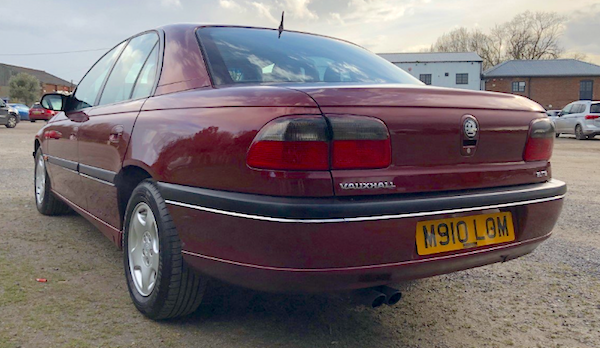
Rear Omega view.  The main difference is the simpler trunk lid features.

Front quarter view of a Vauxhall Omega.  Its grille fits in the Opel's opening.  Otherwise, there are no visible exterior differences: true badge engineering.

The same can be said for the Vauxhall's rear in this "for sale" photo.

Thursday, June 18, 2020

Transatlantic Badge Engineering: Chevy Chevette and Opel Kadett "City"

A while ago I wrote about General Motors' Chevrolet Chevette, a small car that sold fairly well despite being unimpressive in many ways.  The Chevette was part of a 1970s GM initiative to have a basic platform serve as the basis for cars branded and assembled in the various parts of the world where GM had a presence.

That was the 1973 T Platform, and the link lists the many models associated with it.

Given the badge engineering theme of the present post, I will focus on two models that share the same two-door hatchback body -- an American Chevrolet Chevette and a German Opel Kadett C "City."

The Chevette's wheelbase is one inch (25 mm) longer than the Opel's, but most body features are the same aside from the front ends, as noted below.  Motors and interior trim also differ, but so far as styling is concerned, the cars are in badge engineering territory.

Gallery

The Opel Kadett C using the T Platform entered production in 1973.  The car shown here is from a few years later, but shows the basic two-door styling with its notchback/bustleback trunk.

The "City" hatchback (three-door) version appeared around 1975.  This is the body shared with its transatlantic cousin.

City rear quarter view.

City with its hatch raised.

A 1976 Chevrolet Chevette hatchback posing in a publicity photo probably with Chevy executives.  The Chevette's front differs from the Opel in several ways.  The forward-thrusting fender line and grille are replaced by a back-sloping grille and headlight assemblies.  The bumper is beefed up to accommodate US government impact regulations.  The detailed designs of the grilles also differ.

Seen from the rear quarter the cars are the same aside from some minor trim variations.

Monday, October 28, 2019

Morris 1948 Badge Engineering -- And More!

What follows is not "badge engineering" (different brands of cars with minor appearance differences) in the narrow sense.  It is definitely the use of major body components by two brands and various models.  And in one instance regarding appearance, there is true badge engineering.

The subject matter is variations on Morris Motors' first postwar design.  The primary model was the best-selling Morris Minor that I wrote about here.

The postwar Minor began as a two-door saloon (sedan), and it wasn't until around the end of 1950s that a four-door version appeared.  That version used the body shown below.  However, abaft of the forward edge of the C-pillar, two-door and four-door Minors used the same 1948-vintage stamping.

Using the body discussed above, from the cowling aft, front ends and wheelbases varied depending upon the motors used.  Those cars were the Morris Oxford MO (97 inch, 2646 mm wheelbase), the Morris Six MS (110 inch, 2794 mm wheelbase), and two Wolseley models, the 4 cylinder 4/50 and six cylinder 6/80 (respective wheelbases 102 inches, 2591 mm, and 110 inches, 2794 mm).  Note that the Morris MS and Wolseley 6/90 have the same wheelbase: these are the badge-engineered models.

Gallery

1948c. Morris Oxford MO
The smallest of this set.  Note the stubby front end and the shaping of the fender extension over the front door.  This fender design is that of the Morris Minor.

1948c. Wolseley 4/50
The 4-cylinder Wolseley carries a high hood and grille that visually define the brand.  The section of the fender overlapping the front door is shaped differently from the Oxford's.

1948c. Morris Six MS
Two views of the Morris Six.  It's hard to see here, but the grille's design differs from the Wolseley's, being more curved, less severe. The fender line here is the same as the Wolseley's, not the Oxford's.

1948c. Morris Six MS
Aft ends of all these cars were essentially the same.

1948c. Wolseley 6/80
The top of the line shown here is this six-cylinder Wolseley.  These were popular police cars in England.

1954 Wolseley 6/80 for sale photo

Monday, April 30, 2018

Surprise Cygnet Sighting in Mayfair

A week and a half ago I was strolling along Curzon Street in London's posh Mayfair area on my way to visit the Duke of Wellington's Apsley House.

Mayfair is a great place for spotting expensive, exotic cars, so one would expect to spot a few Aston Martins.  But the one I spotted came as a total surprise.  Here is the photo I took (click to enlarge):


It happened to be an Aston Martin Cygnet from around 2012, a car that never got on my radar because they were not sold in the USA.

According to this Wikipedia entry (scroll down towards the bottom), Aston Martin wanted to lessen fuel efficiency penalties, so badge-engineered Toyota iQs (the main link subject).  The plan was to sell about 4,000 Cygnets a year, priority given to owners of Astons.  As it happened, only about 300 were made, half of which were sold in Britain.  So that car pictured above is a very rare young swan -- almost a black one ("black swan" reference here).

Thursday, April 26, 2018

Allstate, the Badge-Engineered Henry J

A nice example of 1950s American badge engineering is the 1952-53 Allstate.  As the link indicates, Kaiser wished to increase sales of its slow-selling compact Henry J brand by offering a faintly facelifted version for sale at the (in those days) dominant Sears-Roebuck department store chain.  What this means was that in a number of larger Sears stores there would be a small section with an Allstate car on display along with a sales desk.  By the way, for non-USA readers, the name "Allstate" is the name Sears uses for its insurance sales arm -- it was borrowed for naming the car.

Below are comparison images for Allstate and its host Henry J brand.

Gallery

You might want to click on this Allstate advertisement to enlarge it so that the smudgy text is faintly readable.

Publicity photo of a 1951 Henry J, the car's initial model year.  This design was carried over into 1952, but soon supplemented, as shown below.

Publicity photo of a 1952 Allstate.


This is a 2015 photo of mine of an Allstate taken at the National Automobile Museum (The Harrah Collection) in Reno.  That's a 1937 Cord 812 Beverly Sedan in the background.

Allstate grille.  Compare to the grille on the 1953 Henry J Corsair below.

"For sale" photo of a 1953 Henry J Corsair.  The Corsair model with the same grille design was introduced during the 1952 model year.  It has a cleaner, bolder design than that of the Allstate in the pervious photo.  Badge-engineering economy measures included the shared grille opening and the positioning of the turn-signal lights.

Bonus view: Allstate interior.

Monday, April 9, 2018

Badge-Engineering: 1947 Kaisers and Frazers

The end of World War 2 saw the emergence of several new automobile companies in the United States.  Even in those days when cars were much more simple than now, it still took a large amount of money to create a standard passenger car brand from scratch.  The Tucker was a famous failure, whereas Kaiser-Frazer, backed by famed industrialist Henry J. Kaiser, was somewhat successful, at one point capturing more than four percent of the American market before failing by the mid-1950s.  More information can be found starting here.

During the product development phase, front wheel drive was considered for the Kaiser brand.  But this was called off and Kaisers and the more up-scale Frazers shared the same 123.5-inch (3137 mm) wheelbase body.  Frazers had slightly more powerful motors and fancier interiors.  But exterior differences mostly had to do with grille design.

This is not full-fledged badge engineering, yet it comes fairly close to that.  Below are images of early (1947-1948) Kaisers and Frazers.

Gallery

A 1947 Kaiser publicity photo showing the simple, but rather awkward, design.

I include this idealized advertising illustration because it shows the Kaiser's grill design.  One inaccuracy is the raised area at the center -- behind it was body color painted sheet metal, and not a dark opening as shown.

Again, distorted illustrations typical of those times.  It shows the two brands' grilles for a quick comparison.  Note the chrome strip on the side of the Frazer as well as its more elaborate bumper design.

This Frazer publicity photo seems to show either a pre-production or perhaps an early production car.  That's because the grille lacks vertical bars typically seen on 1947-48 Frazers.  The bumper has only two guards instead of the usual four.

A "for sale" photo of a 1947 Frazer showing the grille and a two-tone paint job.  The radiator opening was the same as the Kaiser's and lacks the false grille opening segment mentioned above.

Thursday, March 29, 2018

Cute Neon

Chrysler produced a cute compact (in American terms) called the Neon over model years 1995-2005 with a body revision in model year 2000.  This is related by Wikipedia here.

Neons were a prime example of "badge engineering" whereby an automobile is marketed under two (or more) brand names with minimal differences.  In the Neon's case, those brands were Plymouth and Dodge in the USA, and overseas Neons were sold as Chryslers.  Basic first-generation Plymouth and Dodge Neons differed externally mostly via brand badges, though they also might have had different hub caps and other minor non- brand related items here and there.

Styling was of its time, featuring increased aerodynamic refinement compared to boxy Chrysler Corporation K cars that were marketed from the early 1980s into the 1995 model year.  Passenger compartment greenhouses were large and the rest of the bodies were comparatively short, features also in line with styling fashion in those days.  Ornamentation was minimal, this too a current practice.

The detail that made Neons seem "cute" and helped their marketplace success was the shape of their headlights and the smile-like effect of the lower air intake.  The story goes that Chrysler bean-counters objected to the headlight design on the basis of cost, wanting cheaper round ones.  This would have made Neons less distinctive and probably would have lessened sales.  Fortunately, the financial folks were overruled and Neons sold well, especially during the first model years.

The images below have captions based on what I found on the Internet: in many cases it's hard to tell if a Neon is a Plymouth or a Dodge when looking at a small photo.  Even the model years posted are problematical, though the Plymouth brand was dropped during 2001, so all USA Neons thereafter were Dodges.

Gallery

This is said to be a 1996 Plymouth Neon ...

... and this a 1996 Dodge Neon.  Two-door Neons such as this were produced only during the first generation.

1998 Dodge Neon showing rear-end styling.  First-generation Neons' front and rear bumpers and side trim had rub-strips at the same level, helping to integrate the design.

2001 Dodge Neon.  The general effect is quite similar to that of the first-generation design despite many detail differences.  The set of rub-strips mentioned in the previous caption is gone so far as bumper relationships are concerned.  The side strip has been joined by a character line above the door handles.  Headlights are a slightly different shape, but retain the "cute" theme of those on earlier Neons.

Rear 3/4 view of a 2003 Neon.  Different from before, but not seriously different.

Dodge Neon from late in the production run.  Its grille has been facelifted to incorporate Dodge's cross or "gunsight" theme that remains in place today.

Monday, April 3, 2017

A High Point in Platform-Based Brand Styling Variation

It costs huge amounts of money to develop a new automobile design.  For decades, manufacturers with more than one brand have been spreading those costs by using basic parts of the new body for various models of designated brands.

At one extreme, there is what is derisively called "badge engineering" where brands are differentiated by a small number of details such as brand badges.  The opposite extreme is the use of large amounts of differing sheet metal to give the basic body distinctly different appearances for each brand used.  A classic, successful instance of the latter was 1966-67 bodies on General Motors' E Platform.

The brands and models involved were the 1966 Buick Riviera, the 1966 Oldsmobile Toronado and the 1967 Cadillac Eldorado.  All were large, sporty coupes.  And they were made to look so different that casual observers were unlikely to realize that they shared a common platform.  Half a century ago, GM was rich enough to be able to do such things.

Gallery


From top to bottom are the Riviera, Toronado and Eldorado.  Similarities include the door cut lines, windshields, the tops as far back as the aft door cuts, and (to a large degree) the front and rear overhang.  Everything else seems different.


From the rear, there are no obviously shared parts.