Showing posts with label Bristol. Show all posts

Monday, December 2, 2024

Bristol - Same Basic Wheelbase 65 Years, 1946-2011

Bristol cars (Wikipedia entry here) were manufactured from 1946 (protoype) through 2011.  Most shared the same 114-inch (2896 mm) wheelbase even though there were a few body redesigns during that period.

This post presents side views of nearly all Bristol models based on that wheelbase.  Future posts might deal with other styling features.

Gallery

1949 Bristol 400 - Iconic Autioneers photo
The original Bristol's design was very mid-to-late 1930s.  The shape of the passenger compartment greenhouse is similar to that of many American coupés from that period.  So is the exposed running board.  The spare tire sits atop the trunk lid.

1951 Bristol 401 - car-for-sale photo
All that changed after Italian Carrozzeria Touring produced its classic design for Bristol that I discussed here.  When I think of Bristols, this is the design that usually comes to mind.

1955 Bristol 403 - Bonhams Auction photo
The next model retained the same design.

1957 Bristol 405 - car-for-sale photo
The 405s from 1954-1958 were unusual due to being four-door sedans (saloons) rather than coupés.  The wheelbase was the same as before, while the design was entirely new.  Behind the front wheel opening is a panel that opens upward, hinged at the fender chrome strip.  This feature, housing a spare tire (on the left side, battery access on the right side), was retained in subsequent models pictured below.

1960 Bristol 406 - Bonhams Auction photo
It seems that some of the frontal structure of the 405 was retained on the 406.  The design is the "three box" variety common until aerodynamic efficiency became important in the 1980s.

1961c. Bristol 407 - Factory photo
The main difference here is a longer chrome strip.

1963 Bristol 408 - Gallery Aaldering photo
New fender chrome strip design with a wider strip along the lower part of the side.

1969c. Bristol 410 - photo via Car and Classic
There was a Bristol 409 model, but it looked nearly the same as the 408.  This was the model seen in many episodes to the British television series "The Inspector Linley Mysteries."  Again, the main difference is the chrome trim.

1974 Bristol 411 Series 2 - car-for sale photo
Now the chrome is a wide strip aligned with the front and rear bumpers.  It's difficult to see here, but the hinge line of the spare tire panel is visible, not disguised.

1981 Bristol 603 Series 2 - car-for sale photo
1976 saw the introduction of a new design, yet again on the traditional wheelbase.  The passenger compartment greenhouse extends farther forward and the windshield rake is increased.  A slight slope to the rear contributes to a less-boxy appearance.  The tire panel hinge line adjoins the side sculpting.

1998 Bristol Blenheim - car-for sale photo
The rear is more boxy, adding a little more trunk space.

Thursday, November 14, 2024

Bristol 406 Zagato: What Were They Thinking?

The classic Bristol 401 design that I wrote about here was replaced in 1958 by the Bristol 406.

A year later the Bristol 406 Zagato appeared.  As the link explains, these were "commissioned by Bristol dealer Tony Crook" to a design by Italian coachbuilder Zagato, and fewer than ten were built.

The link (as of July 2024) mentions: "The body of the 406 Zagato is independent.  It has neither stylistic nor technical references to the body of the 406 Saloon designed by Dudley Hobbs and Dennis Sevier."

I don't quite think so regarding styling references.  And will explain why in the captions below.

Gallery

1960 Bristol 406 - Brightwells photo
The frontal design of the 406 is unfortunate -- especially the hole incorporating a recessed grille.  Perhaps this feature inspired Crook to commission Zagato to create an improvement.

1960 Bristol 406 Zagato - Bonhams
Yes, Zagato's front end is better, even though the new grille is nondescript.  The Zagato is 127 mm (5.2 inches) narrower than the basic 406, so the windshields are quite similar, yet not the same.

1959 Bristol 406 - Bonhams photo
The 406 and later models based on its basic body included a front fender-mounted spare tire.  The lid covering the opening is the panel located between the front wheel and the forward cutline of the door.  Its hinging is by the cutline visible immediately below the chrome strip.  This feature was retained by Zagato.

1960 Bristol 406 Zagato - Bonhams
Also essentially similar are the door and firewall-cowling structure, not to mention the basic side-view proportions.  The passenger compartment greenhouse has a flatter roof and different aft shaping.  The beltline is lowered, altering the fenderline.  An oddity is the near-vertical fenderline up-kick abaft of the door.  It does not improve the design.

1959 Bristol 406 - Bonhams
The 406's rear design is also odd, due to the tiny tail fins.

1959 Bristol 406 Zagato - BaT Auctions photo
Less fussy than the aft end of the 406.  This character change contrasts considerably with the rounded, redesigned front end.  Perhaps the basic proportions of the production 406 were partly to blame, and maybe Tony Crook's design taste.  But the 406 Zagato styling did not speak well for that carrozzeria firm.

Thursday, September 26, 2024

405 - The Only Four-Door Bristol

With one exception, all Bristol cars were two-door models.  The exception was the Bristol 405, Wikipedia entry here.  It is the subject of today's post.

The 1954-1958 Bristol 405 (and the 2-door 404 of 1953-1955) marked the end of the classic 401-403 series design produced 1949-1955.  I wrote about the Bristol 401 here.

Apparently the 405's saloon (sedan) configuration was distant enough from Bristol's high-performance luxury market-target that its replacement 406 model reverted to 2-door status.

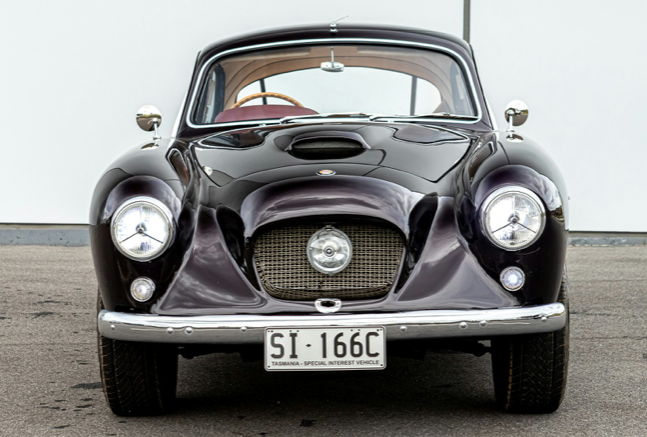
Images below are of a for-sale Bristol 405 located in Tasmania.

Gallery

Previous Bristols featured the prewar BMW grille theme.  The grille we see here is hard to explain.  The opening is nondescript, the grille mesh is recessed a couple inches.  I suppose this could be rated as "distinctive."  But not in a positive sense.

Frontal sheet metal sculpting features complex shapes that do not relate well to one another.  The grille opening was slightly widened on the redesigned Bristol 406, and minor brightwork added on the 407.  It wasn't until the entry of the Bristol 408 in 1963 that a more conventional Bristol grille appeared.

The passenger compartment greenhouse is a rounded fastback with large windows.  This contrasts somewhat uneasily with the long, rather flat hood line.  Note how narrow the front door is compared to the back-seat door.  A three-inch (73.5 mm) rearward adjustment to the B-pillar might have improved the appearance.

Those small, odd tail fins preview a somewhat similar touch found on Bristols 406 to 410 (1957-1969).  For some reason, I rather like the fastback zone (apart from those fins).  Especially that large, three-piece backlight window.

Monday, September 16, 2024

First Bristol - the 400

Before the classic Bristol 401 design whose development I wrote about here, there was the 1946-1950 Bristol 400.

As the link explains, when World War 2 ended, the Bristol Aeroplane Company decided to add automobiles to its product portfolio.  To expedite the development program, Bristol bought the small, BMW-oriented English carmaker Frazer-Nash in 1946, also acquiring data on the prewar BMW 328 motor from Eisenach in a war reparations deal.  The result of this complexity was that Bristol used its version of the 328 sports/racing motor for its new car line.

The chassis of the new Bristol was derived from the frame of the BMW 326 sedan, though its body was a coupé more in line with the BMW 327, the coupé variant of the 326.  I wrote about those designs here.

As background, here are relevant wheelbase numbers: The BMW 327 coupé's was 108 inches (2750 mm); the BMW 326 sedan's was 113 inches (2870 mm); and the Bristol 400's was 114 inches (2793 mm).

The Gallery below includes an image of a BMW 327 for reference, even though the Bristol design is not credited as being related.  Bristol 400 images below are from Iconic Auctioneers.  The photo of the BMW is of a car listed for sale.

Gallery

1938c. BMW 327 Coupé
The nearest-related BMW design to the Bristol 400.

1948 Bristol 400 Coupé
A bit contrary to what I noted above, there are indeed some superficial resemblances to the BMW 327 -- though  most cars from the same general era share thematic features.  That said, note the overall profiles, the hood cutlines and the door arrangement.  Passenger compartment greenhouses are similar aside from the B-pillars and related quarter windows.  They share the same turn-indicator wand position abaft of the pillar.  The six-inch (147 mm) wheelbase difference seems to be found forward of the rear fender.

Frazer-Nash style, the Bristol features a BMW-type grille.

The rear is rather dumpy-looking.

Just for fun, here's an all-open view.

The dashboard seems very basic for a high-price car.

Thursday, December 8, 2022

Bristol 401 Origin and Walkaround

This post contains speculations regarding the design of the Bristol 401 coupé.  Bristol automobile history mavens are encouraged to correct me in comments if I got things wrong.

In 2013 I briefly wrote about Bristol's sporty 401-403 models.  Since then, more information and photos have appeared on the Internet, so I figure it's time for an update.

The Wikipedia entry for the 401 is here.  Christie's auctioneers had a protoype 401 by Touring Superleggera up for bid and wrote:

"It is a result of the collaboration between the Bristol Aeroplane Co. and Carrozzeria Touring of Milan.  Constructed and designed in Italy, the bodies benefitted from the considerable experience for which the Italian coach building company was renowned.  The engine was built by Bristol to an original BMW design, the licence for this having been obtained in the form of compensation for war damage.  This particular car was built by Touring for the Bristol factory as a prototype and was expected to compete in the 1948 Mille Miglia but was unfortunately not finished in time.  The car was however displayed on the Touring stand at the Geneva Motorshow of 1949.  Bristol had invested a great deal of time and money in this project, matching Touring's light weight "Superleggera" concept with Bristol's own experience in aerodynamics.  Unfortunately the original idea of commissioning Touring to build 200 cars fell through in the end."

It seems that a badly deteriorated Touring 401 was found on a French farm, and its body was recreated by Touring, as mentioned here.

From this point, it seems best to move to the Gallery and discuss images, rather than rely purely on wordage.  Walkaround views are via Gallery Aaldering, a Dutch firm, the subject 1951 Bristol 401 having left-side steering.

Gallery

According to a long-lost Web source, this was supposed to be a 1938 Lancia Aprilia by Touring.  Actually, it was displayed at the 1947 Paris auto show and appears to be the original version of the Bristol 401 body design.

This is the 1947 Touring prototype of the Bristol 401.  It is almost the same as the Lancia in the previous image.  Its grille is the two-nostril BMW style used by Bristol.  The beltline drops closer to the top of the rear fender than on the Lancia and closer than other 401s.  Note the smooth sides of the fenders, something different from other Touring Bristol prototypes.  The front fenderline is more curved than production versions.

Front view of the 1947 prototype, posed with Touring's boss Felice Bianchi Anderloni.  Note the BMW-like grille even at this early stage.

I don't have a source for this photo.  The car's body is by Touring, so it's probably a prototype or possibly an early custom 401.

This is the 401 with the recreated body Touring built.  These cars featured sculpted ridges aft of the wheel openings.

Now for walkaround views of a 1951 production Bristol 401.

The front fenderline is straighter than on the cars in the previous images.

Vision to the rear was limited.

Trunk space was also restricted thanks to the tapered passenger compartment greenhouse.

The greenhouse is tall and the windows are large, a fashion more of the 1960s and 70s than the early 1950s.

Most of the busy detailing is at the front, making a nice contrast with the rest of the car.  All told, a pleasing design.

Monday, December 2, 2013

Bristol 401 to 403: Postwar Streamlining

I have a soft spot for late-1940s streamlined sports cars such as the Fiat 8V that I wrote about here.  Another is the (to me) classic Bristol -- the 401, 402 and 403 series, built 1948-1955.  The Wikipedia entry on the 401/402 is here, and that for the 403 here.

The first link suggests that the Bristol's styling was inspired by the work of the Italian coachbuilder Touring, and might have meant the car pictured below.

There is only this photo being turned up by a Google search, and several sources identify the car as a 1938 "Lancia Aprilia Touring," where it is not clear from the Web sites whether the word "Touring" refers to the carrozzeria or just to a type of car, though the former interpretation is more likely.  Regardless, the Bristols shown below bear a strong resemblance to this Lancia, and it's quite possible that Touring had a hand in their design.
Gallery

Here is what seems to be a factory publicity photo of a Bristol 403.

These are photos I found on the Web with other views of the design.

My main criticism is that the side windows are slightly too large.  Raising the belt line at the bottom of the windows an inch (about 2cm) or so might work.  Otherwise, I would lower the top about twice as much, if possible.  Another change that I think would improve the design would be to have the front fender fade fall off more to the rear rather than being largely horizontal.

These so-called defects are most apparent in the side view photo.  From other angles, the car looks good.

Monday, October 28, 2013

Arnolt-Bristol by Bertone

Stanley H. Arnolt (for some reason known as "Wacky") had enough spare money that he created an automobile company that had several hundred cars built during the 1950s.  Nearly all had British based mechanical parts and bodies crafted by Bertone, an Italian coachbuilding firm.  Arnolt's first such effort was based on the MG TD sports car and the next made use of the Bristol. The Wikipedia entry on Arnolt deals with the history of his automobile efforts.

Both cars were nicely styled, but I think the Arnolt-Bristol (built 1953-1959) was the more exciting of the two. One source describing it and presenting some nice photos is here. Another account dealing with the Arnolt-Bristol can be linked here.

Below are some good photos of an Arnolt-Bristol that I found on this site.

Gallery

Here is an introductory view.  Note that this car has no bumpers.  (Some had tiny bumpers that made them street-legal, but offered no serious collision protection.)

Here is how the car is seen from normal eye-level.  One of the sources linked above mentions that the hood and cowl were high due to the dimensions of the engine and its placement on the chassis.  It went on to state that Bertone helped camouflage the bulge by raising the fenders higher than they otherwise needed to be.  The result, in my fairly humble opinion, was a distinctive design that oozes sex, speed and a certain amount of power.  I loved it the first time I saw a photo of it.

A side view.  From this position the car's height and ground clearance are obvious.  It still looks good, but not so sensational.

Seen from towards the rear, the upwards body bulge and high fenders come into play again.  Not quite as nice as the front views above, but in the early 1950s stylists tended to pay less attention to a car's tail.