Showing posts with label Hornet. Show all posts

Monday, March 10, 2025

AMC's 1970-1983 Hornet/Concord

Nowadays, some American automobile brands market the same car body for many years.  An example is the Chrysler 300 introduced for the 2005 model year, and still in production (to the best of my knowledge) as I write this (April, 2024).  That's 20 model years with only one major facelift.

Back in the 1970s and earlier, major manufacturers usually redesigned cars every three or four model years, sometimes even more often.  Some exceptions were Hudson (1936-1947 with three years off due to the war) and Ford (1952-1956 with a major facelift for 1955).

American Motors Corporation was much smaller than the likes of General Motors and Ford, so could not afford frequent redesigns.  And in the 1970s with its 1975-1980 Pacer that did not sell well after its introductory year, the corporation lost money and was purchased by Renault and, later, by Chrysler.

What this boils down to is that AMC's new for 1970 Hornet was facelifted and rebranded for 1978 as the Concord.  These cars were produced for 14 model years: 1970-1983.

I wrote about the Hornet here.  Today's post shows examples of two-door and four-door Hornet/Concord sedans (though the 2-door version looked like a coupe in many cases, and is ofter referred to as such).

Unless noted, images below are car-for-sale photos.

Gallery

1970 AMC Hornet 4-door sedan
The original Hornet was a clean, attractive design.  Not exciting.  So it probably had little of the "Must buy" factor that can be important for sales.

1977 AMC Hornet 4-door sedan
The final version before the re-branding.  The grille area had been facelifted, and this car sports the then-fashionable vinyl-clad passenger compartment roof.  Note the large bumper mandated by the government.
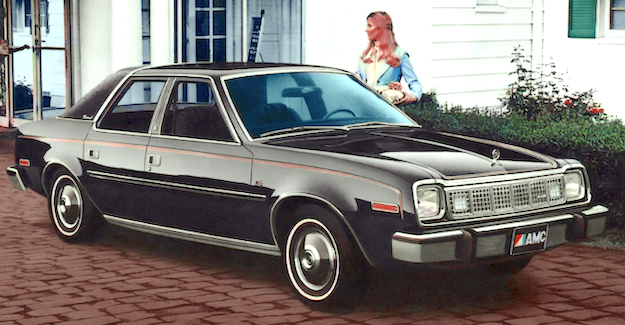
1978 AMC Concord 4-door sedan - factory photo
First-year Concord.  The forward-leaning front seen in 1970 now leads slightly backwards.  The grille is positioned so as to overlap that large bumper, reducing its visual impact.

1980 Concord 4-door sedan - BaT Auctons photo
A less-dressy Concord two years later.  A new grille flanked by rectangular quart headlights -- retrograde, in my opinion.

1983 AMC Concord 4-door sedan - via Hemmings
A final-year Concord.  Now the passenger compartment greenhouse is six-window, not four-window.  Note that the body rides higher off the ground, probably due to compatibility with AMC's 1980-1987 four-wheel-drive Concord-based Eagle.  The grille is little-changed from 1980.

1970 AMC Hornet 2-door sedan
Now for two-door sedans.  Again, the basic original body with entry-level lack of trim.

1977 AMC Hornet 2-door sedan
A final-year Hornet, also lacking ornamentation.

1978 AMC Concord 2-door sedan - BaT Auctions
The Concord version received a padded vinyl top that encroached on the after windows, creating the fashionable opera-window appearance.

1981 AMC Concord 2-door sedan
This rides high, Eagle-fashion.

1982 AMC Concord 2-door sedan
Model year 1982 was the final one for 2-door Concord sedans,  The car seen here has two-tone paint, along with the vinyl.  A far cry from the simple Hornets shown above.

Monday, June 8, 2020

Examples of Chopped-Off Style

I can think of only one example of an American car having its aft end drastically shortened in order to create a new model or new brand.  That was the American Motors Corporation (AMC) Gremlin derived from the AMC Hornet.

A slightly similar example is the General Motors "Aeroback" style found on some 1978 Buick and Oldsmobile models.  Some background regarding these poor-selling cars is here.

Aerobacks were created by putting an angular fastback on what was basically a bustleback design.  Due to the shaping details, the visual effect was that of a chopped-off rear end on four-door versions (but less so for coupés).

Gallery

A 1970 AMC Hornet 2-door, the basis for the Gremlin.

High rear quarter view of a 1971 Gremlin.

Side view of a 1972 2-door Hornet.

Side view of a 1971 Gremlin.  Gremlins were the same as Hornets forward of the B-pillars, though the aft door cuts differ slightly.  The Gremlin's wheelbase is one English foot (305 mm) shorter than the Hornet's.

Shown here are two 1978 Buick Century Custom 4-door sedans, providing a sense of Aeroback styling.


Two views of a for-sale 1978 Oldsmobile Cutlass Salon 4-door sedan.  The "chopped-off" appearance is due to the main plane of the fastback bending at the level of the side character line that is well below the car's beltline.  This visual continuity feature is normally good styling practice.  But here it fails because it makes the upper fastback plane too large and essentially too flat-looking -- what seemed to many viewers (including me) to be a chopping off of what might have been a longer body.

Here is a 1978 Oldsmobile Cutlass 442 that was listed for sale.  In this 2-door instance, the chopped-off effect is less obvious.  This suggests that the side windows and pillars of the 4-door sedan contribute to the effect.

Finally, a 1978 Pontiac Grand Am 4-door sedan showing the bustleback version of the body from which Aerobacks were derived.