Showing posts with label Talbot. Show all posts

Thursday, June 29, 2023

Saoutchik's Streamlined Dalahaye and Talbot Compared

Early in 2022 I wrote about coachbuilder Saoutchik's Delahaye 175 Coupe de Ville of 1949.  It was fairly typical of the wild designs Saoutchik was making in those days.  That said, it had a passenger compartment with an uncluttered fastback that was in the same spirit as 1940s General Motors fastbacks.  I regard it as one of Saoutchik's better post- World War 2 designs

Recently, I came across a Saoutchik design that was similar, yet much better.  It was for a 1950 Talbot Lago T26 Record Grand Sport Coupé.  As was the case for the Delahaye, I don't know how many such bodies were built.  Based on photos found on Internet searches, there seem to have been at least two survivors, and possibly more were made.

The Dalahaye is longer, having a 116.1-inch (2950 mm) wheelbase, whereas that of the Talbot is 104.3 iinches (2650 mm), as the Wikipedia links above state.

Images of the Delahaye are from Barrett-Jackson auctioneers, and most or all of the Talbot are via RM Sotheby's.

Gallery

Frontal design of the Delahaye 175 is largely standard Delahaye, aside from the flamboyant fender work by Saoutchik.

The upper grille frame outline is Talbot, but the rest of the design is by Saoutchik.

Interesting side styling.  The chrome strip extending from the side of the hood to below he beltline to the top of the rear fender does all this in one sweep.  This ties the otherwise somewhat fragmented design together.  The rear fender bulge and the fadeaway front fender reduce visual bulk on what otherwise would have been a slab-sided 1949 design.  That front fender side sculpting and its different paint color assist in this.

Note the narrower door and shorter passenger compartment.  The fenderline is more "modern" than that of the Delahaye.  It's higher, but has subtle shaping below the beltline.

The rear styling is clean and well-shaped aside from the heavy fender chrome.

This Talbot is remarkably brightwork-free for a Saoutchik design, though note the strip tailing abaft of the door, extending along the trunk lid.  At least it's narrow.

Now for two additional Talbot images.  This is a well-styled design in the context of 1950 and in the context of Saoutchik's normal flamboyance.  

This example looks good in part because it lacks bumpers.  What effect might they have?

Here's a photo of another Saoutchik Talbot, this via Bonhams.  It has bumpers, but they don't degrade the design much.

Thursday, July 11, 2019

What Were They Thinking?: Spatted Front Wheels

Applying aerodynamic streamlining to automobiles, either symbolically or in reality, didn't seriously begin until the early 1930s and intensified over the decade.

In streamlining theory, a car's shape should be as smooth and integrated as possible.  Therefore, should not wheel wells be covered either with removable spats or seamlessly?  Nowadays, most cars and SUVs have exposed wheels even though their body designs were tested in wind tunnels.  Why is that?  Perhaps the trade-off between accessibility and aerodynamics favors the former.

In the 1930s and 1940s rear wheels often were either spatted or had shorter wheel well openings. The practical problem here has to do with gaining access to the tire for repairing a flat or chaining up for snow driving.  A small wheel well opening offers less room to work, and if spats are installed, then they might have to be removed to allow any work to be done.

Few cars had covered or spatted front wheel openings.  The most common examples of covered (but not spatted) front wheels were 1949-1956 Nashes and 1950-54 Nash Ramblers.  Spatted front fenders were mostly found on French custom car bodies such as shown below.  Beside accessibility difficulty, covered front wheels have the further problem of restricting a car's turning radius.  The Nashes just cited were typical American cars of their era in that wheels were mounted several inches inbound from the sides of the car body.  In recent decades, American (and essentially all other) cars have wheels at almost body-width, one reason why they are fully exposed.  The European cars shown below also were narrow-track, and turning radius was helped a little further by bulging out the front fenders and their spats sometimes even more so.

Gallery

1929 Travel Air "Mystery Ship"
Teardrop-shaped spatted wheels on fixed (non-retracting) airplane landing gear began to appear on racing planes such as this at the end of the 1920s.  I suspect these forms inspired car stylists a few years later.

1932 Delage D8S Roadster by Letourneur et Marchand, ex-Reneé Friederich racer - via Coachbuild
An early example of teardrop-shaped front fenders.  Spatting will come later.

1935 Mercedes-Benz 500K Roadster by Erdmann & Rossi for the King of Iraq
Unlike the Figoni & Falaschi designs shown below, this car's front fender sides are not bulged outwards.  So in order to achieve a reasonable turning radius, it's possible the the entire body was widened so as to keep the axle width relatively narrow.  (I cannot locate the source of this photo.)

1936 Delahaye 135 M Roadster by Figoni & Falaschi for the Aga Kahn
Figoni & Falachi was the coachbuilder that seems to have made the most cars with spatted front wheels.  This is an early example, as best as I can tell from a serious web search.

1937 Talbot-Lago 150-C SS by Figoni & Falaschi - RM Sotheby's via Car and Driver
Their next step was to connect the fenders.

1937 Delahaye 135 MS Roadster by Figoni & Falaschi - DB Pittenger photo at Revs Institute
Here the connection uses a small running board.  Note how the front fender is ballooned out.

1939 Delage D6-70 by Figoni & Falaschi, Tito Rossi at the wheel
A Delage D8 version of this design (with more elaborate chromed trim) was famously displayed at the 1939-1940 New York World's Fair, but without a complete motor.

1948 Delahaye 135 M "Narval" Cabriolet by Figoni & Falaschi
The first of the seven or so Narvals appeared in 1946.  They sell for outrageous prices at auctions.

1946 Fiat 1500? by Ghia?
I can't confirm the information in the title, but it seems okay.

1948 Alfa Romeo 6C 2500 Sport Cabriolet by Ghia
The spats make this design seem more ponderous and Buick-like than one would expect from Ghia.

1950 Nash Rambler Convertible
Nash-Kelvinator president George Mason had covered front wheels on 1949 Nash cars, and the new Rambler line got them the following year.

Monday, May 2, 2016

Styling Variety: 1930s French Cars

During the 1930s General Motors' styling boss Harley Earl would travel to Paris to visit the annual Salon de l'Automobile.  It was a serious focus to what might seem to some a frivolous enjoy-Paris corporate junket.  That was  because fashion-conscious France was a hotbed of car styling ideas that Earl wanted and needed to be aware of.

And there were many automobile makers in France, even in the depth of the Great Depression.  For example, the mid-decade 1935 Paris salon had 27 firms exhibiting passenger cars.  Those 27 firms produced only about 170,000 cars that year, and 3/4 of those were from the "big three" -- Renault, Citroën, and Peugeot.  The remaining manufacturers averaged about 1,550 cars that year, which makes me wonder how they could afford to keep body designs even halfway fashionable.  The largest firm, Renault, produced around 58,000 cars that year, yet marketed ten lines of cars using what seems to be three basic bodies -- which also seems like a small basis for product renewal.

Regardless, French car styling from the 1930s was innovative and varied.  Admittedly, this was especially the so for custom-built bodies, but also was the case for factory models.  The images below are mostly of standard production cars.

Gallery

Bucciali Double-Huit - body by Saoutchik - Paris Salon 1931
This car was intended to astonish, something it still does 85 years later.  It has a underslung chassis, so it sits low.  The low stance is further emphasized by the large wheels and extremely long hood.  Not to mention the low-headroom passenger compartment.

Voisin C 20 - Paris Salon 1931
Many of Gabriel Voisin's designs also astonish.  His C 20 and C 22 models feature radically disaggregated components.

Voisin Aérodyne - Paris Salon 1934
This is a pre-production car, but essentially the same as the few that were built.  Here Voisin edges towards aerodynamic shaping on his way to the 1936 Aérosport.

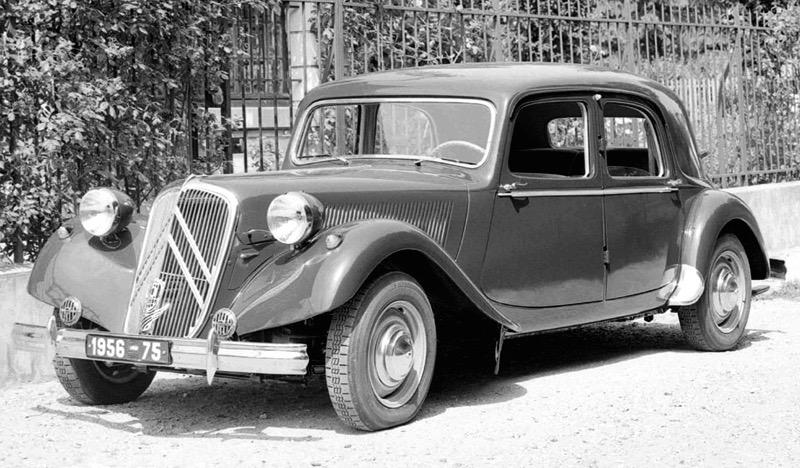
Citroën Traction Avant - 1956
The Traction Avant line was introduced for 1934, and its design was virtually unchanged even by 1956, the year before it was replaced.  The body is low because it lacks a driveshaft and also a chassis, being of semi-unitized construction.  One French styling fashion in the late 30s was the belt line drooping towards the rear, as can be seen here.

1935 Renault Nervastella Grand Sport
Unlike the Citroën, this top-of-the-line Renault is tall.  And it also has a somewhat streamlined appearance that's negated by the formidable grille-hood combination.  Note especially the the highly-sloped, V'd windshield: advanced for 1935.

Peugeot 402 - ca. 1939
The 402 first appeared for the 1936 model year and, like the Renault above, featured a streamlined look.  The body aft of the cowling seems inspired by the 1934 Chrysler Airflow.  For me, the most intriguing feature is the headlamps buried behind the grille.

1937 Hotchkiss 686 Coupé Modane
By the mid-1930s Hotchkiss' were solid looking cars.  Attractive, slightly conservative styling for its bourgeoise clientele.  I am especially fond of the grille design that relates well to the fenders.

1937 Panhard Dynamic
The ancient firm Panhard et Lavassor developed styling senility in the early 30s with its Panoramique three-piece windshield design that progressed to the strange Dynamic model shown here with its central driving position.  "Creativity" does not necessarily produce good results.

Talbot-Lago T 155 SS by Figoni & Falaschi - ca. 1938
Finally a fabulous "Goute d'eau" (teardrop) Talbot-Lago custom that's marred by having spats over the front wheels.  Most similar Talbots had exposed front wheels.