Showing posts with label Pegaso. Show all posts

Thursday, June 23, 2022

Pegaso Z-103 with Panoramic Windshields

The mid-1950s fad of panoramic or wraparound windshields was of General Motors origin, but such windshields soon appeared in Europe as well.

GM's first production wraparounds appeared on low-volume 1953 Oldsmobile and Cadillac convertibles whose basic bodies had been in production for several years.  For 1954, GM's Oldsmobiles, Buicks and Cadillacs received new bodies where wraparounds were a design feature.  Model year 1955 saw other American carmakers incorporating panoramics.  Ford, Mercury, Nash, Hudson and Packard grafted such windshields onto older body designs. 

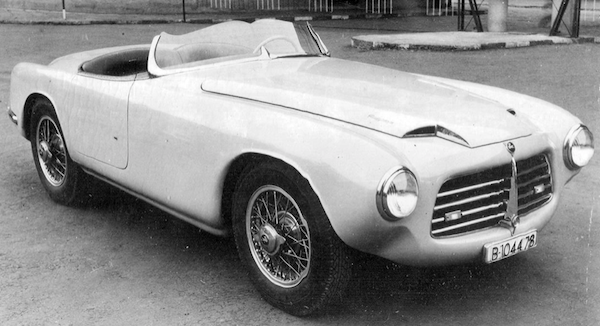
Spain's Pegaso Z-102, a low-production sports car,  retained conventional windshields over its existence.   But the company's Z-103 variant had panoramic windshields.

The Z-103 seems to have been an attempt to market a car with a less-complicated motor.  According to the link above, only perhaps three cars were made.  However, there is uncertainty decades after the reality.

Gallery

1954 Pegaso Z-102 Berlinetta by Touring - for sale photo
Only about 80 Pegaso cars were ever made -- sources vary.  Probably the most common bodies were by Touring, as seen here.

1955 Pegaso Z-103 Coupe by Touring - unknown photo source
When given the task of clothing the Z-103, this was Touring's first try.  The fenderline is similar to their Z-102 design, but the cabin greenhouse has a panoramic windshield.

1955 Pegaso Z-103 Coupe by Touring - unknown photo source
This is probably the same car as in the previous image after a restoration.  Its top is a two-window, not a four-window style and is rather squared-off.

1956 Pegaso Z-103 Panorámica by Touring - unknown photo source
If Internet sources can be believed, the following year Touring created this body that is more in line with their Z-102s.

Differences include the front fender vents, a smoother hood and real bumpers.

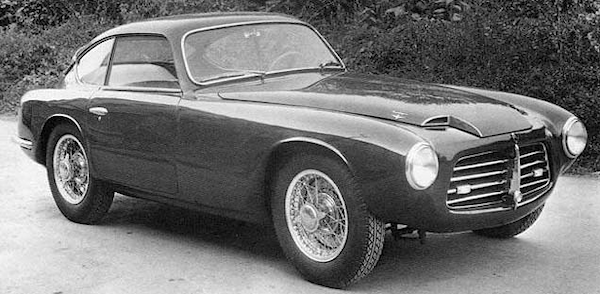
The aft end also differs from Z-102s, but only in some superficial details -- the basic body panels are the same.  What also is similar is the passenger compartment greenhouse, aside from the windshield.  Compare the window and backlight design to that in the following image.

1954 Pegaso Z-102 Berlinetta by Touring

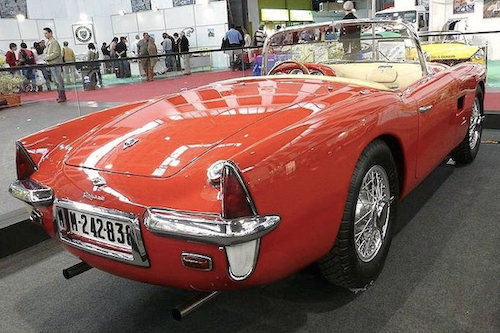
1955 Pegaso Z-103 Spider by Serra - unknown photo source
Barcelona coach builder Serra also made a body for the Z-103.  It's a spider or roadster type with the panoramic windshield.  Like most Pegasos, it lacks a front bumper.

Monday, May 30, 2022

Some Coachbuilder Bodies for Pegaso

Spain's 80 or so Pegaso sports cars built 1951-1958 were mostly clad by coachbuiling firms, as mentioned in Pegaso's Wikipedia entry.  Early Pegasos were given factory bodies.

Those coachbuilt bodies were mostly furnished by Touring in Italy and Saoutchik in France.  A few were by Serra of Pegaso's home town, Barcelona.

Touring and Serra bodies stayed close to basic styles of each firm, whereas Saoutchik bodies were more varied.

Gallery

1952 Pegaso Z-102 Spider "Tibidabo" by Touring
Early on, Touring established its theme of chopped out hood segments.  The same was applied on rear ends of coupes.  Note the lack of a front bumper.  This was fairly typical of Pegasos, though some had sketchy bumper segments up front.

1953 Pegaso Z-102 "Thrill" showcar by Touring
The front end is typical Touring-Pegaso, but the rest is showcar jazz.  Some later American Motors designs had a similar feeling.

1954 Pegaso Z-102 Berlinetta by Touring - RM Sotheby's auction photo
This is a typical Touring body.

1954 Pegaso Z-102 Berlinetta by Touring - unknown photo source
The greenhouse is high, the hood long: another fine Touring design.

Another Sotheby's photo.  Note the chopped-out bits at the rear.  The window design is logical, but the chrome links aren't really needed.

1952 Pegaso Z-102 Berlinetta by Soutchik
Saoutchik made a few coupés and cabriolets with this fender design.  Unusually, there is a substantial front bumper that some later Saoutchik Pegasos lacked.

1954 Pegaso Z-102 Berlinetta by Saoutchik - auction photos
This seems to be a more common Saoutchik design for Pegaso.  Note the nearly invisible bumper.

The fenderline is thrusting and the greenhouse is small.

A more squared-off trunk lid blended with the fenders might have been more practical and better looking.

1954 Pegaso Z102 Cabriolet by Saoutchik - RM Sotheby's photos
The lower body design is the same as that of the car in the previous images.

Rear bumpers offer no serious protection.  This car should never be parked on a Paris street.

1955 Pegaso Z-103 Spider by Serra - unknown source
A nice, clean design.  Unlike most Pegasos, this car and the one below had panoramic (wraparound) windshields: very mid-1950s.

1956 Pegaso Z-102 Spider by Serra - unknown source 
This car has a fairly serious rear bumper.  I like this rear design better than Saoutchhik's.  It's bold, but logical.  Note the vent on the front fender that's absent in the car in the previous photo.

Monday, March 7, 2022

Want to Look Sporty? Chop the Greenhouse

"Greenhouse" is a styling term referring to the part of a car's passenger compartment above the beltline where the windshield and other windows are.

Typically, the greenhouse is fairly tall, comprising more than a third of total body height.  This sort of proportion tends to work against any "sportiness" that stylists might wish to impart to a design.

An alternative is to reduce that proportion.  The price paid might be cramped headroom for passengers and reduced outside visibility for the driver.

Below are examples to serve as food for your thoughts.

Gallery


1953 Pegaso Z 102 Berinetta by Touring
This is an example of an expensive sporting car by a major Italian coachbuilder.  Its tall greenhouse proportions are fairly typical of Italian 1950s golden age styling.

1963 Chevrolet Corvette Sting Ray
General Motors' sports car also had a comparatively tall greenhouse.

1967 Chevrolet Camaro RS Z28 - Mecum Auction photo
So did the later sporty Camaro.

1931 Voisin C22
Now for examples of short greenhouses.  This Voisin had an underslung chassis and low lower body.  Its greenhouse proportion is low, adding to the racy appearance.

1935 Voisin C28 Aérosport - RM Sotheby's photo
This later Voisin features a more normal lower body height, but the short greenhouse imparts sportiness.

1952 Ferrari 340 Mexico by Vignale
Unlike the Pegaso, this Italian body has a low greenhouse.  Perhaps that's because it's an actual race car.

1952 Hudson Hornet
The famous-in-their-day "step down" Hudson sedans had racy looks due to shaping as well as greenhouse proportions.

2005 Chrysler 300C
Lower bodies were rather brick-shaped, but the low greenhouse counteracted that impression.  I owned one, and can assure you that the windshield was too low for easily viewing close-by stoplights.

2016 Chevrolet Camaro Convertible
I was in Hawaii recently (early 2022) and was struck by the racy, sporty look of the plentiful Mustang and Camaro rental convertibles I saw.  Blunt lower bodies are common nowadays thanks to rules by European bureaucrats.  But the extreme windshield rake and very short greenhouse oddly combine to enhance an aggressive, sporty appearance.

2016 Chevrolet Camaro Coupe
The same can be said for the fixed-top version.

Thursday, March 3, 2022

Somewhat Separated Twins - Pegaso Thrill and AMC AMX

The cars featured below do not resemble each other closely, so "separated twins" might seem like an exaggeration.  Yet they do share some noteworthy characteristics.

These cars are the 1953 Pegaso Z-102 "Thrill" show car (some background here), and the 1968-1970 American Motors AMX (Wikipedia entry here).

Each retained the front half of a larger-production run automobile.  Each had a restyled aft half.  The Pegaso was built by the Italian carozzerria Touring, which based the frontal design on its low-production bodies supplied to Pegaso.  The AMX used the front half of American Motors' Javelin "pony car," but had a chopped-down, restyled rear.

Let's take a look.

Gallery

1953 Pegaso Z-102 Berlinetta by Touring
Most Pegasos with Touring-supplied bodies looked like this.

1953 Pegaso Z-102 Thrill showcar by Touring
The front half of the berlinetta design is retained on the "Thrill," though the grille bar arrangement differs.

Here we see the revised aft in near-profile.

And in three-quarter perspective.

1968 American Motors Javelin
This was the basis for the smaller AMX.  The designs are the same forward of the after cutline of the door, though grille details differ.

1968 American Motors AMX - Mecum Auction photo
The AMX grille lacks the Javelin's center divider.

Same car, right side.  The aft part has proportionally more C-pillar sheet metal and looks heavier than the Javelin.  The same could be said with regard to the Thrill -- compare to the similar pose above.

1968 American Motors AMX - Barrett-Jackson Auction photo
Not like the Thrill's rear window, but the sail panels here and the Thrill's fin-like rear fenders create a similar effect.

Thursday, January 20, 2022

Pegasos with Factory-Built Bodies

I wrote about an astonishing Pegaso design here and here.  For me, that  Berlina Cúpolo is what I think about when Pegaso comes to mind.

But there was only two of those built.  What of the other 80 or so Pegasos?  The present post presents two early cars with factory-built, rather than custom-built bodies.

Gallery

1952 Pegaso Z-102 2.5 Berlineta Cúpula - ENASA Body - unknown image source
ENASA (Empresa Nacional de Autocamiones S.A.) was a Barcelona based builder of trucks (and a few Pegaso automobiles).  This, perhaps the most famous Pegaso, is clad with a body made at the factory.  It seems that two were made, and one survives.  Most later Pegasos had bodies built in Italy and France.

1951 Pegaso Z-102 Berlineta prototype - ENASA body - for sale photo
Styled in the spirit of contemporary Italian custom designs, this car established Pegaso's frontal theme.  Wheel openings are extended towards the rear and topped by character lines intended to reduce the visual bulk of slab sides.  The vent on the front fender doesn't relate well to the items just mentioned.  There is no front bumper.

However, there is a minimal rear bumper.  The curved trunk lid and nearby rear fenderline are simple.  An interesting touch is the three-segment wraparound back window.  It's clearly influenced by American designs, but is rather short, cramped, perhaps due to glass forming limitations of the time.

1952 Pegaso Z-102 cabriolet - ENASA body - Bonhams auction photo
This is the open-top version.  Both cars have an odd, tacked-on air intake behind the door cutline.  The front has tiny bumper-guards, but no bumper.

Another type of minimal rear bumper.  Again, a simple, rounded shape.  Fender openings conform more to wheel shape than on the previous car.

1954 Pegaso Z-120 berlinetta by Touring - unknown source
An example of a later, Italian-built body found on many Pegasos.  Touring was doing excellent work in those days.  Yet there is still no front bumper.

Thursday, June 4, 2020

More Pegaso Z-102 Berlina Cúpula Images

As I noted here several years ago, the 1952 Pegaso Z-102 Berlinetta Cúpula is an astonishing, fascinating design.  When it first appeared it was sensational, and it has lost little of that impact nearly 70 years later.  (The Pegaso Wikipedia link is here; scroll down for a snippet about that car).

Its body seems to have been built in a shop in Spain, and not by Italian coachbuilders as was the case for many Z-120s.  The story goes that the design grew out of some suggestions by Spanish students asked to visualize a car of the future.  Even if that was the case, the result strikes me as coming from a professional stylist's hand.  So either one such student was very good or else a professional got involved at some point.

This post contains images of the Berlinetta Cúpula that did not appear in my earlier post.  So far as I can tell, they all are photos taken by individuals in museums or at outdoor car shows.  One image is copyrighted, but I include it because it provides a useful perspective regarding the car's shaping.

Gallery