Showing posts with label Daimler (England). Show all posts

Thursday, November 21, 2024

1932 Daimler Double-Six 40/50 Walter Sport Saloon

Back in 2014 I wrote a popular post titled "Very Long Hoods."  One of the cars shown was a sporty 1931 Daimler V-12 drophead (convertible) coupé.  It seems that there also was a V-12 Daimler with an extremenly long hood that appeared the following year from a different coachbuilder.  That 1932 Daimler Double-Six 40/50 Walter Sport Saloon is today's subject car.  Sources linked below credit the design to H.R. Owen.

Captain Harold Rolfe Owen (1899-1940) was a dealer of luxury automobiles starting in 1932 (Wikipedia entry here) who seems to have had design inluence with coachbuilders such as Gurney Nutting and Walter Martin.  As the links below suggest, the design of today's subject car was either entirely his or, most likely, he provided the concept and details were worked out by coachbuilder staff.

This source states:

"In 1931 Daimler offered a 6.5-litre version of their Double Six 50 known as the Double-Six 40/50.  Our feature car is the very best of these models featuring a Martin Walter Ltd. body designed by H.R. Owens [sic]."

"The imposing proportions of the body were initially penned by H.R. Owens of Gurney Nutting.  He exaggerated an already lengthy hood by fitting an impossibly low windscreen. When combined with oversize wire wheels, the car had massive presence."

"This car was built on chassis number 32382 and is the longest of all the double sixes made.  At 13 feet in length the complex engine could still power the car to 80 mph.  Almost a lesson in over-engineering, the the Double Six used a V12 sleeve valve engine attached to 4-speed Wilson pre-selector transmission."

The Coachbuild website mentions:

"Production of the Daimler Double Six started in 1926 and although the model remained available until 1937, a production figure of as low as 26 is frequently quoted, but other sources mention a figure closer to 75.  All of them were built to meet the special demands of the owners and as a result no two were alike.

"The Double Six in this gallery was commissioned by Herbert Wilcox for his wife and famous film star Anna Neagle.  The car has a very beautiful 'Sport Saloon' body designed by [Captain] H. R. Owen and constructed by Martin Walter [Ltd.].  With a wheelbase of over four metres, it is the largest Double Six ever built."

Some images of this impressive car are from the Gooding auction company, others are from origins presently unknown to me.

Gallery

1931 Daimler Double-Six 50 Drophead Coupe by Corsica
The design of this car surely influenced that of the featured Sport Saloon.  Some background is here.

Now for some photos of the Sport Saloon -- this from a source unknown to me.  Like the drophead coupe is the previous images, this car lacks bumpers so as create a more pure, though less-practical, appearance.

Side view via Gooding auctions.  The hood is extraordinary long, even at a time when Bentleys also featured long hoods.  The motor is located near the center of the hood -- note the access panel's aft cutline, and there is a forward one near the trailing edge of the fender.

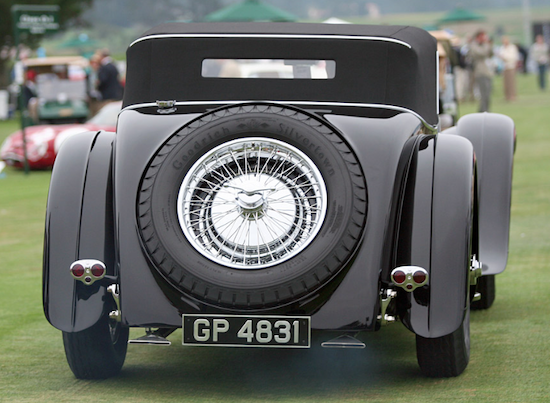
Rear quarter view via Gooding.  The passenger compartment greenhouse is rounded at its rear corners, a departure from the angular style of the 1920s.  Spare tires are mounted at the rear rather than on front fenders.  That mounting would have interfered with engine access.  The fenders are near-cycle type and are similar to those of the Corsica-built drophead coupe shown above.

Unknown source view of the front end.  The Daimler ribbed grille frame is less conspicuous than usual, being offset by the size of the car.  Note how low to the ground the body clearance is.

Another front view, this via Gooding.  Unlike the drophead, the hood is higher than the tops of the fenders.  On the other hand, the passenger compartment greenhouse is low.  Given the long, high hood and small windshield, I wonder what the driver's outside visibility would be like.

Thursday, July 18, 2024

Winston Churchill's 1939 Daimler Drophead Coupé

This post is one of several dealing with English Daimler cars that were sporty, rather than formal Royal Family types.  The subject is a 1939 Daimler DB18 Drophead Coupé, body by Carlton.  The Wikipedia entry for Daimler DB18 is here.

That entry (as of late April 2024) mentions: "In 1939, Winston Churchill commissioned Carlton Carriage Co to build a drophead coupe on a DB18 chassis, chassis No.49531.  He used it during election campaigns in the later 1940s."

That does not seem to be so.  Several other sources state that Churchill never owned the car.  According to this:

"Chassis 49531 – resplendent in Carlton Carriage Company bodywork – was retained by the Daimler company itself until 1950, so that it could be used for special occasions.  These occasions included two separate loans to Winston Churchill, once in 1944 and once in 1949, during which he sat on the rear deck to address the crowds as he was driven through various cities, helped by large speakers temporarily attached to the bonnet."

Setting its provenance aside, it's an attractive car combining traditional British features with "streamlined" details current in Europe in the late 1930s.

Unless noted, images below are via RM Sotheby's auction house.

Gallery

I don't know the sourcce of this news photo of Chrurchill campaigning in the car.

Unlike the competing Rolls-Royce, Daimler's grille ensemble is more rounded, blending -- rather than contrasting -- with the curvy body.  I think contrast can work just as well from a composition viewpoint.  it all depends on how the design is done.

The two-tone paint scheme is somewhat unusual in the it is not based on body sculpting or chrome outlining aside from abaft of the rear wheel.  I suppose some design purists might complain that its use here is not "functional."  I think it's effective.  An interesting touch is the chrome sculpting across the upper part of the door.

Speaking of contrasts, the hood is tall and straight, whereas the aft is rounded downwards.  The paint scheme and chrome strip add to the sense of falling away from the car's frontal section.

Rear quarter view showing the top raised.  Note the unusual design of the rear wheel spat combining circularity with echoing of the rear fender's upper profile.  As noted, here is where the two-tone paint relates to body detail shaping.

Side view with top raised.  The wheelbase is on the short side for a Daimler, being 114 inches (2900 mm).  This results in a fairly short hood.

Interior view via the Daily Mail.

Monday, April 29, 2024

1931 Daimler Double-Six 50 Drophead Coupe by Corsica

This post, "Very Long Hoods," is one of the most popular on this blog.  Among the cars pictured is the unique 1931 Daimler Double-Six 50 Drophead Coupe, body by Corsica -- the subject of today's post.

Corsica Coachworks (Wikipedia entry here) is interesting because it had no formal in-house design staff.  Instead, clients presented their wishes, and these were either refined by Corsica staff or else formalized by outside consultants.  I have found no claim regarding who actually designed today's featured car.

Some background can be found here, including: "Apart from its glorious body and impressive engine, this Daimler sits on one of the few chassis modified at Thompson & Taylor by Reed Railton to achieve an underslung chassis of the lowest possible height.  So much so, the fenders which surround the oversize 23 inch wheels nearly reach above the hood line."

Also: "The Double Six is named after a taxable RAC rating of 50 hp, but the modern rating is somewhere between 130-150 bhp.  Less then 10 cars were ordered with the Double Six 50 engine."

Its long wheelbase might be 142.5 inches (3620 mm), according to this confusing link (What cars are they actually discussing?).

Regardless, that V-12 convertible coupe was an astonishing design, vastly different from a common perception of Daimlers being tall, awkward limousines owned by members of the Royal Family.

Images of the subject car on the Internet are repeated in so many sites that I find it difficult to cite original sources.

Gallery

An earlier photo of the car.  Other photos on the Web show the color as a sort of pale yellow-tan with light brown fenders.  In any case, it wasn't painted black in its youth.  The registration plate looks like it was Photoshopped -- but might not be.

As seen at the 2006 Concours d'Élégance at Pebble Beach where it was named "Best of Show."

Its hood covers more area than its motor takes up.  Those two vertically oriented handles on the hood's side are near the edges of a folding engine-access panel, indicating the space the engine takes.  Also note the small air intake atop the hood about at the middle of the motor -- probably for carburation.

Note the almost-cycle fenders and abbreviated running board.

No bumpers fore or aft, making for a cleaner, but less-practical design.

I think this photo showing the raised top is by Pavel Novitski.

The hood takes up about half the body length abaft of the grille.  Note the tidy top.

Frontal view showing those large wheels/tires and high fenders compared to the height of the hood.

Thursday, October 26, 2023

Daimler DS420 Limousine

Daimler DS420 - factory photo

When I first saw a photo similar to the one above, I was tempted to make this a "What Were They Thinking?" post.

On reflection, I'm still tempted, but decided not to pull that trigger.  That's because the Daimler DS420 Limousine came from an aristocratic English brand that continued its heritage of supplying cars to British and other royalty, governments, and various upper-crust species.  So the DS420 makes sense in those contexts, even though it's not an attractive automobile.

DS420s were marketed 1968-1992, and 4,141 limousines and 903 chassis (for later attachment of custom bodies) were made, a total of 5,044, or a bit more than 200 cars per year, on average.

They were large, having a wheelbase of 141.0 inches (3581 mm).  And luxurious, as some images below will show.

The DS420 was launched after Daimler was purchased by Jaguar (some background on the Daimler Motors firm is here).  Some Jaguar components were used, but its body design was unique, unlike Daimlers that usually were little more than Jaguars with Daimler grilles.  So to some extent, the DS420 has been considered the last of the real Daimlers.

Gallery

1990 Daimler DS420 - car-for-sale photos
An interesting overhead view featuring the tapered hood and Daimler grille.

From this angle we see that the DS420's rear is an elongated English "Razor Edge" design.  Classical versions were shorter, more upright.  Also note the subtle two-toning on this car.

1985 Daimler DS420 Limousine - photos via Park Ward Motors (Australia)
Now for a walkaround.  Again, the traditional Daimler grille with its fluting on the upper frame.

Each end of the car has its interesting features, but the long middle section is quite bland aside from the chrome window framing.

The fenderline and beltline fall off towards the rear, a British styling feature from years past, but out of date even for England in the late 1960s.

I think this is the most interesting aspect of the design.  Note the concave side sculpting contrasted by the convex trunk shape.

A plain rear end, but the upper license plate frame carries over the grille motif, a cute touch.

The trunk seems fairly small, though perhaps the size of the rest of the car makes that seem so.  On the other hand, how much trunk space do luxury limousines require?

The passenger compartment greenhouse is quite tall compared to the lower body, part of a general styling trend in those days.

The headlight frames seem a little droopy.

The cockpit is very nice, very English.  Better than typical historical chauffeur territory.

The passenger zone.  Jump seats are folded next to the chauffeur partition.

Photo via Ascot Limousine Services
View of a tricked-out interior of a DS420 used for special occasion rental.

Thursday, July 1, 2021

John Reinhart's Complaint

John M. Reinhart (1916-1986) led Packard styling 1947-51 and later worked at Ford where he is credited with the design of the 1956 Continental Mk. II.  While at Packard he was responsible for its redesigned 1951 line.

Regarding that design, he has been quoted in the Packard Cormorant (No. 129, Winter 2007, page 30) and elsewhere as stating that the car looked "...bottom heavy.  I wasn't particularly happy with it, but then I hated every design I ever made anyway.  You never get what you really want because you have to compromise; the thing could have been a lot better looking had we the option of altering the glass along with the sheet metal."  It seems he would have liked to lower the main body to provide another 1 1/2 inches (35 mm) of glass, but Packard engineers supposedly wanted to limit the amount of glass for price reasons.

The situation might have been more complex than that.  Packard built luxury cars (along with lower-priced models using the same basic body).  If I had been in charge of Packard marketing or product planning an important consideration would have been the design's "image" as a luxury car.  To a degree, that would trump the aesthetic considerations Reinhart favored.

Therefore, let's examine luxury car design circa-1950 to see where the 1951 Packard fits.

Unless noted, images below are of car listed for sale.  All are of four-door sedans for comparative purposes.

Gallery

1951 Packard Patrician 400 - Bonhams auction photo
Patricians were the top of Packard's line.  Side window height is less than one-half the height of the lower body.

1951 Rolls-Royce Silver Dawn
Silver Dawns had factory bodies and were meant to be owner-driven.  English luxury cars tended to have large-appearing side windows, though these are proportionally only marginally taller than Packard's.

1950 Daimler DE36 Touring Limousine by Freestone & Webb - auction photo
The same can be said for Rolls' rival.

Jaguar Mark VII
This Jaguar, a semi-luxury car, has windows about half the distance from rocker panel to beltline.

1951 Mercedes-Benz 300 W186
Yet again, similar.

1952 Lincoln
The redesigned '52 Lincoln has windows about the same proportion as Packard..

1950 Cadillac Sixty Special
The redesigned for 1950 Caddy's windows are noticeably narrower than Packard's.

1951 Packard 300
Long-wheelbase '51 Packards such as this 300 had three-piece wraparound backlight windows.  These give the car an airy feeling that complements the solid-looking lower body.

1951 Packard 200
But entry-level 1951 Packards had smaller backlights.  As seen here, Reinhart's complaint has some validity.

1951 Kaiser Golden Dragon - RM Sotheby's auction photo
Kaiser's attractive 1951 design has tall side windows, perhaps a bit more height than Reinhart mentioned.  Their ratio to lower body height was about 58 percent as opposed to Packard's 42 and Cadillac's 35.  But Kaiser was not a luxury brand.  In the early 1950s a Packard with Kaiser proportions would not have seemed big, solid, important.  Perhaps not worth spending luxury car dollars for.

Thursday, August 6, 2020

Daimler (England) Ribbed Grille Frames

I have written many times about visual automobile brand identification on this blog, not to mention my e-book "How Cars Faced the Market: Grille Design Continuity."  In general, luxury and other up-market marques tend to maintain identification continuity more than do brands farther down the price/prestige scale.  A common means of doing this involves continuity of grille design themes.  My usual examples of this are Rolls-Royce and Packard.

Another strong example is England's Daimler, a now-dormant luxury brand that for many years was favored by British royalty.  Daimler grilles' distinctive feature was tube-like ribbing across the top part of the grille frame.  Its origin is explained in the link above.

This ornamentation feature is truly distinctive.  Also unattractive, which might explain why no other important brand's stylists bothered to design variations on that theme.  (For example, Ford's Lincoln brand sometimes featured grilles reminiscent of Rolls-Royce's, but never Daimler's.)

Below are images of some Daimlers that illustrate how the grille theme evolved to accommodate changing body designs.

Gallery

1911 Daimler Phaeton - for sale photo
A fairly early example of the Daimler grille ensemble.

1928 Daimler 2 litre saloon - Barrett-Jackson auction photo
Even by the late 1920s the grille area on some Daimlers was the radiator.  However, the two-segment grille (see below) had also appeared on other models.

1935 Daimler Light Fifteen Saloon - Mecum auction photo
Shown here is a grille with nearly all the standard Daimler elements.  A two-segment frame with a central chromed divider, and the rounded-off upper frame element with those ribs.  Yet to come are vertical chromed grille bars.

1939 Daimler DB18 2.5 Litre Sports Saloon - Bonhams auction photo
This grille ensemble works fairly well with the other frontal elements.

1949 Daimler DB18 2.5 Litre Foursome Drophead Coupé by Barker & Co. - Bonhams auction photo
A postwar version of the same model.  From this angle the grille seems more V'd than that of the 1939 car.

1953 Daimler Empress Saloon - Barrett-Jackson auction photo
By the late 1940s Daimler grilles featured stronger grille bars and the ensemble shape was now curved backwards, as seen in this 1953 example.

1960c. Daimler Majestic
A Daimler from around the time Jaguar took over the company.  This is one of the final pure-Daimler designs.  The grille is well-integrated with the rest of the car, yet those ribs are a distraction.

1964 Daimler Majestic Major Saloon - Hyman photo
Later example of the same model providing a better view of the grille.

1984 Daimler Sovereign - for sale photo
Finally, a Daimler based on a Jaguar body.  The grille ensemble is necessarily smaller, shorter and flatter.  But even those ribs atop the frame do little to distinguish this Daimler from contemporary Jaguars.