Showing posts with label Honda. Show all posts

Thursday, January 23, 2025

Sterling: a Car From Rover and Honda

In the early 1980s, Japan's Honda desired to enter the executive/luxury car market, following Toyota's Lexus and Nissan's Infiniti brands.   The brand name selected was Acura.  The car itself was a joint effort with England's Rover Group -- the latter marketing its versions as the 800-series Rover and the Stirling (in North America, but also as a Rover model in the UK at times).

Background on Rover 800s is here, on the Acura Legend model here, and the Sterling here.  All featured a 107.8 inch (2760 mm) wheelbase and basic body structure, though some other details varied.

The first generation, featured here, was produced 1985-1990 by Honda, and 1986-1991 by Rover.

The Americanized Sterling sold fairly well in 1986, but quality control and other defects caused sales to fall off drastically thereafter.  The third link above (as of January 2025) contains annual sales data.  Acura sales were okay, as were non-Americanized Rover/Stirling cars in Europe.

Styling detail variations of the Acura Legend, Rover 800 and Stirling are discussed below.

Gallery

1987 Acura Legend - BaT Auctions photo
The Japanese version.

1987 Sterling 825 - car-for-sale photo
The Sterling for North America.  Most body panels are the same, the greatest difference seen here being in the area of the C-pillar and backlight window.

1986 Rover SD1 Vitesse - Iconic Auctioneers photo
The four-door hatchback version.  It was marketed as the Stirling 827 in North America, where hatchbacks of any kind almost never had strong sales for some reason.
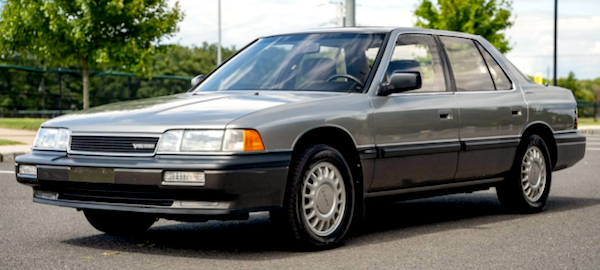
1987 Acura Legend - BaT Auctions
Front quarter view.

1987 Rover 820SE via Car and Classic
Hoods (including cutlines) differ, but only slightly.  Other front end detailing is also similar for both brands.  Little tooling variation seen here.  

1987 Acura Legend - BaT Auctions
Rear quarter.

1986c. Rover Sterling - factory image
As noted above, the main difference is in the C-pillar zone and use of different backlight windows.  Otherwise, tail light and reflector panels differ in details, as well as license plate locations.  The aft crease on the Stirling's trunk lid seems crisper due to what looks to be a sharp fold above the type of fold seen on the Acura.

Thursday, July 16, 2020

Evolution of the Ever-Growing Honda Civic Four-Door Sedan

A while ago I touched on the growth of Honda's Civic model as found here in America.  Now I want to add more detail regarding that growth as expressed in wheelbase length.  Perhaps that's because for many years I was professionally a "numbers guy."

The second link above is Wikipedia's Honda Civic entry that, with sub-links, offers information on what the writer(s) contend are ten generations of Civics.  According to the data panels in the generation sub-links, some generations either did not vary in wheelbase length or such variation was trivial (one-tenth of an inch, three millimeters).  In one instance (2012 model year in the USA), wheelbase actually declined, but I will not treat that deviation here.

Below are images of Honda Civics for each generation showing a noteworthy length increase.  Ideally, I would present the cars facing the same direction and sized for comparative scale.  But that was not possible, given the images I could find via Google.

Gallery

1973 Honda Civic
The first Civics imported to America were coupés such as this.  Its wheelbase was 86.6 inches, 2200 mm.

c. 1976 Honda Civic Sedan
A four-door sedan entered the US market later, with a wheelbase of 88.9 inches, 2288 mm.  This is the benchmark for the overall growth comparison.  It styling, like that of the 2-door, has a slightly rounded appearance that was at variance from the emerging angular look of European cars.

1980 Honda Civic Sedan
The next generation had a 91.3 inch, 2320 mm wheelbase, and its styling was now in line with prevailing fashions.

c.1986 Honda Civic Sedan
Not a sharp photo (from an unknown source), this angular Civic sedan's hood curves downwards toward the front, a Honda theme for many years.  Wheelbase: 96 inches, 2438 mm.

1988 Honda Civic Sedan
Styling is similar to the car in the previous image, but the wheelbase is now 98.4 inches, 2500mm.

1993 Honda Civic Sedan
The following generation Civic shows some wind tunnel testing influence.  Wheelbase jumped to 103.2 inches, 2621 mm, where it essentially remained for the next two generations.

2006 Honda Civic Sedan
Now the wheelbase is up to 106.3 inches, 2700 mm.  The body shape is more aerodynamic.  Perhaps this length increase was due to aerodynamic considerations.  Or it was simply more of the length-creep trend due to marketing, packaging, and other factors.

2016 Honda Civic Sedan
A recent Honda Civic sedan.  Sleek, yet fashionably Japanese-fussy.  Its wheelbase is also 106.3 inches, 2700 mm, though the car is longer (182.3 inches, 4630 mm versus 176.7 inches, 4488 mm).  Its wheelbase compared to the initial Civic sedan is 17.4 inches, 420 mm longer.

Thursday, August 29, 2019

Not Quite a 4-Door Hatchback Nor a SUV

Three years ago I wrote about Honda's 2010 Accord Crosstour and the 2015 BMW version, its X4.  I used the term "Fastback SUV" to describe them.

That's not a bad term, but so far as I know, it hasn't been picked up by the automotive press.  For example, Subaru's Crosstrek (the name looks a lot like "Crosstour," doesn't it) has been called a "four-door hatchback" by at least one source.  Other cars with a similar body type are usually called SUVs, even though they don't look very SUV-like.

Semantics or typologies aside, despite Honda having given up on its Crosstour by 2015, new entries have appeared during the last two or three years.  These are shown below.

Gallery

2010 Honda Accord Crosstour
This is the original.  Pretty graceful in profile as far aft as the B-pillar, but then it looks too bulky.

2019 BMW X4
Go to the link above for images of the first-generation X4.  The current version has a strongly curved roof, but just tall enough at the rear to suggest short-item carrying capacity.

2018 Subaru Crosstrek
The Crosstrek has a higher roofline at the rear that's more suggestive of SUVs.  On the other hand, it does hint at being a four-door hatchback sedan.

2017 Maserati Levante
High-priced sporty marques are now getting into the SUV act.  To retain that sporty feeling, the Fastback SUV style seems more appropriate than the traditional SUV boxy, station wagon style.

2019 Lamborghini Urus
Here is a recent entry.  The roofline is closer to that of the X4 than the Levante.

Monday, August 12, 2019

Current Luxury SUVs

Crossover Sport-Utility-Vehicles (SUVs) are taking the American market by storm.  They seem to be catching on in Europe too, based on what I recently saw in northern Italy -- this despite high ($6.50 per gallon) gasoline prices there at the time.

Moreover, luxury brands have been adding SUVs to their lineups lately.  One expects luxury vehicles to be more distinctive than high-volume equivalents, though that seems to be less the case than it was decades ago.  And given that SUVs tend to have more constrained basic shapes than even current wind-tunnel tested sedans, I became curious as to how much style variation might be found in a sample of such brands and vehicles.

Results are in the images below.  Cars are shown side-view because that reveals their packaging better than other viewpoints that tend to favor brand-specific identification ornamentation.  Marques are in alphabetical order.

Gallery

2017 Honda CR-V
Not a luxury SUV, but a contemporary and popular example included as a reference point.  It rides on a shorter wheelbase than the luxury SUVs, and consequently has a narrower rear passenger door.  All the vehicles shown here have a lip overhanging the rear window (backlight), a feature dictated by wind-tunnel test.  Aside from sheet metal sculpting, SUV designers have their greatest stylistic freedom in shaping the aft side windows and the slope of the cars' sterns.

2016 Bentley Bentayga
Clearly manufacturers are running out of good names for car models.  This Bentley has the trace of a rear fender providing a visual link to its sporty Continental line.  This is its most distinctive feature, but not part of the basic body architecture.  The aft is more greatly sloped than the Honda's and its hood is longer.  My overall impression is that it's bulky.

2019 BMW X7
This BMW SUV features a comparatively long hood and short front overhang.  Rear slope is less than that of the Honda.  The passenger compartment greenhouse is high in part due to a slightly low beltline.  Its aft side window is larger than most others.  Overall, the impression is boxy.

2017 Cadillac XT5
Cadillac's main SUV is its large, boxy Escalade.  I thought I would show its smaller, less-popular XT5 instead due to its styling.  An XT6 is on the way, but few photos are available as this post is being drafted.  Features include a rising beltline and an aft slope similar to Bentley's.  Small, angular aft side window.

2017 Jaguar F-Pace
Tapered side-window treatment similar to the Cadillac's, but less angular.  Hood and overhang setup is like the BMW's.  And the aft slope is steep like the Bentley's, so carrying capacity seems secondary to sportiness -- the key factor for Jags and Bentleys.

2017 Maserati Levante
This Maserati is a trifle more sporty than the Bentley and Jaguar, if aft slope matters.  Its roofline is the most curved of the lot, making the car almost a hatchback four-door sedan instead of a SUV (the Subaru Crosstrek is a similar case).  Very short side windows due to a high beltline.  Like the Bentley, there's a trace of a rear fender, but it's cosmetic and unrelated to our main objective here.

2019 Rolls-Royce Cullinan
Rolls sedans are shaped like bricks -- I assume the idea is to look imposing.  This SUV builds on that base, featuring a tall passenger greenhouse atop a high beltline.  All side windows are large, and there's also a large C-pillar.  Front overhang is short.  Aft slope is considerable, but not as extreme as the Maserati's, thereby reducing visual bulk ever so slightly.  Carrying capacity seems great, however.  Side sculpting is minimal.

All these luxury SUVs, aside from perhaps the Cadillac, are longer than typical mid-range SUVs found in North America.  Excepting the BMW, the slopes of the backlights (rear windows) tend to be fairly great, providing a sporting appearance and less capacity for hauling large, tall objects in their cargo zones.

The Maserati and Rolls-Royce have the most distinctive shapes.  The former is this most graceful (and least SUV-like), the latter is the most boxy (though the BMW comes close).  I won't consider overall attractiveness here because that involves frontal and rear styling as well as side sculpting and other ornamentation.

Thursday, August 1, 2019

C-Pillar Black Divider Swath Fad

Some of the library books about industrial design from the 1930s that I read when I was young seemed to go along with the contemporary Architecture ideology that designers should strive for functional, truth-to-materials purity in their creations.   No doubt there were car designers in the USA and, more likely Europe (due to the Bauhaus influence), who pursued such ideals.  But the men in charge of styling departments knew that a major function of a car's design was to sell in appropriate numbers.  And to do that, a certain amount of attention to fashion had to be paid.

To be in step with fashion means that popular features introduced by a competitor might be borrowed to appease potential buyers who value being au courant.  I myself was caught up with that when I was in my teens.  If a car maker wasn't offering four-door hardtop convertibles or the correct type of wraparound windshields, then I would urge my father to not consider those products.

Nowadays when wind tunnel tests largely determine overall body shapes, exterior stylists are reduced to coming up with distinctive cladding features to differentiate brands and models.  Usually this takes the form of sheet metal sculpting and angular front and rear detailing elements.

A recent fad is for black patches or swaths, sometimes with chromed edges, placed on cars' C-pillars as a kind of faux (non-structural) division between the roof and the lower body of the vehicle.  Even though I left the Church of Functionality decades ago, this latest styling touch strikes me as being utterly phony: an important line has been crossed.

Below are some examples.

Gallery

1953 Packard Balboa Concept Car
Here we see a sculpted element at the base the C-pillar that clearly separates the passenger compartment roof from the lower body.  Because it is sculpted, it gives the appearance of being structural, and therefore is "believable."

2017 Chevrolet Bolt
The recent separators of roofs and lower bodies are clearly cosmetic.  The Bolt's separator conflicts with the rest of the styling and adds visual clutter.  The car would look nicer without it.

2018 GMC Terrain
I couldn't locate a factory photo that clearly illustrates the Terrain's divider.  But you might be able to see that it, along with strongly tinted side windows, hints at being wraparound rear windows.
UPDATE:
It wasn't visible in the photos I consulted, but it turns out that in that C-pillar black zone there lies a very small window intended for passengers in third-row seats.

2018 Honda Odyssey
No chromed edges here.  Just a clearly tacked-on element that clashes with the aft side window and actual shape of the C-pillar.

2018 Lexus RX L
Lexuses have featured extreme angularity in recent model years.  Here the black swath gives the C-pillar a wedged shape that it lacks in reality.

2019 Nissan Altima
This black element is comparatively discrete and almost yields a coherent theme.  Some work is needed where it touches the side window.

Thursday, July 25, 2019

2019 Volkswagen Touareg: A Relatively Clean Design

An impression I get is that the most overly-decorated cars these days are made by Japanese companies.  Germany's Volkswagen, on the other hand, has tended to keep its designs cleaner.  I recently saw a new VW Touareg SUV on a freeway, and it inspired this post.

Actually, the Touareg does have a lot more sculpting and ornamentation than previous VWs, but a disciplined design theme was imposed to yield a calmer appearance.

Let's take a look.

Gallery

Setting the stage is this 2017 Honda Civic hatchback.  Side sculpting is angular with triangular spots.  The rear end has a large collection of angled shapes that don't relate well to one another.  Such over-detailing and confusion has become all too common in recent years.

This 2019 VW Touareg  carries some angled detailing, but not nearly as much as on that Honda.  Note the horizontal bars in the grille area and on the (possibly) fake air vents in front of the front wheels.  This horizontal theme ties the design together and lessens the visual confusion of the kind seen in the first photo.

Side view.  Yes, there is the side sculpting that's de rigueur these days.  But note that the main character creases are horizontal, continuing the theme developed at the front.  The shoulder-level crease is more modulated, subtly softening the horizontal parts.  I like the side window profile.

The Touareg's rear again emphasizes the horizontal, adding to the clean-yet-detailed styling solution. The angles on the tail light assembly are modest and integrated with adjoining sculpting, though a hint of styling cliché remains.

Monday, October 29, 2018

HR-V: Honda's Small SUV

A rough styling rule-of-thumb is that the smaller the car, the more difficult it is to make it beautiful.  Small cars can be cute or even attractive, of course, and this post's subject falls into that aesthetic range.  But it has one serious flaw and a few minor ones, in my opinion.

That car is the Honda HR-V that appeared in the USA as a 2016 model.  As explained here, there was a previous version that was not imported here.   The link also notes that it shares components with the Honda Fit.  HR-Vs are slightly longer than Fits, their wheelbase being 102.8 inches (2610 mm) versus 99.6 inches (2530 mm).

The HR-V was given a modest facelift for 2019 that tidies up some front-end fussiness.

Gallery

A 2015 Honda Fit, the basis for the 2016 Hr-V.  Although it features many angles in its sculpting, they present a cluttered, yet coherent theme.

The 2016 Honda HR-V might be based on the Fit according to Wikipedia, but that is not apparent when comparing this image with the previous one.  The major flaw I mentioned has to do with the side character line that bends upward to converge with the upper side window framing curve.  These meet in the form of a triangle, the vertical element of which is the rear door handle, a touch borrowed from the Alfa Romeo 156.  That feature was dictated by the sweep of the curve: the resulting sculpting overlaid where a door handle would normally be.

This rear quarter view shows the door handle as well a questionable touch on the rear design.  That is the "smile" sculpting that sweeps below the license plate area.  The ends of this do partly relate to the tail light assembly designs and the curve does provide contrast with most of the other elements which are either horizontal or angular.  To my mind, the flaw is that the "smile" extends too far down.

A more conventional alternative to the bold up-sweep of the side sculpting would have it terminate along the top of the tail light assembly rather than abaft of the side windows.  That would give the rather stubby SUV design more visual length.  As it stands, it serves to enhance the stubbiness.  On the other hand, that sculpting and its setting are distinctive, and this might be considered a marketing plus in that the HR-V does not quite look like the rest of the crowd.

The 2019 Honda HR-V.  What was facelifted was the car's face.  The upper part of the ensemble including the headlight assemblies and the bold chrome bar have been greatly simplified from the clutter seen the earlier version.  Honda styling, like Toyota's, has been jarringly fussy in recent years, so I hope this facelift is a sign of returning sanity.

Monday, July 2, 2018

The Tiny Honda Beat Sports Car


While walking around London this April I noticed this rather dingy Honda sports car.  I'd never seen one before, so I snapped this reference photo so that I could research it after returning to Seattle.

It turns out that it was a Honda Beat from around 1991-1996 (Wikipedia reference here).  The entry states that it was the last car Soichiro Honda approved before he died in 1991.  I'm a little skeptical because, given development timelines, it's possible that he approved other models that appeared a year or two later.  Let me know in comments if my skepticism is wrong.

The entry also mentions that the design was by Pininfarina and sold to Honda.

Beats were of the small-displacement Japanese Kei class, having a 3-cylinder 656 cc motor producing 63 horsepower (according to Wikipedia) that was mounted between the seats and the rear axle line.  The wheelbase was 90 inches (2,280 mm) and it weighed only 1,675 pounds (760kg).  Its speed was governed to 84 mph (135 km/h).

Wikipedia doesn't mention if Beats were exported when new.  United States allows used Beats to be imported, this having to do with the interval since they were built.  Given my uncertainty regarding exportation, I have no idea as to when the car I saw in London arrived in the UK.  Given its unkempt state, I would say it had been there for quite a while.

I rate its styling as very good for such a small package, though I'll also note that small sports cars are much easier to style than sedans of comparable size.

Gallery

Images of a 1991 Honda Beat up for bid: high right front quarter view.

Right rear quarter view.

1991 Honda Beat side view from Mecum Auctions.

Phantom view of Beat from Honda.

Monday, May 14, 2018

Rogues Gallery of Busy Grilles and Front Ends

I've been hammering away for a while now about the current fashion for overly decorated designs.  I think an important reason for this fad or fashion is government fuel efficiency regulations that have driven engineers and stylists to wind tunnels in the pursuit of high aerodynamic efficiency.  The result is car bodies with nearly identical basic shapes, and this has led to the use of excessive ornamentation and aerodynamically irrelevant body surface sculpting as means to establish brand and model identification.

Another -- probably lesser -- reason is the normal pendulum swing from one extreme to another that is common where fashion is concerned.

This post presents examples of overly-busy looking grilles and front end ensembles on American cars of the 1950s, an era noted for extravagant styling themes.  Then recent and current examples are shown, illustrating that we now seem to be in a period even more extreme than the '50s.

The 1950s images are of cars for sale.  The others are manufacturers' publicity photos.

Gallery

1950s American Examples

1950 Buick
Classic overstatement that was toned down for the next model year.

1952 Packard 400 Patrician
This is a modernized version of the traditional Packard grille intended to better blend with post- World War 2 styling trends.  The sculpting is rather Rococo, but the overly decorated part is the "teeth" that thankfully disappeared on the 1953 facelift.

1958 Buick
If the decorations on the face of the hood were eliminated, the design would be a lot more coherent.

1959 DeSoto
A three-level grille-bumper ensemble, each level having a separate theme.

1959 Dodge
This design approaches the confusion seen in some of the recent images below.


Current and Recent Examples


2015 Nissan Juke
A small car with intentionally funky styling.

2016 Nassan Maxima
The Nissan badge and its chrome nest serve as brand-wide identification.

2017 Lexus IS
Variously termed as "hourglass," "spindle," and (by me) "back-to-back Lexus Ls, this has been a Lexus theme for several years now.  And, as seen farther below, Toyota seems to be adding it to its mass-market brand.

2017 Renault Mégane sedan
That enduring, yet somewhat inexplicable Moebius-diamond symbol reinforces an already somewhat cluttered design.

2018 Audi A8
Audi pioneered the theme of draping the grille over the front bumper.

2018 Genesis
Count the textures on the face of this Genesis by Hyundai.

2018 Honda Accord
This car has some interesting sculpting, but it gets carried a little too far on the front end.  The sweeping element atop the grille and its details do not relate well to what is below.

2018 Hyundai Sonata
This design is cleaner than most shown here.  But the faddish fake air intakes flanking the grille add to the clutter.

2018 Infiniti Q50
An odd, droopy look to the front.

2018 Toyota Camry
As mentioned above, Toyota's mainline American sedan is now getting a Lexus-like frontal design.  The hood face, the faux air intakes flanking the actual grille and the dark, two-level apparent grille segment do not work well together.