Showing posts with label Bucciali. Show all posts

Monday, April 25, 2022

Low-Level 1930 French Headlights

Nowadays headlight heights above the road are regulated.  That didn't seem to be the case in France during the 1930s.  Whereas most French cars had headlights placed fairly high relative to their grilles and fenders, there were some cases where they were closer to the ground.

This styling fad ended around the 1937 model year, aside from some Puegeot lines.  Their 302s and 402s were essentially pre- World War 2, and 202s were built for a few years after.

Examples of French cars with low-mounted headlights are shown below.

Gallery
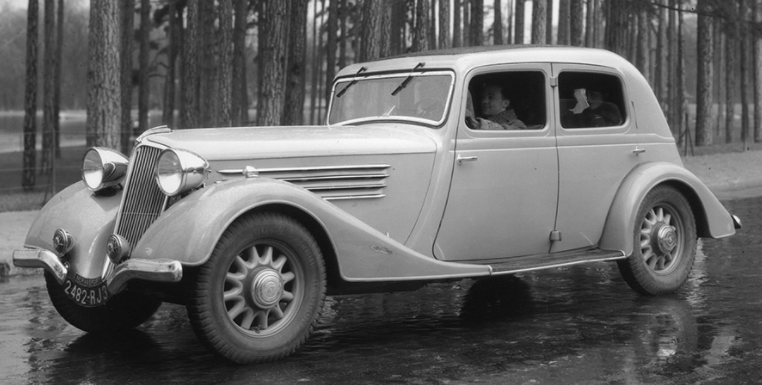
1935 Renault Nervasport
Here is an example of headlight placement on a Renault, the leading French manufacturer.  Compare to the automobiles pictured below.

1930 Bucciali TAV 30 La Marie Torpédo Sport Type Cannes by Saoutchik - Bonhams photo
Bucciali was an especially exotic French brand.  Here is an early instance of low headlights.

1933 Panhard 6CS Coupé
An early example, this by an important French manufacturer.

1935 Avions Voisin C25 Aérodyne - Gooding photo
Voisin was a builder of exotic, expensive cars.

1935 Peugeot 401 Cabriolet
An important French carbuilder.  1934 401s had normal headlight placement.  For 1936 the 401 gave way to the 402 that was clad "Fuseau Sochaux" style.

1937 Peugeot 302 "Fuseau Sochaux"
Peugeot 302s appeared for 1937 with the same styling theme as the 402.  Headlights were distinctively placed behind the grille for models 202, 302 and 402.  They are not as low as seen on the 401 in the previous image -- but they aren't very high either.
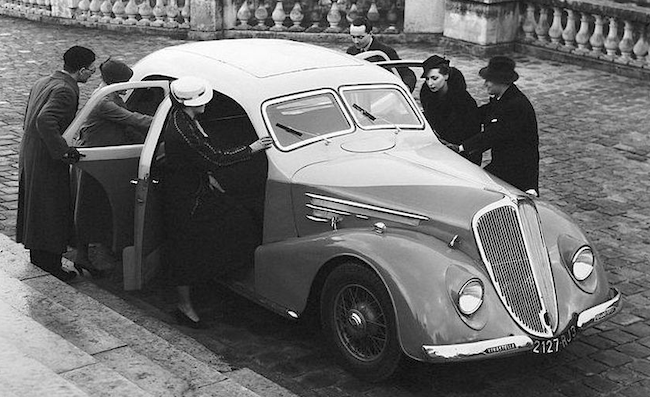
1935 Vivastella Grand Sport - factory photo by Robert Doisneau
Low-mounted headlights were on Renault's most expensive lines for the 1935 and 1936 model years.

Monday, May 2, 2016

Styling Variety: 1930s French Cars

During the 1930s General Motors' styling boss Harley Earl would travel to Paris to visit the annual Salon de l'Automobile.  It was a serious focus to what might seem to some a frivolous enjoy-Paris corporate junket.  That was  because fashion-conscious France was a hotbed of car styling ideas that Earl wanted and needed to be aware of.

And there were many automobile makers in France, even in the depth of the Great Depression.  For example, the mid-decade 1935 Paris salon had 27 firms exhibiting passenger cars.  Those 27 firms produced only about 170,000 cars that year, and 3/4 of those were from the "big three" -- Renault, Citroën, and Peugeot.  The remaining manufacturers averaged about 1,550 cars that year, which makes me wonder how they could afford to keep body designs even halfway fashionable.  The largest firm, Renault, produced around 58,000 cars that year, yet marketed ten lines of cars using what seems to be three basic bodies -- which also seems like a small basis for product renewal.

Regardless, French car styling from the 1930s was innovative and varied.  Admittedly, this was especially the so for custom-built bodies, but also was the case for factory models.  The images below are mostly of standard production cars.

Gallery

Bucciali Double-Huit - body by Saoutchik - Paris Salon 1931
This car was intended to astonish, something it still does 85 years later.  It has a underslung chassis, so it sits low.  The low stance is further emphasized by the large wheels and extremely long hood.  Not to mention the low-headroom passenger compartment.

Voisin C 20 - Paris Salon 1931
Many of Gabriel Voisin's designs also astonish.  His C 20 and C 22 models feature radically disaggregated components.

Voisin Aérodyne - Paris Salon 1934
This is a pre-production car, but essentially the same as the few that were built.  Here Voisin edges towards aerodynamic shaping on his way to the 1936 Aérosport.

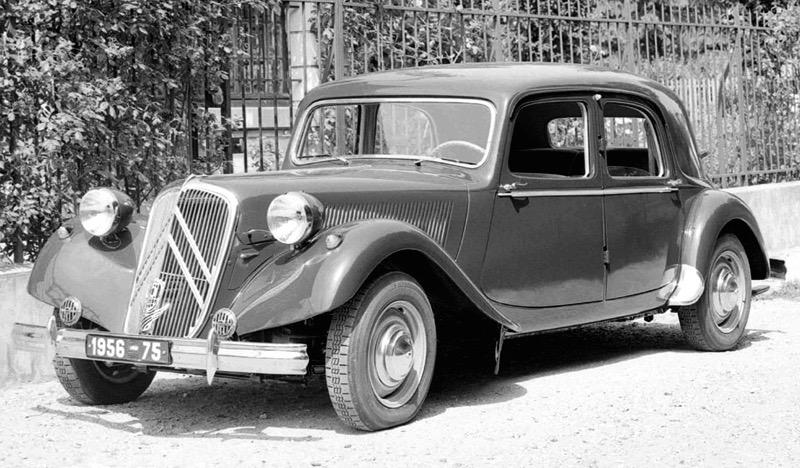
Citroën Traction Avant - 1956
The Traction Avant line was introduced for 1934, and its design was virtually unchanged even by 1956, the year before it was replaced.  The body is low because it lacks a driveshaft and also a chassis, being of semi-unitized construction.  One French styling fashion in the late 30s was the belt line drooping towards the rear, as can be seen here.

1935 Renault Nervastella Grand Sport
Unlike the Citroën, this top-of-the-line Renault is tall.  And it also has a somewhat streamlined appearance that's negated by the formidable grille-hood combination.  Note especially the the highly-sloped, V'd windshield: advanced for 1935.

Peugeot 402 - ca. 1939
The 402 first appeared for the 1936 model year and, like the Renault above, featured a streamlined look.  The body aft of the cowling seems inspired by the 1934 Chrysler Airflow.  For me, the most intriguing feature is the headlamps buried behind the grille.

1937 Hotchkiss 686 Coupé Modane
By the mid-1930s Hotchkiss' were solid looking cars.  Attractive, slightly conservative styling for its bourgeoise clientele.  I am especially fond of the grille design that relates well to the fenders.

1937 Panhard Dynamic
The ancient firm Panhard et Lavassor developed styling senility in the early 30s with its Panoramique three-piece windshield design that progressed to the strange Dynamic model shown here with its central driving position.  "Creativity" does not necessarily produce good results.

Talbot-Lago T 155 SS by Figoni & Falaschi - ca. 1938
Finally a fabulous "Goute d'eau" (teardrop) Talbot-Lago custom that's marred by having spats over the front wheels.  Most similar Talbots had exposed front wheels.

Monday, July 14, 2014

Very Long Hoods

Once upon a time, stylists such as General Motors' Harley Earl favored long, high hoods on their designs because this suggested that a car was powerful.  This line of thought was based on the fact that many 1930-vintage luxury cars had large, powerful straight-eight, V-12 and V-16 motors that required long hoods.

As might be expected, 1930-vintage automobile company managers and designers fell to the temptation of gilding the long-hood lily.  The present post deals with some examples extra-long -- needlessly long? -- hoods and concludes with thoughts regarding why long hoods are seldom, if ever, found on production cars today.

Gallery

Daimler Double Six 50 Sport Corsica Drophead Coupé - 1931
Proportionally, this is one of the longest hoods I've ever noticed.  Daimler was best known for supplying cars for British royalty, but the Double Six series featured long hoods and the drophead example shown here is sporty, though in a cumbersome, almost unbalanced sort of way.

Voisin C 22 - 1931
Voisin seldom put long hoods on his cars.  But when he did, the results were spectacular, as with this C 22.

Bucciali TAV Double Huit U-16 - 1932
Bucciali built few cars, but they were even more spectacular those from M.Voisin.  As with the Voisin and Daimler shown above, the Bucciali's hood length was emphasized by the close-fitting front fenders.

Bugatti 41 Royale - c. 1931
Ettore Bugatti's Royale was intended to be sold to royalty.  His plan didn't work as intended, yet seven cars in the 41 series were built over a period of years.  All were huge and carried impressively long hoods, as can can be seen in this photo.

Bentley Speed Six Gurney Nutting Sportsman Coupé (Blue Train) - 1930
The Bentley Speed Six line included one that famously raced the famous French Le Train Bleu from the Riviera to Calais on the English Channel and then went on to London in less than the train's scheduled Riviera-Calais run time.  But as the link indicates, the Gurney Nutting coupé came later, and was named in honor of the Speed Six that actually performed Woolf Barnato's famous stunt.

As for the hood, it's physically shorter than those pictured above.  Yet it's proportionally long, extending about half the length of the car.

Cadillac Sixteen concept car - 2003
Cadillac's Sixteen show car (that in theory might have entered production) had two V-8 engines mounted on axis, making a unit about as long as classic-era V-16s and straight-eight motors such as the Royale had.  Yet the Sixteen's hood is shorter.  That is because production cars nowadays need to be aerodynamically efficient, and part of what it takes to achieve good efficiency is a sharply slanted windshield.  All the previously discussed cars have their windshields sitting atop their cowlings.  But the base of the Sixteen's windshield is set forward of the cowling so that it and the roofline are high enough to clear the driver's head.

Toyota Avalon - 2013
To illustrate this point further, here is Toyota's top-of-the-line Avalon.  Wind tunnel testing played an important role in establishing the car's general shape.  Also having an effect are current "packaging" requirements that include a usefully large trunk at the rear, and a compact power unit at the front.  The result is a passenger compartment with a slight forward bias.  This, coupled with the aerodynamics-dictated windshield slope, yields a stubby hood.