Showing posts with label Volvo. Show all posts

Thursday, August 20, 2026

Volvo 144 and 244: Same Body for 27 Model Years

Long gone are the late 1930s and circa-1950s, along with the occasional Detroit practice in those times of keeping a design in production for only two model years.  European carmakers tended to keep models in production a lot longer.  And Volkswagen's Beetle success in the USA helped influence American firms to retain designs beyond even the typical four-year span.

All the while, European carmakers have continued long production runs.  Today's subject is an example.  It's Volvos's 140 and slightly facelifted 240 series, specifically 144 and 244 four-door sedans.  Those models were marketed model years 1967-1993: 27 years.

I selected these Volvos because my mother bought a '67 144 and I bought a '68 142 (the two-door version).  The sudden, high demand for 140 series Volvos seems to have forced the firm to push production levels to the point where quality control slipped.  My Mom's car was okay (so far as I know; she lived in Seattle, and I was in grad school in Philadelphia).  The Volvo I had twice broke down due to a loosened part of its distributer rotor.  But that was Bosch's fault, not Volvo's.  Two of my grad school buddies also bought 1968 Volvos.  The Volvo 122 Amazon owner had to have its engine replaced.  I was riding in Philly's Main Line one day with the guy who also had a '68 142.  Its engine compartment started smoking, but he switched off the motor before it actually caught fire.  Sweet days, those.

The images in the Gallery reveal little change in the main body over all those years.  There were interior changes and mechanical changes, but this styling blog focuses on exterior design.

Volvo 244s were slightly longer, having a wheelbase of 104.3 inches (2649 mm), compared to 102.5 inches (2604 mm) on 144s.

Styling was by Jan Wilsgaard.
Gallery

1967 Volvo 144 - Bilweb Auctions photos
A simple design, decent proportions.  In those days Volvos were more lower-midlevel.  My 142's floor mats were rubber, not fabric.  Its gearshift lever was floor-mounted, hence tall.  The grille seen here is inexpensively stamped metal, not really sculpted.  Those fender-mounted mirrors are not standard, so far as I know.

1990 Volvo 244 - Bilweb photos
The design as it appeared near the end of the long production run.  The front face and hood are what's changed.  The grille is more expensive to make, and Volvos had moved higher up the price/prestige ladder.

Only a single chrome strip for side decoration.

The added length is between the firewall and front wheel opening.  Passenger compartment greenhouse seems unchanged, the side chrome strip nearly so.  A non-metal rocker panel has been added.

Rear quarter view.

Revised trunk and rear end.  The gradual rear facelifting process began in the late 1960s and eventually evolved to what is seen here.

1973 Volvo 144 - unknown photo source
An intermediate frontal design.  The characteristic Volvo diagonal slash has been added.

1979 Volvo 244 - unknown photo source
The grille shape is narrower, more classical, and the hood altered to match it.  Headlight fixtures varied over time, influenced partly by fashion and mostly by regulation of various governments.

Thursday, January 29, 2026

Volvo's 1935 Chrysler Airflow-like PV36 Carioca


As I mentioned here in my post "Airflow and its Variations in 1936," an Airflow "look-similar" was the Volvo PV36 Carioca.  One is shown in the evocative photo above.

The nickname "Carioca" is Brazilian, not Swedish -- a mid-1930s thing noted in the Wikipedia link.

A more detailed account is here.  It mentions that "The design was heavily based on streamline styling from American vehicles.  How many influences the Swedish designer Ivan Örnberg brought back home from his former employer Hupmobile in Detroit in 1933 can only be guessed.  In any case, there are various optical parallels, for example to the Chrysler Airflow."

Clearly, Airflow influence was strong.  I see little 1934 Hupmobile influence aside from the very rear.  One  important Airflow detail was placement of the passenger compartment between the axle lines, with the motor mounted more forward than conventional at the time.  Side views of the Carioca suggest that it followed Chrysler practice.  Its body was "all steel" (aside from the fabric roof insert), but probably not quasi-unitized in Airflow fashion.

Gallery

1935 Volvo PV36 Carioca - factory photo
Likely a prototype or early production model.  The slightly raised grille and hood front is more conventional than the strongly rounded (and much criticized) early Airflow front ends.  Basically a decent, tidy design for its time.

1935 Volvo PV36 Carioca - factory photo
Publicity or advertising image.

Volvo PV36 Carioca - via Top Gear
The grille and body shaping above the headlights is different from that show in the top photos.  Perhaps this is later than a 1935 model.

The decoration on the rear wheel spats is similar to that on Chrysler Airflows.  However, that sort of thing was also found on other 1930s cars such as Nashes and Peugeots.

Volvo PV36 Carioca - Bilweb Auctions photos
Same car as on the previous images, but in a different setting.

Rear quarter view.  Compare to the Hupmobile in the following image.

1934 Hupmobile 421 - image via Automobile Quarterly, Vol. 16 No. 1
As mentioned above, Carioca's rear resembles this Hupp more than it does a '34 Airflow.  CU Airflow sedans lacked trunk lids, and the spare tire was not sunk into the aft sheet metal.

Volvo PV36 Carioca - via classicandsportscar.com
Again, a slightly different grille design.  License plate appears to be British.

Volvo PV36 Carioca - unknown photo source
Probably the same car as in the previous photo.  Compare its profile to the Airflow below.

1934 DeSoto Airflow - car-for-sale photo
Shown here is a DeSoto Airflow whose wheelbase (115.5 inches, 2934  mm) is closer than Chrysler's to that of the Carioca (116.1 inches, 2950 mm), making for a reasonable comparison.  The Carioca is a 4-window car, the Airflow has 6 windows.  Having fewer windows, the Carioca's aft profile curve is less abrupt than the DeSotos'.  Door hinging is reversed: "suicide" front on Carioca, rear on Airflow.  Airflows got some production cost savings by having major parts of door shapes reversed.  Note the symmetrical (but flipped) side window shapes.  The left front door and right rear door would used the same window shape tooling, ditto the right front door and left rear door.  Carioca seems to have done the same with respect to windows.

Monday, July 24, 2023

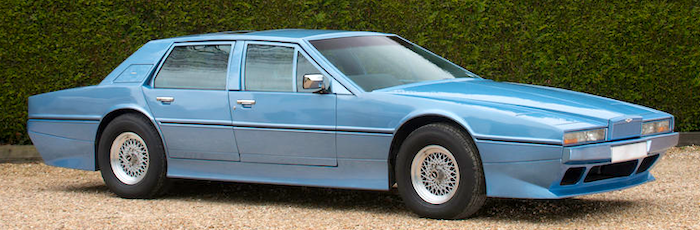
Aston Martin Lagonda Series 2: Low and Angular

Nearly ten years ago I wrote about the Aston Martin Lagonda Series 2 design.  Since then, more images of  those cars have appeared on the Internet, so now I can present a walkaround sequence showing the styling in much greater detail.

There were four production series: Series 1 (1974-75), Series 2 (1979-85), Series 3 (1986-87) and Series 4 (1987-90) with 645 built, all told.  The first series amounted to fewer than ten cars, as the second link above mentions.  It also states that its cars were based on Aston Martin components, whereas Series 2 and later cars had a unique platform.  A prototype was displayed in 1976, but production cars were not marketed until 1979.

In my earlier Aston Martin Lagonda post, I noted: "[I]n my judgment the design suffers because of the dimensions of the 'package.'  The car is simply too long and too low; its proportions would make almost any styling seem wrong."

Keep in mind that a long-term design trend was to increasingly low car bodies.  By the early 1970s this yielded some sports cars and show cars whose height had reached levels essentially impractical for everyday use: for example, the 1966-73 Lamborghini Miura and 1968-78 Lamborghini Espada.  At the same time, the current styling fashion was for cars to be angular-looking: razor-edge all-over.  Both factors dominated the Aston Martin Lagonda design created by William Towns.

Here are Series 2 dimensions as reported in the Wikipedia link: wheelbase, 114.8 inches (2916 mm); length, 208 inches (5282 mm) and height, 51.3 inches (1302 mm).  Clearly, overhang was enormous.

Gallery

Circa 1966 Volvo 144
An example of angular styling on a car with practical passenger packaging dimensions.

1984 Lagonda Series 2 Saloon - Gallery Aaldering photo
And here is an Aston Martin Series 2 Lagonda.

1980 Lagonda Series 2 Saloon - Bonhams auction photos
Now for the walkaround.  Plenty of razor-edge angularity.

Yet the styling is professional, with few errors aside from the overall proportions.

Long hood, short, all-overhung trunk.  Note the chin spoiler at the front.

The full-length rub-bar transitions to the upper edge of the rear bumper.  I'm not sure of the purpose of the panel on the C-pillars; seems set too low for a potential knock-out opera window.  Perhaps one is a fuel filler cover.

Tail light and reflector assemblies are geometrical.  But other lines are subtly curved, as on Greek temple columns.

Sigh: If only the car were slightly taller, all might have been well.

The steeply raked windshield helps aerodynamic efficiency.

Consistency: the rub strip meets the top of the front bumper, as it does the rear bumper.  The body flares outwards near its lower edge.

The cockpit is quite angular in spirit with high-tech details.  The steering wheel's single spoke recalls that of the Citroën DS.

Thursday, January 23, 2020

Recent Design Language: Volvo S90, S60 and XC40

The Swedish automobile company Volvo is no longer Swedish, having been taken over by Geely of China about ten years ago.  As best I can tell, styling and other product development remains in Sweden.

For many years Volvo stressed safety features and retained rather boxy, plain styling, though cars became less-boxy as time passed.  This post looks at three recent models' styling.

Volvo models dealt with here are the top-of-the-line 2017 S90 sedan, the smaller 2019 S60 sedan, and the Toyota RAV4-class crossover SUV 2018 XC40

Gallery

2017 Volvo S90

The Chinese-built S90 received good styling reviews when introduced.  Dominating the front is a variation of the traditional Volvo grille.  Below it are some of the usual clutter items found on most current cars.

Its profile is typical of sedan forms subjected to wind tunnel testing: graceful, with a hint of a fastback.  Side sculpting is restrained compared to extremes taken by some Japanese brands in particular.

Rear styling is more fussy.  The dominant features are the lazy-U shaped tail light assemblies that carry on Volvo's wraparound theme from previous years.

2019 Volvo S60

The new S60 line is assembled in the USA.  The frontal design follows current styling clichés, though the grille opening profile and the interior Volvo symbolism counteract that to some degree.

In profile, the shorter S60 is similar to the S90, as might be expected given aerodynamic requirements.  Side window profiles are similar, especially by the C-pillar.  Side sculpting is stronger, more in line with current fashions.  The result is a reduction in distinctiveness.

The S90 tail light theme is continued on the S60.  Otherwise rear styling is elaborate and its elements are not well coordinated.

2018 Volvo XC40

Winds tunnels and interior packaging requirements give most mid-size crossover SUVs largely the same exterior profiles, and the XC40 is no exception.  Sculpting is more angular than on the sedans just discussed, following styling cues of other brands.  The black top paint job is yet another cliché, though its dividing line on the C-pillar ties the window frame and rear spoiler better than seen on other SUVs.

Tail light assemblies are a variation of those found on previous Volvo SUVs and station wagons.  The rear design here is uncluttered and, aside from those tail lights, coherent.

The front is strongly Volvo, though an interesting variation is the mini-shouvelnose grille.  The upper side character line visually carries through from front to rear while actually being in three segments with varying sculpting.  I haven't make up my mind as to whether this is something that adds appropriate interest or is simply yet another instance of over-elaboration.

Thursday, November 14, 2019

Some Three-Door Sports Cars

Two-passenger sports cars are impractical when it comes to carrying things besides people.  Most can handle a couple of grocery bags or even a small suitcase or two for short vacations.  But household items can be beyond their capability.  For that reason, if one is determined to buy a sports car, yet can only afford to run one car, then a sports car with extra carrying capacity might make sense.

That might be why during the last third of the last century some sports cars appeared with fixed metal tops and an aft, hatchback type door.  Three such cars are treated here.

The first example is the MGB GT hatchback produced 1965-1980. (The roadster dates from 1962. Wikipedia entry for the MGB is here.)  According to the link, Pininfarina was responsible for the GT styling.

Next is the Volvo P1800 ES, a station wagon version of the coupé sports car (background here).  The sports cars were produced 1961-1973, but the ES version lasted only two model years, 1972-1973.

The most recent of the three is the BMW Z3 M Coupé, produced 1998-2002.  The roadster was produced 1996-2002.  Wikipedia entry here.

Images below are either factory publicity or cars listed for sale, unless noted.

Gallery

* * * * * MGB * * * * *

A 1963 MGB, a roadster style but with roll-up windows.

A MGB GT with its airy passenger greenhouse.

Side view showing how neatly the Pininfarina firm grafted the coupé ingredients to the basic MGB body.

Rear quarter view showing the hatchback door.  Many years ago a co-worker let me test-drive his GT when I was sports car shopping.  I had no problem with the styling, but the cramped driver area made me veto the MGB and I bought a Porsche 914 instead.

* * * * * Volvo P1800 * * * * *

1961 Volvo P1800 Coupé, Hyman Ltd. photo.  By the time the ES came along,  P1800s had been lightly facelifted.

1973 Volvo P1800 ES.

This side view makes it quite clear that the ES is more a staton wagon than a hatchback.  The aft side window is surprisingly long: I'd be tempted to make it a two-piece affair with a forward-sloping divider aligned above the after edge of the rear wheel.

Volvo advertising clearly stressed the station wagon aspect of the ES.

* * * * * BMW Z3 * * * * *

1996 BMW Z3 sports car.

1999 BMW Z3 M Coupé.  The greenhouse grafted onto the roadster-type body seems awkward from this angle.

The design details are professionally done.  But the problem has to do with the small size of the car and the the proportions of its main elements.  For example, the long, low hoodline and comparatively tall greenhouse extending to the rear of the car do not relate well.  The dipped fenderline inherited from the roadster results in side windows that seem too large.  A rising fenderline could cure some of this, but would have been too expensive to implement: apparently the budget for the Coupé actually was quite tight.

Therefore, the Coupé has to count as a design failure.  Seen on the streets and roads, they never looked right to me.  Not surprising that only 1,112 were built.