Showing posts with label Exterior Trim Variations. Show all posts

Thursday, April 22, 2021

1955 Chrysler, Imperial and DeSoto Variations

Whereas General Motors' redesigned 1954 Buicks, Oldsmobiles and Cadillacs with their panoramic (wraparound) windshields seemed flashy and futuristic when introduced, in retrospect I think the 1955 Desoto/Chrysler/Imperial body design was the most satisfying of the mid-1950s American models.

They were styled under the leadership of Chrysler's new Design Vice President Virgil Exner.  Work began apparently in 1952, a very short development timeline for a line of cars to be introduced towards the end of 1954.  It was fairly quickly decided to base the design on Exner's 1952 Chrysler Imperial Parade Phaeton -- of which three were built and all still exist (though extensively facelifted).

I posted on 1955 DeSotos here, Chryslers here, and Imperials here.  Today's post covers much of the same ground, but takes a slightly different perspective.  Here are featured exterior trim variations used on four-door sedan and hardtop coupĂ© bodies for the three brands using the same basic bodies.  Differences in grille design are ignored in order to simplify the presentation.

Unless noted, image sources are of cars listed for sale or are factory publicity photos.

Gallery

1952 Chrysler Imperial Parade Phaeton
The basis for the 1955 basic body.

1955 Imperial Newport -- RM Sotheby's auction photo
Imperials featured restrained, dignified trim aside from their gunsight taillights.

1955 Imperial Sedan
Sedans and hardtops shared the same side chrome strip.

1955 Chrysler 300 - Mecum auction photo
Chryslers had odd, tacked-on looking taillights.  The sporty 300 model had a very simple side chrome strip.

1955 Chrysler Windsor Deluxe Nassau - Mecum photo
Entry-level Windsor hardtops also featured simple side trim.

1955 Chrysler New Yorker Deluxe St Regis
But the upscale New Yorker St Regis hardtops had a bold two-tone paint scheme.

1955 Chrysler New Yorker Deluxe Newport
More conservatively-inclined New Yorker hardtop buyers could opt for the Newport with its simpler two-toning.  Both models had about the same price, but the St Regis outsold the Newport by a 2:1 ratio.

1955 Chrysler Windsor Deluxe Sedan
Again, simple side trim for some Windsor sedans.

1955 Chrysler Windsor Deluxe Sedan
But others received fancy lower-body two-toning.

1955 New Yorker Deluxe Sedan
New Yorker sedans and Newports shared the same side trim.

1955 Chrysler Deluxe Summer Special Sedan - Bonhams auction photo
But, in a mid- model year effort to boost sales, some New Yorkers received trim incorporating Windsor along with New Yorker two-tone areas.

1955 DeSoto Firedome Sportsman
Attractive side chrome trim that follows the fender shape.

1955 DeSoto Fireflite Sportsman
Less attractive was DeSoto's two-tome scheme.  Taillights are a more logical design than Chrysler's.

1955 DeSoto Sedan

1955 DeSoto Firedome Sedan - Barrett-Jackson auction photo
DeSoto sedans featured the same trim schemes as the hardtops.

1955 DeSoto Fireflite Coronado - photo via Hemmings
However, a three-tone paint scheme was added during the model year.  Some 1955 Dodges also were three-toned.

Monday, May 11, 2020

The 1956 Rambler's Curious Styling

The Nash Rambler, launched during the 1950 model year was the most successful American postwar "compact" car.  Not so successful were the early 1950s Henry J from Kaiser, the Aero Willys and the Hudson Jet.

Eventually, a redesign was called for, resulting in the 1956 Rambler from American Motors Corporation (AMC, created by a merger of Nash and Hudson in the spring of 1954).  Ramblers for the 1955-56 model years were badged as either Nash Rambler or Hudson Rambler.  Beginning in 1957, Rambler became a distinct brand.

Given the lead-time required for the creation and production of a new design, it seems likely that styling of the 1956 Rambler line was started before AMC was created.  Edmund Anderson, a veteran of General Motors, joined Nash in 1950 and was responsible for Nash and AMC styling until his departure in 1961.

The previous link suggests that Anderson might have been more an administrator than designer, but was good at hiring talented stylists.  Whatever the design situation was at Nash and AMC in roughly 1952-55, the resulting Rambler was an odd-looking car both in the context of its times and even today.

Unless noted, the images below are either factory-derived photos or are pictures of cars listed for sale.

Gallery

Setting the scene -- a four-door 1955 Rambler sedan.

And a 1955 Rambler station wagon.  Its roofline theme was carried over to the 1956 redesign.

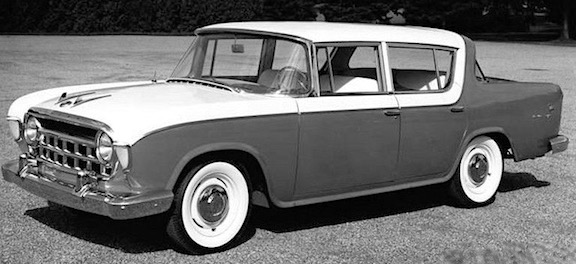
1956 Rambler 4-door hardtop.  This design was significantly longer than previous Nash Ramblers.  Its windshield is panoramic/wraparound in line with mid-1950s American styling fashion.  The three-color paint scheme (usually black, white and an accent color) was also fashionable.

Front view.  Headlights were set inside the grille frame, a feature found on 1955 and 1956 Nash full-size cars.  I find this ensemble awkward, even incoherent.  Perhaps a better solution using the same elements would place the vertical bars in the upper two levels, leaving the lower level blank.

Quasi-side view.  The panoramic windshield design seems cramped, ungraceful.  The dominant feature is the heavy C-pillar that is over-emphasized by having two colors pass over it.  This paint scheme does relate somewhat to body elements, but mostly serves to disguise  them.  I suspect that the general form of the passenger compartment "greenhouse" was strongly influenced by engineering, rather than styling, considerations.

This isn't the best possible view of the rear end, but it was the best I could find at the time.  It is a four-door sedan -- note the full-height B-pillar.  The various details work together poorly for the most part.

Alternative three-color side trim for "Sedan Custom" model.  Apparently the wrap-over-the-C-pillar paint scheme was criticized by potential buyers, so this revised pattern was offered.  It is an improvement, and the wrap-over was only offered for 1956 Ramblers.

Rambler "Super" with its simplified two-color paint scheme.  It too has that wrap-over, but provides us a better feeling for the body design.  Besides the awkward grille design mentioned above, an improvement would have been to eliminate the panoramic windshield, replacing it with a conventional A-pillar (though that might have been risky from a marketing standpoint at the time).

1956 Rambler Cross Country station wagon, hardtop (pillarless) version.  The stepped aft roofline is a carryover from the previous Rambler design: compare to the second image from the top.

Barrett-Jackson auction photo showing the station wagon's rear.

The 1956 Rambler's design is something of a mystery to me.  Anderson and his staff were competent, yet the cars were not attractive: Why?  I suggested above that engineering considerations and styling fashions might have been factors.  Another possible factor was the need (as seen by Nash president George Mason) for Ramblers to be distinct from normal American styling and design practice.  This was true of his original compact Nash Rambler that was first offered as a well-equipped convertible rather than a stripped-down compact sedan.  The first Ramblers were reasonably successful in the marketplace, and so was the design discussed here.  Apparently beauty isn't always everything.

Thursday, March 12, 2020

1958 Chevrolet Exterior Trim Variations by Model

A common automobile industry practice is to have exterior trim variations for brand models that share the same basic body.  This is to allow viewers to distinguish entry-level, top-level and any intermediate level models from one another.  (A glance at interiors usually makes these distinctions obvious -- cloth-covered versus leather-covered seats, for instance.)

Exterior differentiations have ranged from subtle to glaringly obvious.  For a subtle example, aside from the types of wheels, Toyota RAV4 SUVs of the 2013-2018 generation had just small chrome lettering on their rear doors: LE, LXE and Limited -- in increasing price rank.

Towards the other extreme, the 1956 Ford line had distinct trim differences that I wrote about here.

The current post deals with 1958 exterior rank variations for General Motors' Chevrolet brand, America's largest seller that model year.  Chevrolets were given redesigned bodies for 1958.  In addition, the two lowest ranking models were given new names to add to the hoped-for excitement: the One-Fifty line became the Delray, and the Two-Ten line was renamed Biscayne.

Gallery

1958 Chevrolet Delray, Mecum Auctions photo
The two-door model shown here is pretty much Chevrolet's entry car.  Little in the way of chrome trim aside from the piece extending along the side.  Compare it to the side trim shown next.

1958 Chevrolet Biscayne
Biscaynes used the trim from the Delray and were given an additional strip positioned slightly below the forward section and in effect extending the after Delray segment forwards.  Photo of a for-sale car.

1958 Chevrolet Bel Air, "for sale" photo
Top-of-the-line Bel Airs got entirely different side trim that was bolder, more elaborate.  The leading part of the front fender has four decorative hash marks, as does the side sculpting abaft of the rear wheel opening.  No mistaking Bel Airs from lowly Biscayne or Delrays.

1958 Chevrolet Impala, Mecum photo
The apex of the Chevrolet lineup was the Impala.  Besides having a different basic body (compare the thickness of the top with the other Chevys), Impalas received a fake air vent forward of the real wheel opening.  There were other differences, but here we limit the discussion to side views of the various models.