Showing posts with label Pierce-Arrow. Show all posts

Thursday, November 30, 2023

1937 Ford Headlight Assembly Details

Who designed the front end of 1937 Ford cars?

The overall styling was sub-par.  So far as I've been able to find, no claims have been made regarding any aspect of the design.  Ford's styling chief Bob Gregorie said that he was busy getting the styling department organized at the time the '37 was designed, so he could not be blamed.  Credit is usually given to the styling staff of Briggs Manufacturing, a supplier of car bodies to Ford in those days.  The studio dealing with production car design was headed by Ralph Roberts, formerly of LeBaron coachbuilders.  Under him were Phillip O. Wright, Holden "Bob" Koto, Al Prance, and a few others.  These were very good designers.  Yet none seems to have claimed credit for the '37's front ends.

That said, I really like the design of the front end of 1937 Ford passenger cars.  But not the awkward-looking part aft of the firewall/cowling on the sedans.

What impresses me is the sculpting of the fenders and catwalks that are contrasted by the sharp frontal part of the hood and grille.  The especially nice feature is the design of the headlight assemblies and their blending into the catwalk zone.

Gallery

1937 Chevrolet Master DeLuxe - car-for-sale photo
Ford's main competition.  General Motors headlights were not blended into fenders until the 1940-41 model years.

1936 Pierce-Arrow - Mecum Auctions photo
Pierce-Arrow's design signature for decades was headlights placed atop fenders.  The car shown here represents the firm's final design.

1937 Willys - factory photo
The redesigned 1937 Willys featured fender-mounted headlights.  All other American cars save Lincoln-Zephyr and Cord had headlights mounted in the general mode of the Chevy pictured above.

1936 Lincoln-Zephyr - cropped factory image
The "streamlined style" 1936 Lincoln-Zephyr's frontal styling was borrowed to some degree by the 1937 Ford.  Gregorie was responsible for the Zephyr grille design.  And likely for the rest of the front, though I have no evidence.

1937 Ford DeLuxe Fordor Sedan - car-for-sale photo
Compare the front of this car to that of the Lincoln-Zephyr.  Hoods, grilles and front fenders are quite similar.  The main difference is in the Ford's catwalk placement of headlight assemblies, though the lens and chrome surround designs are essentially the same.

1937 Ford Standard - car-for-sale photo
Close-up view showing the sheet metal sculpting of the fenders/catwalk/headlight zone.

1937 Ford Standard - Vanguard Motor photo
Frontal view.  Note the crease atop the fender's form.  This crisp feature is echoed by the grille and the pointed bottoms of the headlight assemblies (that also echo the grille's plan-view shape).

1937 Ford Standard - Barnfinds photo
High frontal view showing the blending of the headlight assemblies into the catwalks.  Very nice sculpting.

1937 Ford Standard - Barnfinds photo
Another view of the same car.

1937 Ford Standard - BaT Auctions photo
The catwalk zone viewed from the rear.

Given all the similarities of the front ends of the Ford and Lincoln-Zephyr, I suspect Gregorie was responsible for the styling -- directly or indirectly.

Thursday, January 12, 2023

1930s American Club Sedans

Names given to automobile body types are not rock-solid.  That's partly because manufacturing techniques change over time, making it more efficient to favor one style while letting another fade away.  Mostly, body type names are the stuff of marketing.  Here, an upscale name might be placed on a lesser design in an effort to increase prestige and stimulate sales.

That said, some names did persist over the decades.  The word "sedan" has been applied to closed, four-door passenger cars that do not have passenger compartment storage capacity such as is found on station wagons and SUVs.  Two-door cars called sedans and not something else slowly became more common during the 1930s, and "two-door sedan" was an established body type name in the USA by the 1950s.  And those body designs then gradually became more coupe-like and the two-door sedan body type slowly faded away.

Today's post deals with the "Club Sedan" body found on some luxury brands during the 1930s. Wikipedia's automobile sedan's entry here says the following regarding the club sedan:

"Produced in the United States from the mid-1920s to the mid-1950s, the name club sedan was used for highly appointed models using the sedan chassis.   Some people describe a club sedan as a two-door vehicle with a body style otherwise identical to the sedan models in the range.  Others describe a club sedan as having either two or four doors and a shorter roof (and therefore less interior space) than the other sedan models in the range."

My sources indicate that 1930s American cars called club sedans were four-door, four-window cars rated as carrying five passengers.  The same type of car was called something different by other carmakers, so the category name was not rigid.  And the use of the term for two-door cars came later: fastback 1946-1950 Packards were labeled club sedans, for instance.

Side views of some club sedans by several car makers are shown below.  Unless noted, they are of for-sale cars.

Gallery

1931 Pierce-Arrow Club Sedan - RM Sotheby's auction photo
That nice, long hood covers a nice, long inline eight cylinder motor.  It's nearly as long as the passenger compartment.  Club sedan passenger compartments tended to be on the short side.  Note the comparatively narrow aft side door, a sometime trait.  A universal club sedan characteristic, as noted in the text above, is that the car is four-window -- leading to a wide C-pillar area, yet another trait.

1933 Buick 90 Club Sedan
Club sedans were mostly on luxury or near-luxury brands.  The 90 was the top Buick line.

1933 Packard Twelve Club Sedan
This is a large car, so the rear passenger area is not cramped.

1934 Cadillac V-12 Fleetwood Town Sedan
Cadillac and LaSalle got new bodies for 1934, and this could easily have been called a club sedan, but wasn't.  LaSalle did market a club sedan that year with a different rear side door profile.  Unfortunately, I have no side view of one.

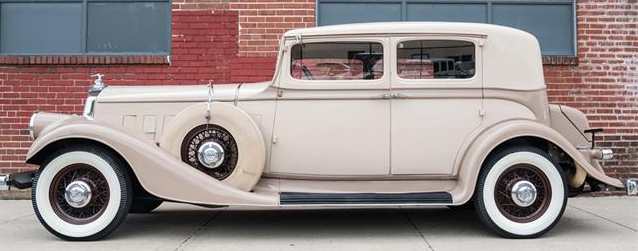
1935 Pierce-Arrow Five-Passenger Club Sedan - Mecum auction photo
Pierce-Arrow got new bodies for 1934.  Here is its '35 club sedan.

1936 Pierce-Arrow Club Sedan - Mecum
And its 1936 version, apparently on a longer wheelbase than the car's in the image above.  Everything abaft of the rear end of the running board is different.

1937 Packard One-Twenty Club Sedan - Barrett-Jackson auction photo
Packard also continued to market club sedans in the late 1930s. This one is from its entry-level inline eight cylinder motor line.  Like the 1935 Pierce-Arrow above, entry to the back passenger seat seems cramped.

1937 Cadillac 75 Five-Passenger Town Sedan
Not a club sedan by name, this Cadillac, like the one shown earlier, has the club sedan look.

1940 Packard One-Twenty Custom Club Sedan - Daniel Schmitt photo
Model year 1940 was Packard's last for four-door club sedans.  This is the entry-level version.

1940 Packard One-Eighty Club Sedan
And this is Packard's top-of-the line club sedan.

Thursday, October 13, 2022

Pierce-Arrow Silver Arrow Coupe Walkaround

For most of the 1901-1938 period that Pierce-Arrow built luxury automobiles, design was secondary to quality engineering, materials, and assembly.  That is, Pierce-Arrows were seldom sporty and often appeared old-fashioned compared to cars from competitors such as Packard.

But there were exceptions.  Beginning in the 1929 model year, Pierce-Arrow cars became decent-looking and in line with current style expectations.  And then there appeared the sensationally futuristic Silver Arrow, only five of which were made.

The following year Pierce-Arrow launched another Silver Arrow, basically a coupe with a fastback aft body that echoed the original Silver Arrow's aft.  It shared body components with a Studebaker model that I wrote about here.

Featured below are walkaround images of a 1934 Pierce-Arrow 1240A Silver Arrow Coupe -- Bring a Trailer auction photos.

Gallery

1933 Pierce-Arrow Silver Arrow - Blackhawk Museum photo
This view shows the aspect of the Silver Arrow that was echoed in the later Silver Arrow Coupes.

Now for the walkaround.  The face is stock '34 pierce-Arrow.

The 1930s streamlining fashion was getting underway, so traditional Pierce-Arrow headlight assembly stalks are finally abandoned, the assemblies being blended into the fenders.  The grille is now V'd and slanted back.

The after body is not a pure fastback, but near enough that it little matters.

Note the two-tone paint scheme with red divider accents.

Compare the shaping to that seen in the '33 Silver Arrow in the top image.


The hood houses a V-12 motor.


1935 Pierce-Arrow Silver Arrow Coupe
Compare this model to the four-door Studebaker below.

1935 Studebaker Commander Land Cruiser - image via Hemmings
Studebaker divested Pierce-Arrow in 1933, but some cooperation between the firms continued, as can be seen in the shared body components evident in these two photos.  The Studebaker is a four-door sedan, so doors and side windows differ from the P-A coupe.

Thursday, September 29, 2022

1933 Pierce-Arrow Silver Arrow Walkaround

For around 30 years Pierce-Arrow was an important American builder of luxury automobiles.  That was due to excellent engineering and high quality materials and assembly.  Not design.  One major exception was the then-sensational 1933 Silver Arrow show car displayed at the 1933 New York Auto Show.  At the time, Studebaker owned Pierce-Arrow, and management was receptive to stylist Philip O. Wright's futuristic concept.  I wrote about the Silver Arrow here.

Five Silver Arrows were made, and it seems that three survive.  They are considered very important in car design history and are valuable.  For instance, in 2017 a Silver Arrow was auctioned by RM Sotheby's for $2,310,000.

For my analysis, refer to the above link.  Gallery images are without captions and are for your viewing enjoyment.

My search for photos on the Internet did not turn up a complete eight-image walkaround set.  Therefore, those shown below are uneven in background and lighting condition.  Image sources are: Blackhawk Museum, RM Sotheby's, Dreihaus Collection and Barrett-Jackson.

Gallery


Thursday, September 15, 2022

1930 American Luxury Sedans

Styling departments had only recently begun to appear in the USA by the 1930 model year.  Most high-priced cars having factory-built or contract body-builder bodies were not professionally designed.  General Motors had a styling section and Chrysler Corporation was setting one up around that time.  Otherwise, "factory" bodies were usually designed by engineers, though some carmakers might have made use of custom body designers to make suggestions or even do some actual design work.

The present post presents some non-custom-bodied sedans from that essentially pre-styling model year.  Car bodies were typically wood-framed with metal or sometimes fabric cladding.  How appealing are they?

Gallery

1930 Cadillac V-16 - Hyman Ltd. photo
The body seems to be by Fleetwood, a captive supplier.  Fisher-bodied V-16 sedans were similar, but had hood louvers rather than doors.

1930 Chrysler Imperial Seven-Passenger Sedan
"Styled" Imperials arrived the next model year.

1930 Lincoln L Series Sedan - for-sale photo
This was the final model year for that series, so the design is less up-to-date than some others seen here.

1930 Packard 740 Custom Eight Five-Passenger Sedan
At that time, Packard was regarded as the premier American luxury carmaker.

1930 Pierce-Arrow Model A Seven-Passenger Sedan - for sale photo
Most Pierce-Arrows featured distinctive (and ugly) fender-mounted headlights.

1930 Peerless
I'm not sure if this is a sedan or a limousine.  Alexis de Sakhnoffsky might have contributed to the design.

1930 Marmon Big Eight Five-Passenger Sedan - via Marmon Club: owner's photo
The rounded top and window outlines suggest a designer's touch.

Thursday, September 8, 2022

Pierce-Arrow's Peak Styling Years

For the first third or so of the twentieth century Pierce-Arrow was one of America's leading luxury car brands.  Its carbuilding years were 1901-1938, but the Great Depression of the '30s snuffed out the company along with other luxury makes such as Peerless and Marmon.

Pierce-Arrow's heyday was in the years before the Great War, years when engineering predominated and corporate styling staffs were unknown.  By the end of the war Pierce automobiles were conservatively designed to the point of looking old-fashioned.

And from 1913 through the 1932 model year most Pierce-Arrow front fenders sprouted a strange, awkward, ugly headlight housing.  I wrote about that in my post "Not All Pierce-Arrows Had Those Awful Headlights," where I noted that some Pierce-Arrows had conventional assemblies and looked better for it.  As will be seen below, starting in 1933 headlight assemblies became better integrated with other aspects of the car's design.

As for Pierce-Arrow styling in general, discounting prewar models, the best-looking cars were those for model years 1929-1933, especially 1933 when the those headlight stalks disappeared.  There was an unfortunate redesign for 1934 that might have helped kill the company.

Below are some examples of Pierce-Arrow design in the period 1925-1936.

Gallery

1925 Pierce-Arrow Model 80 2-door coach - for sale
An example of a design that seemed old-fashioned at the time.  Pierce-Arrow's marketing strength was its high quality engineering and assembly.

1927 Pierce-Arrow Model 35 Limousine - for sale
The same applies here.  Note the headlight assembly stalks.

1928 Pierce-Arrow Model 81 4-door sedan - for sale
This car has normal (for 1928) headlight assemblies.  Model 81s appeared for 1928 only, but passenger compartment details were carried over to 1929.

1929 Pierce-Arrow Model 133 4-door sedan
The front from the cowling forward was redesigned to house the new inline-eight cylinder motor that replaced sixes.  The grille design is handsome in an understated way.

1930 Pierce-Arrow Model 41 Sport Sedan by LeBaron - Barrrett-Jackson Auction photo
Custom bodies were rare for Pierce-Arrow, as were two-segment windshields.

1933 Pierce-Arrow Model 836 Sedan - RM Sotheby's
Headlights are now blended into the front fenders.  The grille is V'd and slanted, conforming the the then-new streamlining fashion.  All-told, an attractive design in Pierce-Arrow's context.

1933 Pierce-Arrow Model 1242 Seven Passenger Sedan - Owls Head Auction photo
This V-12 engined car is more traditionally styled.

1934 Pierce-Arrow Five Passenger Sedan - Auctions America photo
Pierce-Arrows were redesigned for 1934, this being perhaps the most attractive example.  Its one-piece windshield is sort of old-fashioned (though Lincolns and some Chrysler Corporation cars retained them well into the 1930s), but a V'd, two-segment design would have been better.  This design was in line with 1934 expectations aside from Chrysler-DeSoto Airflows and the redesigned Cadillacs and LaSalles.

1935 Pierce-Arrow Sedan - Mecum Auction photo
Similar car, next model year.  But about to drop behind the times.

1936 Pierce-Arrow DeLuxe Sedan - Auctions America
A longer four-door sedan with restyled headlight assemblies.  It looks out of date and not upscale.  The main problem is the passenger compartment greenhouse with its flat windshield and nondescript side windows.  Pierce-Arrow died shortly after the next model year.