Thursday, July 11, 2019

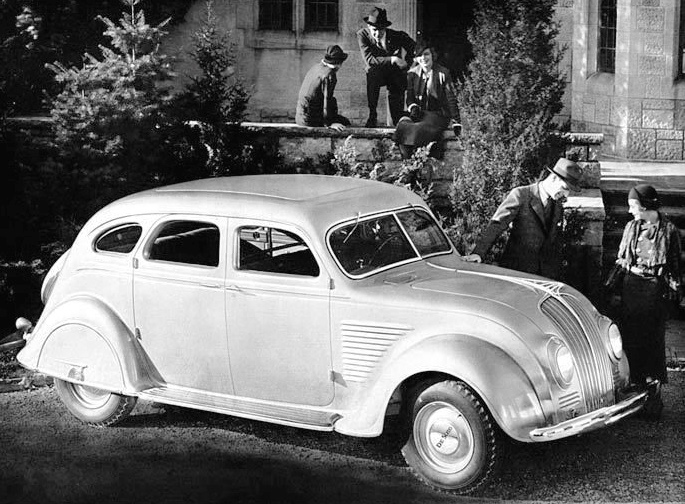
What Were They Thinking?: Spatted Front Wheels

Applying aerodynamic streamlining to automobiles, either symbolically or in reality, didn't seriously begin until the early 1930s and intensified over the decade.

In streamlining theory, a car's shape should be as smooth and integrated as possible.  Therefore, should not wheel wells be covered either with removable spats or seamlessly?  Nowadays, most cars and SUVs have exposed wheels even though their body designs were tested in wind tunnels.  Why is that?  Perhaps the trade-off between accessibility and aerodynamics favors the former.

In the 1930s and 1940s rear wheels often were either spatted or had shorter wheel well openings. The practical problem here has to do with gaining access to the tire for repairing a flat or chaining up for snow driving.  A small wheel well opening offers less room to work, and if spats are installed, then they might have to be removed to allow any work to be done.

Few cars had covered or spatted front wheel openings.  The most common examples of covered (but not spatted) front wheels were 1949-1956 Nashes and 1950-54 Nash Ramblers.  Spatted front fenders were mostly found on French custom car bodies such as shown below.  Beside accessibility difficulty, covered front wheels have the further problem of restricting a car's turning radius.  The Nashes just cited were typical American cars of their era in that wheels were mounted several inches inbound from the sides of the car body.  In recent decades, American (and essentially all other) cars have wheels at almost body-width, one reason why they are fully exposed.  The European cars shown below also were narrow-track, and turning radius was helped a little further by bulging out the front fenders and their spats sometimes even more so.

Gallery

1929 Travel Air "Mystery Ship"
Teardrop-shaped spatted wheels on fixed (non-retracting) airplane landing gear began to appear on racing planes such as this at the end of the 1920s.  I suspect these forms inspired car stylists a few years later.

1932 Delage D8S Roadster by Letourneur et Marchand, ex-Reneé Friederich racer - via Coachbuild
An early example of teardrop-shaped front fenders.  Spatting will come later.

1935 Mercedes-Benz 500K Roadster by Erdmann & Rossi for the King of Iraq
Unlike the Figoni & Falaschi designs shown below, this car's front fender sides are not bulged outwards.  So in order to achieve a reasonable turning radius, it's possible the the entire body was widened so as to keep the axle width relatively narrow.  (I cannot locate the source of this photo.)

1936 Delahaye 135 M Roadster by Figoni & Falaschi for the Aga Kahn
Figoni & Falachi was the coachbuilder that seems to have made the most cars with spatted front wheels.  This is an early example, as best as I can tell from a serious web search.

1937 Talbot-Lago 150-C SS by Figoni & Falaschi - RM Sotheby's via Car and Driver
Their next step was to connect the fenders.

1937 Delahaye 135 MS Roadster by Figoni & Falaschi - DB Pittenger photo at Revs Institute
Here the connection uses a small running board.  Note how the front fender is ballooned out.

1939 Delage D6-70 by Figoni & Falaschi, Tito Rossi at the wheel
A Delage D8 version of this design (with more elaborate chromed trim) was famously displayed at the 1939-1940 New York World's Fair, but without a complete motor.

1948 Delahaye 135 M "Narval" Cabriolet by Figoni & Falaschi
The first of the seven or so Narvals appeared in 1946.  They sell for outrageous prices at auctions.

1946 Fiat 1500? by Ghia?
I can't confirm the information in the title, but it seems okay.

1948 Alfa Romeo 6C 2500 Sport Cabriolet by Ghia
The spats make this design seem more ponderous and Buick-like than one would expect from Ghia.

1950 Nash Rambler Convertible
Nash-Kelvinator president George Mason had covered front wheels on 1949 Nash cars, and the new Rambler line got them the following year.

Monday, July 8, 2019

Some Styling Models of Ferraris

In May I was in Italy with a tour group, but my agenda differed from theirs in that my real goal was to visit three automobile museums.  However, on a Sunday -- a day when much of the country is closed -- the tour included a brief visit to the Ferrari museum in Maranello.  Like the other museums, the Ferrari had a few styling models on display.  Those are the subject of this post.

All the models I saw in the various museums were small, 1/10 actual size and even smaller.  I suppose their main purpose was to indicate actual proportions, something easily distorted in a stylist's rendering.  For mass-production cars, a full-size model was essential for evaluation.  But limited-production or even one-off designs could not be economically justified by that extra effort.

Note that one of the models pictured below was used for aerodynamic testing.  The purpose was to gain a sense of airflow on various parts of the body.  Determining the potential drag coefficient might not have been a primary task due to the difference in scale between the model and an actual car.

Click on images to enlarge (and for reading the museum's captions for the models).

Gallery


Model of 1948 Ferrari 166 MM Barchetta by Touring (background here).

1949 Ferrari 166 MM Barchetta, Touring Superleggeria.

Two models: first, regarding the one to the right in the photo.

The caption states that it's from 1966 by Pininfarina and of the Ferrari Dino 206 GT.

Publicity photo of the Dino 206 GT prototype.

A 1967 Ferrari Dino 206 GT.  Both examples lack the blended headlights seen on the model.

Caption for the model at the left of the reference photo: 1968 Pininfarina design P6.

Ferrari P6 concept model by Pininfarina. This was a engineless "pushmobile" that was exhibited, but did not directly see production.  This model was used for aerodynamic testing.


Photos of the Ferrari Pininfarina P6.

Thursday, July 4, 2019

Examples of Drastic American Redesigns

My book "Automobile Styling: From Evolution to Fashion" deals with American car design from around 1930 to around 1950.  By the end of the 1940s, automobile appearance was drastically different from what it was at the start of the 1930s.  For some brands during that period, change from one redesign to the next were quite noticeable, but not as drastic as could be found in other cases.

Generally speaking, the most abrupt, drastic redesigns could be found around model years 1934 and 1949.  For 1934 or thereabouts, squared-off bodies with distinct components such as headlights, fenders and so forth were replaced by redesigns that retained such components, but in softer forms harking to streamlining.  From then until shortly after World War 2 the streamlining concept continued while those components became less distinct as bodies became more integrated.  The first postwar redesigns yielded the highly integrated "envelope" shapes that became the basis for the norm ever since.

As dealt with in my book "How Cars Faced the Market: Grille Design Continuity," some brands such as Cadillac, Packard and Buick tended to preserve grille style themes from one design to its redesign, thus softening the impact of the change.  Pontiac did the same for many years by continuation of its "Silver Streak" chromed hood stripes.  I wrote about Chrysler Corporation's 1949 redesign here, and discussed grille treatment carryovers.

The present post has examples of the most dramatic styling changes found during that period and a while beyond.  As usual, images are factory publicity or cars listed for sale.

Gallery

1933 LaSalle
Final model year before a new design was introduced.  It incorporates some facelifting touches such as skirted front fenders, a V'd grille, a slightly raked-back windshield, and a touch of rounding on basic body features.  Still, the design isn't much removed from 1920s practice.

1934 LaSalle
The redesign.  By 1935 or 1936 most American cars had been given the more rounded, quasi-streamlined appearance of this LaSalle.  This marks a strong break from previous American sedan designs, but not a revolutionary break.

1948 Chevrolet
Here is another example of a design break that's clearly distinctly different, but not really drastic.  The body design of this Chevrolet first appeared in 1940 and was given facelifts since.

1949 Chevrolet
Chevrolet's postwar redesign.  Clearly a different feeling, but not extremely so, given that the prior body was already partly integrated.

1933 DeSoto
Now for some of those drastic redesigns.  This 1933 Desoto's basic body is very 1920s abaft of the A-pillar, but was facelifted in the form of a raked windshield, a rounded grille and puffier front fenders.

1934 DeSoto Airflow
The 1934 DeSoto Airflow is indeed drastically changed.

1948 Nash
Now for three Nashes.  The 1948 model shown here is a pleasant looking facelift on a prewar body.

1949 Nash
The redesign was radical, having the flavor of prewar imaginings of the postwar "car of the future" molded by aerodynamics.  Aside from the hood ornament and badges, '49 Nashes bore no resemblance to the '48s.  To my mind, the stylists went to too great an extreme.

1952 Nash
Nash management quickly realized that the 1949 design was on a trajectory removed from mainstream taste as defined by General Motors.  Now we find a boxy design that's still heavier looking that it ought to be.  The main carryover feature is the covered front wheels.  The grille outline and frontal lights are nearly the same.

1947 Hudson
The body design seen here first appeared for the 1936 model year and was heavily facelifted over time.  Note the cross-section profile at the B-pillar: clearly out of date even when compared to the '48 Chevrolet and Nash pictured above.

1948 Hudson
Hudson's 1948 redesign was totally new.

1949 Kaiser
Kaiser was a brand created after the war, and its body is an example of the "envelope" type.  Unfortunately, the styling was rather plain and bulky-looking, especially when compared to postwar designs from Studebaker, Hudson and the General Motors line.

1951 Kaiser
In compensation, the new 1951 Kaisers were lithe and sleek.

1946 Mercury
1948 Mercurys were nearly identical to the '46 model seen here.  Once again, it's a facelifted prewar design.

1949 Mercury
Mercury's postwar redesign was sleeker and more rounded: a major character revision.  The carryover detail is the vertical grille bars.

1952 Mercury
But the '49 style didn't jibe with the emerging fashion for a more boxy appearance, so Mercurys again changed their design character.

Monday, July 1, 2019

1935-36 Fiat 508 Balilla Berlinetta Aerodinamica MM

Streamlining was one of the major styling fashions of the 1930s.  Most examples that either passed through wind tunnels or at least incorporated considerable "teardrop" sculpting were not small.  That's because the real or imagined flow of air over a car body required a certain proportional length to look right or perform right.

I came across one exception, a rather small, stubby car with all the usual teardrop items that actually is attractive.  It is the 1935-1936 Fiat 508 Balilla Sport Berlinetta Aerodinamica Mille Miglia -- to list all the names associated with it (though usually only some of these are mentioned on one Web site or another).

Some background can be found here at RM Sotheby's auction site as well as here.

Both sites mention that its designer was Conte Mario Revelli di Beaumont, an important stylist who worked with Fiat and various Italian coachbuilding firms over a long career. The second link mentions that Beaumont designed a Balilla-based Mille Miglia streamliner for SIATA, this leading to Fiat having the Balilla Aerodinamicas built. Its form was probably sketched sometime in the second half of 1934, so the styling was highly advanced.

Only 11 of the Fiat-built cars were made, and three or perhaps four survive, based on what can be viewed on the Internet.  There might even be more than that: remarkable, considering they were built nearly 85 years ago and had to survive a war along with the usual entropy.

Besides some 1930s items, the images below are of three known survivors photographed as sales publicity.

Gallery

The initial version for SIATA.  So far as I can tell, this car no longer exists.  Carryover details include its general profile (but not the rounded nose), the window profile, and the teardrop-shape fenders -- though even these are not identical.  However, the spirit of the design was retained.

Factory photo of the Balilla Aerodinamica.

Another likely factory image.

Front quarter view of a 1936 car.  Unlike the SIATA, the hood, grille, and light assemblies are close to stock Balilla items.  Due to its short size, the windshield is flat, not V'd (which would have made the greenhouse slightly longer, perhaps adding visual bulk).  None of these cars seems to have had bumpers.

Rear quarter view: taut and well-shaped teardrop elements, especially considering how small the package is  The chromed quasi-windsplit is a nice touch.  A rear bumper would have badly interfered with the design, practical though it would have been.

Overhead view of a 1935 Aerodinamica emphasizing the teardrop theme.

This side view of another 1936 car is the only one that reveals how stubby the car actually was.  Beaumont did a fine job of disguising this.

Thursday, June 27, 2019

Chevrolet's Ill-Fated Second-Series Corvair

From around the end of the Great War until 1960 the American automobile industry built cars to the engineering convention having the following characteristics: Water cooled motor at the front of the car connected by a drive shaft to a rear-mounted differential.

There were almost no exceptions.  One was the Franklin whose engine was air-cooled, but the rest of its drive-train conventional.  Cords and Ruxtons had front-wheel drive, but their motors were water-cooled.  The brands mentioned here had an almost invisible share of the American market.

But during the late 1950s sales of Volkswagen Beetles with rear-mounted air-cooled motors were surging to the point that the Detroit Big Three carmakers decided that they had to react in order to preserve or even recover market share.  Ford and Chrysler introduced "compact" (smaller than U.S. standard size) cars for the 1960 model year.

General Motors also introduced a compact car, the Chevrolet Corvair.  The Corvair defied the existing convention by following VW, its motor being rear-mounted, air-cooled and with a flat (six opposed cylinders) layout.  The Corvair was praised in the automotive press for finally! showing some innovation.  And the cars sold reasonably well at first.

But cars with rear-mounted motors have a potentially serious flaw: At speed and due to icy roads or driver-induced maneuvering, the heavier rear will tend to rotate the car so as to lead in the direction of the car's trajectory.  That is, the car will do a half-spin so as to travel rear-end forwards.

Rear-engine VWs would do that, even a mid-engine car such as a Porsche 914 would -- I know about both through personal experience.  Over much time, Porsche engineers have been able to minimize this tendency, though they cannot easily overcome basic physics.

The link above tells of the crusade by lawyer Ralph Nader against the Corvair, calling it unsafe due to the rear-mounted motor and characteristics of the rear suspension system.  This accusation drove sales drastically downwards, the car affected being the second-generation Corvair introduced for 1965.

In this post, I deal with styling of the 1965 Corvair.

Gallery

I'll mostly focus on the coupé version of the Corvair.  To start setting the scene, above is a 1960 Corvair Monza Coupe (Mecum Auctions photo).  It has a short passenger compartment with a cramped rear seat (as I also know from experience).  The area abaft of the greenhouse is long in order to house the motor and related components.

A smaller, but analogous car is the 1961 VW Karmann-Ghia 34.  Its proportions are similar to the '60 Corvair's.

Proportions of the redesigned 1965 Corvair coupe shown in this "for sale" photo are again similar.  Note the aft point of the greenhouses in relation to the rear wheels.  Clearly, engineering considerations dominated the body "packages" and the resulting styling.  Even so, the '65 Corvair had a proportionally shorter aft zone, and so is a better balanced design.


Two Hyman Ltd. photos of a 1965 Corvair Corsa Coupe.  Styling is consistent with General Motors practice at that time during the Bill Mitchell design supremo era.  Pleasant looking with no obvious major flaws.  Impressive, actually, considering the need to deal with a rear-engine layout.

There were convertible 1965 Corvairs, this one listed for sale.

And there were four-door hardtop Corvairs as seen in this and the following "for sale" images.  Here GM engineers and stylists were able to achieve proportions not far from those of conventional, front-engine designs.

Note how subtly the air-cooling intakes are blended with the backlight.  The near-microscopic C-pillar sail panel helps to achieve a conventional, for 1965, appearance.

Here is a 1960 Corvair sedan seen from a similar angle.  Its design was established about the time Harley Earl was retiring as GM design vice-president.  It probably didn't have much Earl influence, as features such as the wraparound backlight reflect standard 1959 GM sedan designs created in reaction to preliminary work incorporating Earl's ideas.