Monday, October 9, 2023

1930s BMW 326 Sedan - 327 Coupé Comparison

BMW's model 326 (production years 1936-1941, 15,936 built) was a four-door sedan with convertible variants.  It served as the basis for a two-passenger sporty variant, the BMW 327 (production years 1937-1941, 1,965 built in that time frame).  BMW 327s at first were cabriolets (convertible coupes / drophead coupes), and actual fixed-top coupés were added during 1938.  Data above are for pre- World War 2 production.  Production for both models was resumed postwar in Eisenach, Soviet occupation zone / East Germany.

The 326s and early 327s used the same 1971 cc motors.  A more powerful engine variation used on BMW 328 sports and racing cars was added to the 327 line, those cars named the BMW 327/28.

As for dimensions -- Wheelbases: BMW 326 = 113 inches (2870 mm), BMW 327 = 108 inches (2750 mm);  Lengths: BMW 326 = 180 inches (4600 mm), BMW 327 = 177 inches (4500 mm);  Height: BMW 326 = 61 inches (1540 mm), BMW 327 = 56 inches (1430 mm);  Width for both: 63 inches (1600 mm).  In words, 327s were definitely less tall than 326s, but nearly as long and just as wide.

Regarding styling, credit for the BMW 326 is given to Peter Schimanowski.  I haven't been able to find much information about him, aside from that he continued to style Munich-based BMWs postwar.  I also haven't found credit for the BMW 327's styling, but I think it highly likely that Schimanowski was  greatly involved.

Below are comparative design images.  I haven't discovered the source of the 1936 326 sedan photos, but those of the 1938 327 coupé are via Artcurial, a French auction firm.

Gallery

BMW 326.  The passenger compartment greenhouse is proportionally tall.  Large windows give it an airy appearance that's degraded somewhat by the heavy, rounded roof.

BMW 327 Coupé.  Its frontal components are more integrated than on the 326.  No front catwalk, for instance, replaced by the blended headlight assemblies.  Both cars have V'd, sloped-back windshields.


Greenhouse is lower, windows less high.  The hood cutline is similar, though the side venting shape differs.  Otherwise, both cars appear to share the same hood.  The zone between the A-pillar and hood cutline is greater here.  The forward door cutlines seem the same, and door handle positions ditto.  Fenders on the 327 are longer with more pleasing curvatures.  But note that both cars' fenders feature sculpting along their sides.


That fender sculpting is seen in these images as well.  Spare tires are trunk-mounted on both cars, though the 327's treatment is cleaner, more integrated.  Backlight windows are two-pane on both cars, though not the same shape.  The 326 had dual bumper bars front and rear, but for the 327, only one at each end.

Thursday, October 5, 2023

Short-Wheelbase Post-War Plymouths and Dodges

This post adds some information to supplement previous posts "Plymouth's 1949 Fastback" here, and "The Transitional 1949 Dodge Wayfarer Line" here.

Post- World War 2, Chrysler Corporation was in second place in terms of sales behind General Motors and ahead of the then-struggling Ford Motor Company.  It was prosperous enough to spend more money than was perhaps necessary on its redesigned 1949 model line that I wrote about here.

Besides a set of what can be considered standard-size bodies used for all brands (Plymouth, Dodge, DeSoto and Chrysler), shorter-wheelbase bodies were produced as entry-level models for Plymouth and Dodge.  They never sold well, but were mostly kept in production during the basic 1949-1952 lifetime of that body range.  For example, model-years 1951 and 1952 saw entry-level Dodge Wayfarers' share of Dodge production at 19.2 percent.  For those years, Plymouth's Concords were only 12.6 percent of total Plymouth production.

Total production of these smaller Plymouths and Dodges over 1949-52 was 465,139 - perhaps enough that Chrysler didn't lose money on them.  An average annual sales total of around 115,000 in those days would have been profitable for a maker of mid- or higher-price cars.  For example, Nash production for 1949 was 135,328 while Hudson built 159,100 cars.  More-upscale Packard produced 116,248.  But aside from Plymouth's new, all-metal station wagons, the rest of the model line cars had entry-level prices and lower break-even points.  So I can't rule out that Chrysler lost some money there.

Moreover, Plymouth and Dodge versions differed in wheelbase and, as will be shown below in the Gallery, differed in some structural areas.

Regarding wheelbases, Plymouth DeLuxes and (later) Concords had 111-inch (2819 mm) wheelbases, compared to 118.5-inch (3010 mm) wheelbases for standard size Plymouths.  Dodge Wayfarer wheelbases were 115 inches (2921 mm) compared to 123.5 inches (3137 mm) for regular Dodges.  So the smaller Plymouth and Dodge wheelbases differed by 4 inches (102 mm), resulting in additional tooling expenses for chassis' and bodies.  Why couldn't they have shared the same, say, 113-inch (2870 mm) wheelbase?

Featured below are fastback 2-door sedans and business coupes.  Not shown are roadsters and station wagons.

Gallery

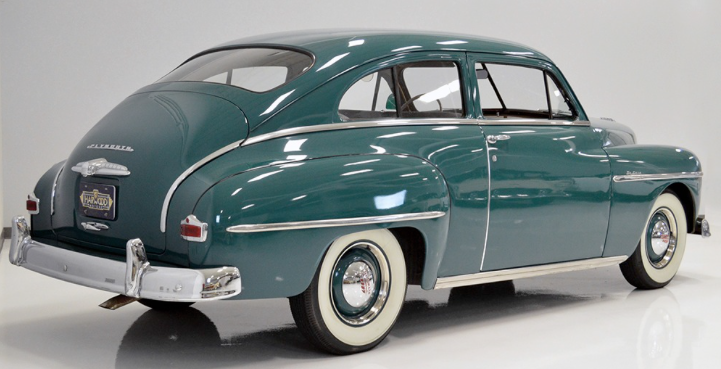
1950 Plymouth P19 DeLuxe 2-door sedan - car-for-sale photo
Fastback styles were still in production around 1950, though rapidly losing popularity to the more practical (in terms of trunk carrying capacity) bustle-back designs.  Perhaps playing it safe in case trends changed, Chrysler Corporation added the Plymouth and Dodge fastbacks discussed here.

1952 Dodge D-42 Wayfarer 2-door sedan - Barnfinds photo
The Dodge version was partly a fastback, but did feature a small aft bustle.

1950 Plymouth P19 DeLuxe 2-door sedan - car-for-sale photo
At least the fastback Plymouth looked less boxy than standard Chrysler Corporation sedans.

1952 Dodge D-42 Wayfarer 2-door sedan - Barnfinds photo
Rear sheet metal is considerably different than shown on the Plymouth above.  Was the additional tooling expense worth it?

1949 Plymouth P17 DeLuxe Business Coupe - Vicari Auctions photo
Plymouth dropped its Business Coupe line after 1951.

1952 Dodge D-41 Wayfarer Business Coupe - car-for-sale photo
But Dodge built coupes 1949-1952 even though sales were less than half those of Plymouth's.

1949 Plymouth P17 DeLuxe Business Coupe - Vicari Auctions photo
Unlike the 2-door sedans, rear end sheetmetal was shared by Plymouth and Dodge business coupes.

1952 Dodge D-41 Wayfarer Business Coupe - car-for-sale photo
The different aft curve of the rear fenders of both Plymouth and Dodge business coupes was introduced for 1951.

1949 Plymouth P17 DeLuxe 2-door sedan - car-for-sale photo
Side views often tell the tooling tale best.  Note especially the shape of the Plymouth's door, including the vertical B-pillar.

1949 Dodge D-29 Wayfarer 2-door sedan - BaT Auctions photo
The Dodge has added length between the front wheel opening and the forward door cutline.  The door seems to be the same width as the Plymouth's, but the B-pillar leans forward above the beltline.  As mentioned above, aft shaping is different.

1949 Plymouth P17 DeLuxe Business Coupe - car-for-sale photo
Business coupe styling was almost the same for both brands.

1952 Dodge D-41 Wayfarer Business Coupe - car-for-sale photo
Again, the longer wheelbase is accommodated by the added length forward of the cowling and door.  The forward slant of the above-the-beltline B-pillar is carried over from the Dodge 2-door sedan to this coupe.  Rear overhang is longer than shown in the previous photo, but shared with the slightly facelifted 1951 Plymouth Business Coupe.

Monday, October 2, 2023

Jaguar Mark 1 to Mark 2 Facelift

Jaguar's circa-1960 mid-size model was a market success.  These were produced from 1955 into 1969.   Retroactively, two main generations are identified: Mark 1 (1955-1959) and Mark 2 (1959-1967), also the 240 and 340 models based on the Mark 2 body (1968-1969).

The Mark 2 was a facelifted Mark 1, though the main area that was modified was the passenger compartment greenhouse.

These cars featured unit-bodies rather than previous Jaguars that had body-on frame construction.  Unit bodies are more expensive to modify because the body is a structural unit with the strength to support the mechanical parts of the car -- what the frame did in the body-on-frame case.  This meant that body changes could not be too drastic if it were to be affordable for a firm of Jaguar's capitalization.

The facelift is shown in the images below.

Gallery

1958 Jaguar Mark 1 3.4-Litre - Gallery Aaldering photos
This is a left-hand drive version sold in Holland or perhaps elsewhere on the Continent.

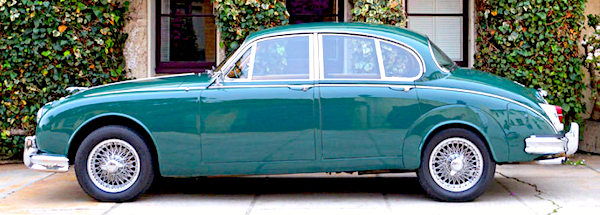
1961 Jaguar Mark 2 3.8-Litre - car-for-sale photos
Aside from minor details at the front, the main difference shown from this angle is the slightly wider windshield and narrower A-pillar framing.

1959 Jaguar Mark 1 3.4-Litre - photo via Classic Car Garage

The roof appears flatter, due to the higher profile of the side windows and related revised door framing.  That chrome framing reduces the visual bulk of the B-pillar.  Rear door windows are longer as well, reducing the size of the C-pillar.  The shape of the retractable window segment also was changed.  The result is an airier greenhouse.  Door handles are slightly repositioned.


The major change from this perspective is the larger backlight window that further reduces the size of the C-pillar.  Tail light assemblies are redesigned.

As best I can tell, these changes, especially regarding the A-pillar, imply less structural rigidity in the case of a rollover accident.  Remember, this facelift took place more than a decade before American regulations regarding accident safety were implemented.  Even so, later Jaguar four-door cars featured similar thin-looking A- and B-pillars: Perhaps there was enough structural strength to satisfy the bureaucrats.

Thursday, September 28, 2023

1993 Bugatti EB112 by Giugiaro


The car pictured above in front of the abandoned Automobili Bugatti factory in Campogalliano, Italy, near Modena, is the second of three Bugatti EB112s.  Some background on the EB112 is here, and on that car is here.

The iconic Bugatti brand name tempted revival more than once following the original firm's demise not long after World War 2.  The brand is now part of Volkswagen's portfolio, and production Bugattis are supercars that I find difficult to relate to.

The other serious revival took place around 1990.  A factory was built, engines designed, and Giorgetto Giugiaro of Italdesign was hired to create the styling.  A prototype car was completed in 1993, before the Bugatti firm foundered.  During liquidation, parts for more cars were bought by Gildo Pallanca Pastor of Monaco and used for creation of two more cars that were completed around the year 2000.  One of these was sold early 2002 for what must have been a substantial price.

I'm not sure about sources for the images in this post.  A few are likely from Italdesign, others are from Schaltkulisse, the Munich firm dealing with the sale of the No. 2 car.  But there might be other sources as well.

Gallery

It is likely that the body was windtunnel-tested.  The traditional Bugatti horseshoe grille design is retained, though aligned with the frontal shape of the hood.

The crease along the centerline of the car harkens to the famous Bugatti 57SC Atlantic.  It extends across the backlight window, fading to the Bugatti logo on the trunk lid.

Front view, where the horseshoe grille predominates, due to its chrome trim and the lack of chrome elsewhere.  This is the for-sale car.  The car in the previous two images is owned by Italdesign or its successor, so far as I know.

The theme is rounded shapes, unlike the angular designs Giugiaro created in the 1970s.

The roofline is rather high at the rear, but not too high, as in the unfortunate case of the 2010 Porsche Panamara.

The fastback curve reminds me of 1940s General Motors designs, though it lacks the sleeker boat-tail plan profile of those cars.

Giorgetto Giugiaro with his creation.  It's a nice design, and with its V-12 motor it had the ingredients of a successful car (though competition in that price-prestige bracket has always been fearsome).

Monday, September 25, 2023

The Most Attractive Chrysler Airflow?

Chrysler's mid-1930s Airflow line is generally regarded as being somewhat ugly-looking ... maybe even seriously ugly-looking.  I never thought they were attractive, but am starting to change my mind a little.

I'm convinced that perception of beauty is subjective.  And my mind seems to be wired such that I find it difficult to proclaim something as being best or worst.  ("What was the best thing you saw on your last European vacation" is a question I almost always can't answer.  I tend to think of gradations more than absolutes.  Maybe that's due to my super-fancy gold-plated Ivy League grad school training.  Or mental laziness.)

This leads to Chrysler Corporation automobile stylist and styling historian Jeff Godshall (who I wrote about here) and his assessment as to the most attractive Airflow.  It can be found in Volume 23, No. 4 (April 1994) of Automonbile Quarterly, an issue devoted to Chrysler Corporation.  In his article "Form, Function and Fantasy: Seventy Years of Chrysler Design" he stated:

"My own personal favorite was the [1934] Airflow Imperial Eight Series CV five-passenger coupe, whose radically sloped rear deck concealed the spare tire ...."

Let's consider that, along with one or maybe two other Airflows that I currently like a bit better than his choice.  Feel free to disagree with one or both of us.

Gallery


1934 Chrysler CV Imperial Airflow Coupe - Revs Institute photos
Here is Godshall's favorite.  Definitely nicer looking than the bulky Airflow sedans and any of the stubby '34 DeSoto Airflows built on the short 115.5 inch (2934 mm) wheelbase.  The CV's wheelbase was 128 inches (3251 mm).

1935 Chrysler C1 Airflow Coupe - Mecum Auctions photos
My current favorite is this 1935 model built on a 123 inch (3124 mm) wheelbase.  Although stylists and critics such as myself usually prefer the first, pre-facelift version of a new body design, I've recently begun to think that the 1935 Airflow facelifts were better looking than the original design.  Although the rounded-down noses of 1934 Airflows was probably more pure aerodynamically, the longer hoods and stronger grilles on the facelifted 1935 models made them aesthetically superior.

1934 Chrysler CV Imperial Airflow Coupe - RM Sotheby's Auctions photo
Rear quarter view of a CV coupe with that fastback feature that Godshall (and I) like.

As seen on the C1 coupe.

Now for the important side-view evaluation.  This '34 CV Imperial's wheelbase is five inches (127 mm) longer than the '35 C1's.  This greater length was manifested in the zone between the door's after cutline and the rear fender.  The result was a longer, larger passenger compartment.  And a comparatively stubbier hood and front end.

The 1935 C1's passenger compartment is visibly smaller (just compare the aft side window lengths and vent pane break lines).  I usually like long-looking hoods, and so this this C1 is better proportioned than the CV by that metric.  Though I wonder if the hood might be a trifle too long.

1934 Chrysler CU Airflow Coupe - Worldwide Auctioneers photo
Here's the '34 version.  The hood seems a bit too short.  Should I call it a toss-up between the two versions?

1937 Chrysler C17 Airflow Coupe - car-for-sale photo
This final-year Airflow coupe is not an Imperial, but is built on the same 128 inch wheelbase body platform as the 1934 Imperial Coupe shown in the comparisons above.  I include this image because it shows that body with a longer hood and a fairly attractive, conventional (for the time) grille.  That longer hood better balances the longer passenger compartment mass than the '34 Imperial coupe's does.  And the more substantial body could be a little more attractive than that of the '35 C1 coupe.  So just maybe this was the best-looking Airflow of all (though I'm still inclined to favor the 1935 C1 coupe due to its grille's backwards slant).

What do you think?

Thursday, September 21, 2023

John J. Chika 1940-Vintage Styling Sketches at Chrysler Corporation

John J. Chika was an automobile stylist active from around 1940.  His career began at Chrysler Corporation.  Then around 1945 he led the styling section for the Kaiser brand, leaving in 1947, about a year after production began.  After that, he worked for General Motors.

Given that track record, it seems that he was respected in the industry.  Yet his early drawings are not very impressive.  Some of these can be found in the book "Imagine! Automobile Concept Art From the 1930s to the 1980s" by Patrick G. Kelley, featuring renderings from his collection.

Three of the drawings shown below are via that book, and others are images found on the Internet.

Click on the images to enlarge.

Gallery

This was made in 1941.  Note that perspective is distorted, the rear part of the car seemingly being twisted towards us.  Might that have been done on purpose, so as to better show side features?  Or did Chika simply not understand perspective well at that stage of his career.  The concept reminds me of the 1948 Hudson.  Details of note are a wraparound windshield (not seen on production cars until the mid-1950s) and what might be a tail fin (later '50s).

A 1940 drawing.  The band running around the car is similar to those seen on some Chrysler Corporation styling clays that I wrote about here and here.

Another in the same apparent series.  The lower body is not tall enough -- stylists then and later often used a good deal of distortion.

This 1941 drawing is a design for Dodge.  Once more, a lot of distortion.  Ignoring that, one can see a fenderline/beltline treatment similar to a blend of Chrysler and GM features circa 1949.

A 1940 DeSoto drawing, according to the word in the grille area.  That bulge above the bumper is similar to that found on 1942 Lincolns.  Another sign that China's thinking was in line with styling ideas percolating at that time elsewhere than Chrysler.

 
Another 1940 DeSoto proposal, this showing a grille concept not far removed from that of DeSoto's 1942 design.  This drawing is much better than the others in terms of realistically depicting a potential automobile design.

Monday, September 18, 2023

2002 Ford Thunderbird Walkaround

Like the original 1955 Ford Thunderbird, the 2002 final generation model seated only the driver and one passenger.  All other Thunderbirds were at least four-place.

The 2002 car was "Retro" in that while it had a wind tunnel tested shape, ornamentation cues came from the original, non-aerodynamic design.  Unfortunately, sales were below expectation.

I thought the 2002 Thunderbird was attractively styled, its shape more coherent than was the '55 model that in some respects was a scaled-down version of a 1955 Ford convertible.  Today's post presents a walkaround of a '02 T-bird for your viewing enjoyment.

Images below are via Bring a Trailer auctions.

Gallery