Thursday, May 9, 2019

Austin A90 Atlantic Design Source Puzzle

Since I wasn't there to experience it, my knowledge of post- World War 2 English cars is not as good as it might be.  Which is why I hope some readers will pitch in regarding whether or not there was a "missing link" in the inspiration of the design of the Austin A90 Atlantic.

The Wikipedia entry cited above states (as of January 2019):

"The Atlantic was one of the first post-war cars engineered from scratch by Austin, and was said to be styled from a thumbnail sketch by Leonard Lord, then Chairman of Austin and later the British Motor Corporation (BMC) — though in truth the styling was more likely the work of resident Argentinian Austin stylist Dick Burzi. The car was almost certainly influenced by a 1946 Pininfarina-bodied Alfa Romeo cabriolet, which just happened to end up at the Longbridge factory in mid-1947, a few months before the light blue 16 hp sports prototype made its first appearance in the experimental department and on nearby roads around the factory."

As for that Pinin Farina design, this link states:

"Ordered new by a wealthy lady from Milan, Giuliana Tortolli-Cuccioli, this car was bodied by Pinin Farina in 1946, on the base of one of the 14 Alfa Romeo chassis delivered to the coachbuilder in 1942...

"It was sold during 1948 to Leonard Lord, the Chairman of Austin, and became an inspiration for the Austin A90 Atlantic, before being used personally by the Managing Director, George Harriman. And it was then that an exciting new chapter in the car's life began. Holden Koto was a young designer collaborating with Raymond Loewy, who had offices in Paris, New York and London. In the early 1950s, Loewy signed a contract with British Leyland to design the new Austin Seven, and Holden Koto was sent to work at Austin for four months. While there, he expressed his huge admiration for the Alfa Romeo, and George Harriman ended by selling it to him, well below its value, as a bonus. Koto used the car for the next 12 months before taking it back to America with him."

One link has the Alfa turning up at Longbridge in mid-1947, the other gives 1948 as the date it was acquired by Lord.  Wikipedia says the dates of the 1948 Earls Court Motor Show were 27 October – 6 November.  Given the time to develop a production car body in those days, the 1947 date seems more likely.  But if Lord bought the car in 1948, it's unlikely that it inspired A90 Atlantic styling -- despite claims from some Internet sources including the first Wikipedia link above.

Also introduced at the '48 Earls Court show was the Daimler DE-36 Drophead Coupe by Hooper called the "Green Godess" by some.  Bonhams auction house states:

"The building and subsequent sorting out of the Daimler Green Goddess is well documented in surviving Daimler and Hooper & Co. Ltd. records. They show that just after New Year's 1948, Hooper body no. 9352 was commissioned, to be built to the coachbuilder's design no. 8183. Daimler DE36 chassis no. 51233, onto which the body for “the Chairman's car” would be mounted, was received by Hooper's on June 7, 1948. Osmund F. Rivers, Hooper's chief designer, was responsible for completing the car for Earls Court. During the final weeks of assembly, 24-hour departmental commitments were required to complete the car for the October 27 opening."

A related design, first appearing on a Rolls-Royce Silver Wraith chassis, as mentioned here:

"This beautiful Hooper bodied Saloon is a one off car with a very interesting history. In 1948, the chief designer for Hooper, Osmond Rivers, was commissioned by Hooper to design a "new look" to get away from the classic designs which had continued after World War II. He produced seven bodies. Once [sic] of which was shown at Earl's Court Motorshow in 1948. Fearing the car would not be well received because it was as he called it "rotund" Hooper asked for a more "razor edged" design. The result was design number 8234 on job number 9568 on chassis number WGC16. No other body was made just like it. It received great acclaim as a Motorshow One Off Prototype that influenced many designs to come. "

That is all the background I could find.  Now for some images to continue the tale.

Gallery

1950 Austin Atlantic Drophead Coupe - auction photo.  The design includes a centrally-mounted auxiliary light similar to that of the 1948 Tucker.  Borrowed from contemporary Pontiacs are "silver streaks on the bonnet and boot (hood and trunk).

Same car seen from rear quarter.  The true subject of this post is the feature of the front fender fading downwards to nearly the car's rear, combined with the lack of a distinct rear fender.  This style theme was in place at Austin months before the A90 Atlantic debuted in October 1948.

1952 Austin A90 Atlantic Sports Saloon - auction photo showing a coupé version.

1946 Alfa Romeo 6C 2500 Cabriolet Speziale by Pinin Farina - auction photo.  This was supposedly the inspiration for A90 Atlantic styling.  A case might be made that the extreme aft designs are similar, but the swept front fender feature is absent here.  Clearly this Pinin Farina design had minimal influence on the Austin.

1948 Daimler DE-36 "Green Godess" Drophead Coupé Earls Court show car, body by Hooper, photo via Bonhams.  On the other hand, this first example of Hooper's "Empress" fender style was first shown at the same time as the A90 Atlantic.  The fender theme is essentially identical.  Were the two designs one of those interesting cases of simultaneous inspiration?  Or was there another similar design from around 1946-47 that inspired them both?  Let us know in comments if there was one.

1949 Rolls-Royce Silver Wraith saloon by Hooper, for sale.  This was the "Empress" saloon that appeared at the 1949 Earls Court show.  Hooper built many variations on this theme over the following decade on Rolls-Royce, Bentley and Daimler chassis.

Monday, May 6, 2019

General Motors' 1961 "Compact" Cars

General Motors introduced "compact" (by American standards of the time) Buicks, Oldsmobiles and Pontiacs for the 1961 model year.  I compared their styling to that of standard-size cars for each brand  here.  In this post, I consider how GM stylists differentiated those models by brand, given that they shared the same body platform.

GM introduced another compact line that year, the Chevrolet Corvair. It was based on a different platform, so a comparison is not worthwhile. I wrote about the first-generation Corvair here.

Images of four-door sedans are shown below.  They are either factory photos or pictures of cars listed for sale on the Internet.  For each viewpoint they are shown in ascending price order: Pontiac Tempest, Oldsmobile F-85, and Buick Special.  Since all versions were given different grille / front end designs for reasons of brand identity, I'll mostly focus on other details.

Gallery

This is a rare entry-level Tempest survivor.  Upscale versions had chrome trim on the sculpted sides abaft of the front wheel opening suggestive of a hot air outlet.

All of these cars had a similar fold below the top fender line -- For F-85s, it was identical to the Tempest's.  Both cars also had a character line starting the the rear of the aft wheel opening and curving upwards as it extended forward.  The F-85 has a chrome strip to emphasize this.  However the cars differ on the panel forward of the front door, where the F-85's line extends to the front of the car while the Tempest's forms a downward J-curve.

Buicks were the most up-scale of the three and perhaps for that reason received greater differentiation.  Here the Special's upper fender fold forms a sort of spearhead shape at its front, unlike the Tempest and F-85.  That shape also was used on full-size Buicks, as noted in the first link above.

Now side views.  This entry-level Tempest shows the basic body without any brand identification frills aside from the J-curve noted above.

The F-85 has a dab of a character line abaft of the rear wheel well, blending with the rear bumper.  Otherwise, apart from the extreme front, things are the same as on the Tempest -- even the wheel cutout profiles.

As mentioned, the Buick has more differentiation.  The lower character line does not curve around the rear wheel well opening, but extends all the way to the rear of the car.  And the rear wheel opening is shaped differently than on the Tempest and F-85 (be aware that this photo probably incorporates some CinemaScope-style horizontal distortion, something fairly often seen on promotion images).  Finally, there is a noticeable sculpted wedge under the upper fold starting about the aft point of the greenhouse and extending to the rear.

As might be expected, the rear end treatment of the Tempest is simple.

Again, the F-85 is quite similar to the Tempest in this part of the car.  Even the rear bumper seems to be the same, though it is blended into the side sculpting mentioned above.

The Buick Special's rear has more elaborate sculpting than on the other makes.  But note that the bumper is the same as on the others, and that the detailing below it is a variation on the F-85's theme.

From the 1940s through the 1970s, General Motors stylists were well practiced at creating brand identities from the same basic body shell.  We have seen it here, where most major design elements are the same, yet the three models have distinct appearances.  The Pontiac Tempest gets my vote as being the most successful design, whereas the Buick has too many seemingly arbitrary tack-ons.

Thursday, May 2, 2019

Sunbeam Rapier with Loewy Styling

Back in the days when American carmakers owned European brands, there were occasions when models of one brand or another would feature Americanized styling instead of the sort of design expected from the country in question.  (Nowadays, styling has become internationalized, so German cars seem less German. Italian cars less Italian, etc. than was the case back in 1955, say.)  In the late 1930s, certain German Fords and French Matfords looked a lot like their USA counterparts.  Some, but not all Opel and Vauxhall models featured styling themes similar to General Motors' American models.

But the Rootes Group was still British-owned in 1955 when its new Sunbeam Rapier line featuring an American look was introduced.  Perhaps they thought Americans were style-leaders where passenger (not sports) cars were concerned, and they wanted Sunbeams to look "progressive" and not English-dowdy.  Whatever the motivation, Rootes contracted with Raymond Loewy's industrial design firm to do the Rapier's styling, as mentioned here.  At that time, Loewy's sensational 1953 Studebaker Starliner/Starlight coupé had appeared, perhaps influencing his selection by Rootes.

What I don't know is whether Rootes requested a Studebaker-like theme or if that type of style was what Loewy's group decided to do on their own.  Regardless, the design was accepted by Rootes management.  The result was an attractive hardtop convertible -- an American body type -- featuring American styling that in turn was probably influenced by the Italians.

Initial-series Rapiers were produced 1955-58, and facelifted versions continued through 1967, according to the Wikipedia link above.  That source reports 68,809 Rapiers built on the Loewy design, or about 4,600 per year on average.  Those production numbers are not large, but apparently were enough to keep the design in production while undergoing four facelifts.  Admittedly, only the first facelift was significant.

Images of first-generation Rapiers along with 1953 Studebaker Starliner coupés are shown below.   Photos are of cars publicized for sale.

Gallery

Sunbeam Rapier brochure cover featuring a Frank Wootton- style illustration.

1957 Sunbeam Rapier.

1953 Studebaker Commander Starliner.  Similarities to the Rapier include the passenger compartment greenhouse, the "frenched" headlight assemblies, the front wheel openings, and the fenderline.

Rear quarter view of the Rapier pictured above.

Side view of another 1957 Rapier.

Side view of a 1953 Studebaker Champion Starliner.  Details differ from the Rapier, but the theme is clearly quite similar.

Monday, April 29, 2019

General Motors' Headlight Evolution 1932-1942

Automobile headlights were becoming nested in car body parts in America as early as the 1934 model year.  But it wasn't until around 1941 that General Motors got around to doing it.  This was despite that GM designs under the direction of Harley Earl were considered style leaders in those days.

Why was this the case?  It happened that GM engineers, in particular "Boss" Kettering, thought that headlamps embedded in fenders would be subject to being put out of alignment if the fender was damaged by a collision.  This is true.  Whether this was truly a major problem or just a comparative rarity is probably debatable in any absence of insurance data.

Actually, GM headlight styling was aligned with most of the rest of the industry until about 1939.  Perhaps accepting Earl's dominance, or perhaps due to tooling cost considerations, many other firms retained separate headlamp housings through 1938.  Nevertheless, Earl had wanted integral headlights long before, and could cite 1936 Lincoln Zephyrs and 1937 Fords as competitors leading the way he wanted to go.  Finally he got what he wanted.

General Motors' mid-range Oldsmobile is used as the example shown below.

Gallery

1932 Oldsmobile
Nearly all American cars looked something like this in 1932.

1933 Pierce-Arrow - Bonhams photo
For many years Pierce Arrows had headlights perched atop front fenders as a visual trademark.  For 1933, they were partially embedded.

1933 Oldsmobile Eight
Oldsmobiles got new bodies for 1933 when streamlined appearance was starting to become a style fashion.  Headlamps were placed in aerodynamic-seeming housings that sat on posts.

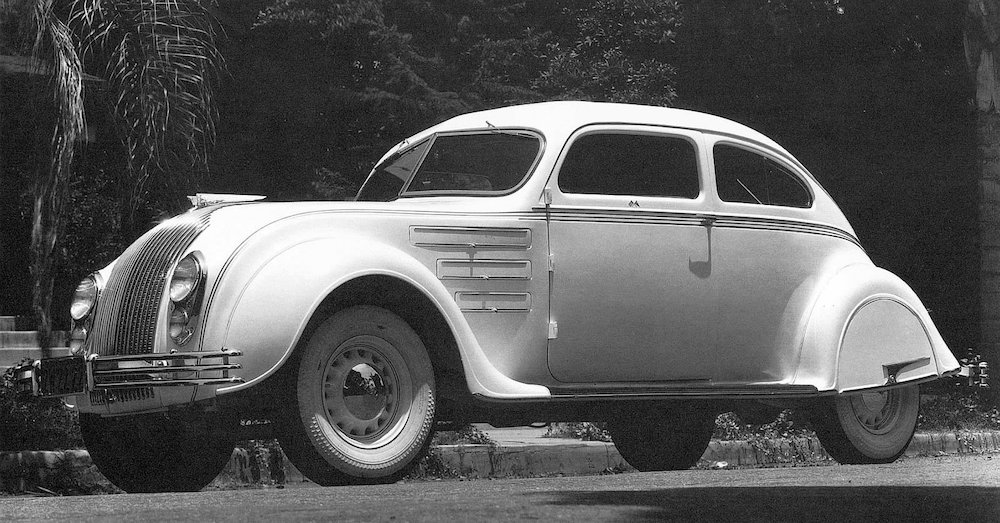
1934 Chrysler Airflow
Airflow design was wind tunnel tested.  Headlights are embedded in the car body.  Other Chrysler Corporation models followed General Motors practice until 1939.

1934 Hupmobile
Hupps were less-streamlined, but headlights also were faired into the body.

1934 Oldsmobile
For '34, Olds headlamp housings were more teardrop-shaped.

1935 Oldsmobile Six
Headlight housing attachments moved from posts to the sides of the body.  The background in the photo is San Francisco's Golden Gate Bridge under construction.

1936 Oldsmobile Six
No real change for 1936.

1937 Ford
Headlights are nested in the catwalk area.  This is similar to 1936 Lincoln Zephyr practice.  At this point, General Motors frontal designs began to look dated.

1937 Oldsmobile Six
Meanwhile, Olds headlights were still free-standing, attached to the hood area.

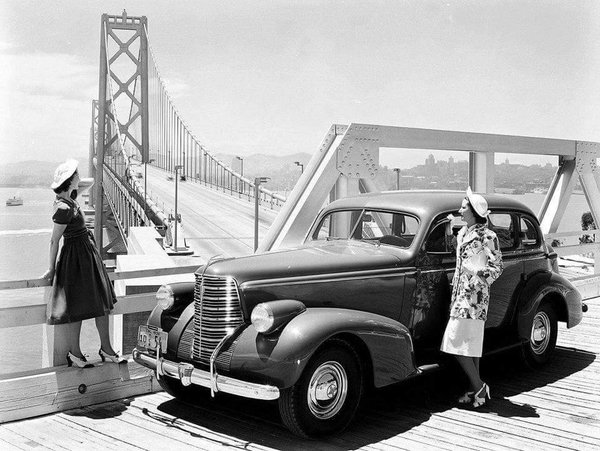
1938 Oldsmobile Eight
Now headlight housings are on the catwalk area, but remain separate elements even though they are very slightly integrated at their bottoms.  In the background is the new San Francisco Bay Bridge.

1939 Oldsmobile Six
Housings are moved ever-so-slightly down into the catwalks.  Meanwhile, many non-GM brands including Nash, Studebaker and the entire Chrysler Corporation line have headlights buried in front fenders.

1940 Oldsmobile 90
Headlight housings became more deeply buried for 1940, but only about halfway so.

1941 Oldsmobile
Finally GM headlights are fully integrated into the body shape.

1942 Oldsmobile B-44
Some GM brands had headlights placed near the fender edges for 1942, but Oldsmobile stylists held off until the 98 series was redesigned for 1948.

Thursday, April 25, 2019

Toyota's Yamaha-Built 2000GT Sports Car

Only 351 Toyota 2000GT sports cars were made 1967-1970, 62 of which were provided left-hand drive for sale in North America.

The Wikipedia entry outlines its fairly complicated background.   Apparently the original concept was by Yamaha, who failed to convince Nissan to produce the car.   But it appealed to Toyota.  What is not perfectly clear to me is how much body styling had been completed at that point.  Regardless, Wikipedia credits Toyota's Satoru Nozaki (English name-order) as being responsible for styling.

Confusingly, this RM Sothebys auction commentary mentions Raymond Loewy's name, but fails to pin down a direct connection to the car and does not mention Nozaki.

Then there is Mecum's commentary:

"Toyota began work on an automobile designed to compete with the new crop of premium European GTs, specifically the Jaguar E-type, as well as the Porsche 901 (soon called 911), Alfa Romeo 2600 and others. Project 280A was spearheaded by Toyota’s racing manager Jiro Kawano and his small team of around a half-dozen people, one of whom was stylist Satoru Nozaki.

"At the same time, Yamaha was attempting to expand its horizons as a sort of low-volume specialist subcontractor and had a four-cylinder sports car project called A550X ongoing with Nissan. Nissan had worked with Yamaha before but in this instance, altered its course and cancelled the A550X.

"As Yamaha had substantial money and commitment invested in the A550X, the company shopped it to Nissan’s arch-rival: Toyota. Since Yamaha would be assembling the limited-production sports cars, Toyota must surely have been pleased to avoid hand-building the engines and bodies. After that, a 2000GT prototype was swiftly completed for the 1965 Tokyo Motor Show in Harumi, where it stunned the world....

"Satoru Nozaki’s body was turned directly from his scale clay model into body bucks, and as no one in Japan had a production line capable of producing the 2000GT’s complex, compound curves, the semi-monocoque steel body was hand built, with all detachable panels and trim being numbered specific to each car. The impossibly low ride height of 3 feet 9 inches is made possible by a central beam, spine-frame with Ys at each end. This also created a front-mid engine position and gave the car its famously perfect balance."

A source I no longer can locate mentioned that Nozaki was inspired by the design of the Jaguar E-Type.  I placed some comparative photos in the Gallery section below.

The 2000GT is a superior design in my opinion, better than what Touring and Pininfarina were starting tp produce by the mid-1960s.  The majority of the 2000GTs ever built still exist, and from time to time you might have the chance to buy one at auction for someplace in the range of $600,000 to $1.2 million.

Photos below are of cars listed for sale or auction.

Gallery

Front 3/4 view.  The front features large, low-set lights that seem like headlights but might not be.

That's because the main headlights pivot upward when switched on.  Those lower lights are positioned fog-light height, so maybe that is what they are.

Side view.  Front wheel jounce range seems limited, but apparently there is no problem there.

Jaguar E-Type side view.  The similarity to the 2000GT seems superficial.  Shared characteristics are a long hood, a fastback/hatchback and the forward part of the rear fenderline.


Rear 3/4 view of the Jaguar and 2000GT.  The latter clearly has different shaping and detailing though the long hood - aft-set passenger compartment theme is the same.

Monday, April 22, 2019

1932 Fiat 508 Balilla / 1937 Fiat 1100

A popular 1930s Fiat line was called the "Balilla," or model number 508.  Somewhat retroactively there were the 508 A (1932-1934), 508 B (1934-1937) and 508 C (1937-1953), though the latter quickly became the first version of the Fiat 1100 and lost the Balilla name.  This post deals with he styling of Balillas from 1932 to 1939.  The Wikipedia entry for 508 A and B is here, and that for the C/1100 is here.

Balilla styling was never innovative, unlike a number of 1930s creations by Italian carrozzeria.  For that reason, I choose to compare some Balillas with contemporary cars that had similar details.  Most of the images below seem to be factory-generated publicity photos.

Gallery

This is a 1932 Ford V8 Deluxe Tudor, the only major American redesign for that model year.

And here is a 1932 Fiat 508 Balilla, also new for that year.  The Balilla carried a number of details that were old-fashioned compared to the Ford.  Its grille is flat, rather than slightly V'd.  There is a fixed exterior sunshade atop the windshield, a feature common in the 1920s.  And its general feeling is also that of a rather angular 1920s car.

A 1935 508 B in a "for sale" photo.  Its facelifted styling is behind the times compared to the 1935 USA norm.  Here the windshield is raked back slightly and the sunshade is gone.  The grille also tilts back and is more sculpted than the '32 version.   Front fenders are reshaped, carrying side skirts and extending farther downwards at the front.  Rear fenders have a touch of skirting.

1937 508 C Balilla, a complete redesign.  Note the detailing on the aft part of the passenger compartment greenhouse.

And compare it to this 1935 Ford Tudor.  It's possible the Ford inspired whoever styled the Balilla.

On the other hand, the Citroën 7 A appeared in the Spring of 1934, also having the same sort of sculpting in the area of the C-pillar.  Actually, that could be found on 1933 Ford two-door sedans, though on a more vertical greenhouse aft end, so it's difficult to determined who originated and who copied..

Another 1937 508 C.  Here we focus on the front end, its sloped hood-grille ensemble specifically.

The Balilla design might well have been inspired by the hood/grille of the 1936 Peugeot 302, shorn here.

The Peugeot 302 had a comparatively long hood, but the 1938 Peugeot 202 was a smaller car, more in line with the Fiat 1100's proportions.

Fiat 508 C / 1100 cars got a facelift for 1939, as can be seen in tis image from Fiat's Centro Storico (Historical Center).  As usual, the styling lags a few years, the grille being similar to what American cars were wearing around 1937.  It did change the character of the design, which was what must have been intended.