Thursday, December 19, 2024

1958 Studebaker Silver Hawk Walkaround

Today's subject car is featured due to availability of a fine set of car-for-sale photos via Connors Motorcar Company.  The car itself might be described as a watered-down version of a classic design -- the 1953 Studebaker Starliner hardtop coupe created by Bob Bourke and his team under Raymond Loewy's direction.

I previously dealt with first-series Studebaker Hawks here.  Since then, many more good quality photo sets showing for-sale and auctioned cars have appeared on the Internet, including the one shown in the Gallery below.

The 1956 facelifted Studebaker coupes were given "Hawk" names.  This naming was revised for 1957 when the number of coupe models was reduced from four to two.  The newly named Golden Hawks were "hardtop" pillarless models, whereas Silver Hawks had B-pillars.  Those B-pillars made the overall design less pleasing, as will be explained below.

Wikipedia's take on the Silver Hawk is here.  Silver Hawks were marketed model years 1957-1959. Today's featured car is quite similar to the 1957 models, but its tail fin chrome accent is not as attractive as for 1959.  Sadly, available photos (as of October 2024) of '59 Silver Hawks lack the quality of the set shown below.

Thanks largely to their side trim, 1957-58 Silver Hawks were the least-attractive of all "Loewy coupes" aside from the unfortunate 1955 versions.  That said, they still were reasonably nice-looking cars.

Gallery

The most noteworthy feature of the 1956 Studebaker coupe facelift was the (then) unusual, seemingly old-fashioned tall grille opening.  The flanking openings echo the openings on 1953 Studebakers.

Thanks mostly to Chrysler Corporation, tail fins became the American styling fashion of the second half of the 1950s.  The mid-decade fad was wraparound (Panoramic) windshields, but fortunately, Studebaker coupes never received them.

Chrysler Corporation cars got modest tail fins on facelifted 1956 models, and imposing ones for their 1957 redesign.  Studebaker Hawks were in synch with Chrysler for 1957, as can be seen here.

The trunk lid redesign first appeared on 1956 Hawks.


Golden Hawks were given more attractive side and tail fin trim, as can be seen in the first link above.  The long chrome strip with the auxiliary strip along the fin shown here make logical sense, but not aesthetic sense.  The two-toning on the side of the fin emphasizes this; single-tone Silver Hawks looked somewhat better.

As for the effect of the B-pillar, its relation to the zone abaft of it is the problem.  Visual business is created.  That quarter-window plus C-pillar zone is narrow, and the B-pillar adds too much visual weight.  Which is why pillarless Hawks look more attractive.


Since I mentioned the 1959 Silver Hawk above, here is a photo (via Hagerty).  Note the better chrome treatment by the tail fin and elsewhere along the side.

Monday, December 16, 2024

1935 Packard 120 Upper-Middle Class Sedan and Its Competition

The Great Depression of the 1930s crippled or snuffed out American carmakers.  Upscale automobile manufacturers were especially heavily affected.  Their brands leaving the market included Auburn, Cord, Duesenberg, Franklin, Marmon, Pierce-Arrow, Reo and Stutz.

America's most popular luxury brand in the early 1930s was Packard.  By 1933 it was suffering from reduced sales so much that for model year 1935 it launched a model for the upper-middle price range, the One-Twenty.  It was a sales success, probably saving the company, which then continued on into the mid-1950s.

Today's post compares 120 sedan styling with those of competitors in its price range.  As will be seen,  the cars most resembling 120s were some 1935 General Motors models.  New 1935 GM's bodies were more advanced than the 120's because they had all-steel roofs, whereas 120s had fabric inserts on their roofs like other American sedans had in those days.

While researching the '35 Packard 120, I was unable to determine with certainty who created its styling.


The man in charge of styling at Packard was Werner Gubitz, pictured here.   The drawing in the photo is not that of a production 120.  Rather, it's a more shapely variation perhaps under consideration for the planned 1938 redesign.

Although evidence is strong that Gubitz did the styling for the 120, that similarity to new designs for 1935 Oldsmobiles and some other GM brands remains slightly puzzling.  That's because Packard had hired George Christopher from GM to set up volume-production infrastructure to handle hoped-for demand for 120s.  I can't rule out the possibility that Christopher might have had some knowledge of forthcoming '35 GM designs and passed along some thoughts to Gubitz.

Another consideration:  Cadillacs and LaSalles received new bodies for 1934 that previewed the 1935 redesign for models of all other GM brands aside from Buick.  However, these retained the industry-standard roof inserts.  So Gubitz was aware of this design trend from America's largest carmaker, but the 120 design was likely largely determined by the time those '34 GM cars were announced.

Let's take a look.  Unless noted, images below are of cars listed for sale.

Gallery

1935 Packard 120 Touring Sedan
First, some front quarter views.  The 120 necessarily featured the Packard grille-hood design theme.

1935 Oldsmobile Eight - publicity photo
The new for 1935 GM body.  The passenger compartment greenhouse's roof is bulged because it is all-steel and subject to metal stamping technology of the time.  Windows are strongly rounded, something of a styling cliche.  Note the faintly V'd two-pane windshield.  The lower body more resembles the Packard 120.

1935 LaSalle Touring Sedan
Slightly more expensive than the 120 was the LaSalle that was rebodied for 1935.

1935 Nash Ambassador - via ConceptCarz
Nashes were given a vaguely "streamlined" look for '35.

1935 Studebaker President Land Cruiser - via Studebaker Drivers Club
This thin-looking design appeared for the 1934 model year.

1935 Hupmobile J 521 - unidentified photo source
Another 120 competitor with a facelifted 1934 body.  The headlights integrated to the body are another example of early streamlining.

1935 Chrysler CZ Airstream Eight - Hyman Ltd photo
Most Chrysler Corporation cars received this new body design for 1935.

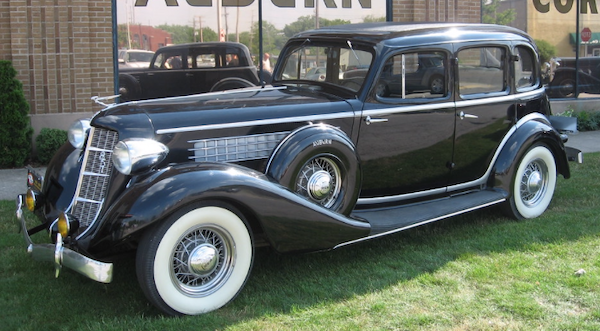
1935 Auburn 851 - unidentified photo source
Fenders are old-style, unlike the "helmet" shaped ones seen on most of the designs shown here.

1935 Graham Supercharged Eight Touring Sedan
A 1934 carryover design.

1935 Packard 120 - Downington Auctions (Australia)
Side-view comparison to a LaSalle.  Windows are better integrated here.  Fenders are more similar to those on the Oldsmobile shown above.

1935 LaSalle
The all-steel roof is visible.  Packard's hood styling is crisper, in line with hood-grille designs of other Packard models.

1935 Packard 120 - Downington Auctions
Right rear quarter view (I don't have a decent left rear quarter image).  Note the separate trunk door for the spare tire..  

1935 LaSalle Touring Sedan
Different in details from the 120, but the design is similar in spirit.

So far as I'm concerned, none of the designs shown above is very attractive.  That's because the mid-1930s was a period of rapid change, including the Chrysler Airflow's placement of the motor farther forward which allowed the back seat to be moved from over the rear axle line.  Also, "streamlining" became a body shaping fashion that few carmakers could successfully resist.  And production technology was slow to catch up with the needs of the latter.  The result: awkward designs.

That said, the Packard One-Twenty was solidly of its time for the first year or two of its initial run.

Thursday, December 12, 2024

Drastic redesign: 1952 Nash

A while ago I wrote a post titled "Examples of Drastic American Redesigns."   I included two Nash redesigns that featured practically no carryover (1951 to 1952) or none at all (1948 to 1949).

Today's post goes into more detail regarding the 1951 to 1952 redesign.

The 1949 Nash, which I dealt with here, was styled in the 1940-vintage "car of the future" mode.   Wikipedia mentions that the stylist version's streamlined shape was refined by wind tunnel testing.  The result was ponderous; when I was young, I called the design "upside-down bathtub," and I haven't changed my opinion much since then.

That design was clearly unfashionable, so the 1952 redesign was much more in line with American car industry trends, though still somewhat different.  It seems that the basic design was created by Nash's styling staff.  Italian designer Battista "Pinin" Farina was hired to provide an alternative '52 design that wasn't used, aside from some details.  But for marketing reasons he was given credit for the  production design. 

Images below are of Nash Statesman entry-level 4-door sedans with shorter hoods than the line-leading Ambassador.  The wheelbase of the '51 Statesman was 112 inches (2845 mm), and 114.3 inches (2903 mm) for the 1952 Statesman.  Respective widths were 77.5 inches (1549 mm) and 78 inches (1981 mm); heights: 61 inches (1549 mm) and 61.75 inches (1568 mm). Therefore, the sizes of the cars differed little despite the appearance change.   Photos of the 1951 example are of a car listed for sale, the 1952 images are via Mecum Auctions.

Gallery

A 1951 Nash Statesman, frontal view.  The main carryover is the general shape of the grille frame and the vertical grille bars.

The new design's front features a much lower hood and higher fenders.  The passenger compartment top is less rounded.  I don't recall seeing newly-built Nashes with this color scheme.

For more context, here is a photo of a for-sale 1950 Nash Statesman.  Its styling is nearly identical to the redesigned 1949 Nash.  But for 1951, Nashes were given a noticeable facelift.

The fender abaft of the C-pillar door cutline is new, adding visual length.  Nashes for 1949-1956 had restricted front wheel openings.  For the 1949-1951 cars, this was for aerodynamic reasons.  For 1952-1956 models, it was more of a brand image continuity feature, because aerodynamics had been downplayed. 

The only continuity visible here besides the wheel openings is the character line running above them that links the fore and aft bumpers.

The new rear fenders required new tail light assemblies.

Those assemblies, slightly reshaped, can be seen here.  The bumper guards also seem to be near- or actual carryovers from 1951.

Monday, December 9, 2024

1941 American Cars' "Speed Lines"

I wrote here about accents added to basic shapes of cars that are intended to enhance "visual dash/speed."   In the early 1940s, American stylists used stacked horizontal sculpted or applied lines for that purpose.   For instance, my post "American 1942 Wraparound Grille Chrome" deals with a type of short-length speed lines.

The present post features generally more lengthy sets of speed lines found on cars' fenders for model year 1941.  For some reason that was the peak year for such ornamentation, with little to show before or after.  All General Motors brands aside from Buick had examples.  Most Packards featured them.  And they were found on Plymouths and a few Studebaker models.

Let's take a look.  Unless noted, images below are of cars listed for sale.

Gallery

1938 Buick Y-Job - factory photo
This early concept car featured numerous speed lines on its fenders.  Later production cars were more more modestly attired.

1941 Pontiac De Luxe Torpedo
Pontiacs were known for their Silver Streaks -- parallel chrome strips along hood center lines and, occasionally, on trunk lids.  For 1941, parallel grooves/ridges were stamped on front and rear fenders, as seen here.

1941 Pontiac Streamliner - photo via Hemmings
Upscale '41 Pontiacs had those ridges enhanced by chromed speed lines.

1941 Plymouth Special DeLuxe
Chrysler's Plymouth line received stamped ridge speed lines, but no chrome.

1941 Chevrolet Special DeLuxe - Mecum Auctions photo
Chevrolet convertibles and top-of-the-line coupes got front fender speed lines.

1941 Oldsmobile 98
Olds Ninety-Eight Custom Cruisers were given panels with multiple thin speed lines.  They are difficult to discern in this image -- go to the Internet and seek close-up views if you are interested.

1941 Cadillac 61
All 1941 Cadillacs aside from Sixty Specials had speed lines.

1941 Packard Custom Super Eight One-Eighty Sport Brougham by LeBaron - RM Sotheby's photo
Packard speed lines were in groups of four.

1941 Studebaker President Land Cruiser - factory photo
Only Land Cruiser Studebakers featured speed lines.

Thursday, December 5, 2024

Jaguar Type 00 Concept Car Design

This post is being drafted 4 December, two days after the formal unveiling of Jaguar's Type 00 battery-powered concept car design, and a week or so following release of a controversial video commercial hyping Jaguar management's attempted revitalization of the brand.  Plenty of Internet bytes and pixels have been spilled already regarding the ad and now the two concept cars.

The reaction seems mostly negative.  On the other hand, Caleb Miller's favorable Car and Driver take on the Type 00 includes the following:

"I figured when the rest of the world saw the car, people would start to get it.  Jaguar has been stagnant and flailing, as its attempts to compete with Mercedes-Benz and BMW in the more mainstream luxury market have failed.  Recent efforts like the F-type and the XF were pretty, but they weren't distinctive or special enough to move Mercedes and BMW customers away.  Survival required something completely fresh, and moving into more expensive and exclusive segments will allow Jaguar's designers to not worry about mass-market appeal."

"Jaguar is trying to capture younger, wealthier, and more style-focused buyers, with plans to establish stores in high-end luxury shopping districts in cities such as Paris and London.  A large part of the rebrand and reveal of the Type 00 is simply getting the brand reestablished in the minds of potential customers.  The Type 00 was designed to generate hype, and this is probably the most attention Jaguar has gotten in the U.S. in decades, and possibly ever.  On those fronts, the Type 00 succeeds.  It may not rival the E-type's elegance or beauty, but it makes a statement that Jaguar has a future and that the path forward will be a different one."

The production embodiment of Jaguar's new direction is said to be a sedan due to appear in 2026.  The extent to which the Type 00 coupes preview the production model is unknown to me at this time.

I'll discuss Type 00 styling in the Gallery below.  As for Jaguar management's thoughts and actions, I offer the following:

The need to do something dramatic to enhance brand presence and excite potential buyers seems clear to me.  However, the proposed move to a higher price range might well be mistaken, given the size of that market and the number of potentially competing car models currently available.  Is it wise for Jaguar to become another limited sales potential Aston Martin sporting brand?  Or maybe sedan (saloon) competition to well-established Bentley and Rolls-Royce?  Not to mention the rarified models offered by the likes of Mercedes and BMW.

Then there is the matter of Jaguar's bad timing.  When the repositioning was made manifest in program planning, engineering and styling -- probably around two years ago -- it was assumed that BEVs (battery-powered electric vehicles) were surely the wave of the future, thanks to actions by various governments.  But during 2024, market demand for BEVs drastically declined, approaching collapse in some places.  Carmakers investing heavily in BEVs now seem to be in serious potential or actual trouble.  Luxury BEVs  don't strike me as being Jaguar's survival lifeline.

Images below are via Jaguar.

Gallery

BEV designs don't have to be wind-tunnel tested for the American market.  That's because fuel economy is essentially irrelevant for a carmaker's BEV line.  That might explain the brick shape of the Type 00's lower body.  (However, aerodynamic efficiency would be a battery power usage consideration for potential buyers.)

For some reason (fashion?) many current production BEV designs are simpler, less-cluttered than those of typical gasoline-powered cars.  The latter are fuel-efficiency constrained and wind-tunnel tested.  So their basic shapes vary little across brands, and stylists are reduced to trying to distinctly decorate those standard shapes to provide brand identity.

The windshield is drastically sloped, in contrast to the car's blunt front end.  The passenger compartment greenhouse hints at some past Jaguar coupe designs.  Doors open by pivoting upwards.

I'm not sure why the backlight window seems to be blanked over.  Perhaps some high-tech touch is involved.  Or maybe it's an example of show-car visual jazz.

Little streamlining is evident in this overhead view.

I'm inclined to agree with the observers who state that Jaguar is abandoning almost all of its historic market base, and that creating a new, profitable clientele might well be impossible.  Maybe they (1) might have gone slightly downmarket with flashier styling, while (2) building a V-16 line with flashy styling for the big spenders

Monday, December 2, 2024

Bristol - Same Basic Wheelbase 65 Years, 1946-2011

Bristol cars (Wikipedia entry here) were manufactured from 1946 (protoype) through 2011.  Most shared the same 114-inch (2896 mm) wheelbase even though there were a few body redesigns during that period.

This post presents side views of nearly all Bristol models based on that wheelbase.  Future posts might deal with other styling features.

Gallery

1949 Bristol 400 - Iconic Autioneers photo
The original Bristol's design was very mid-to-late 1930s.  The shape of the passenger compartment greenhouse is similar to that of many American coupés from that period.  So is the exposed running board.  The spare tire sits atop the trunk lid.

1951 Bristol 401 - car-for-sale photo
All that changed after Italian Carrozzeria Touring produced its classic design for Bristol that I discussed here.  When I think of Bristols, this is the design that usually comes to mind.

1955 Bristol 403 - Bonhams Auction photo
The next model retained the same design.

1957 Bristol 405 - car-for-sale photo
The 405s from 1954-1958 were unusual due to being four-door sedans (saloons) rather than coupés.  The wheelbase was the same as before, while the design was entirely new.  Behind the front wheel opening is a panel that opens upward, hinged at the fender chrome strip.  This feature, housing a spare tire (on the left side, battery access on the right side), was retained in subsequent models pictured below.

1960 Bristol 406 - Bonhams Auction photo
It seems that some of the frontal structure of the 405 was retained on the 406.  The design is the "three box" variety common until aerodynamic efficiency became important in the 1980s.

1961c. Bristol 407 - Factory photo
The main difference here is a longer chrome strip.

1963 Bristol 408 - Gallery Aaldering photo
New fender chrome strip design with a wider strip along the lower part of the side.

1969c. Bristol 410 - photo via Car and Classic
There was a Bristol 409 model, but it looked nearly the same as the 408.  This was the model seen in many episodes to the British television series "The Inspector Linley Mysteries."  Again, the main difference is the chrome trim.

1974 Bristol 411 Series 2 - car-for sale photo
Now the chrome is a wide strip aligned with the front and rear bumpers.  It's difficult to see here, but the hinge line of the spare tire panel is visible, not disguised.

1981 Bristol 603 Series 2 - car-for sale photo
1976 saw the introduction of a new design, yet again on the traditional wheelbase.  The passenger compartment greenhouse extends farther forward and the windshield rake is increased.  A slight slope to the rear contributes to a less-boxy appearance.  The tire panel hinge line adjoins the side sculpting.

1998 Bristol Blenheim - car-for sale photo
The rear is more boxy, adding a little more trunk space.