Monday, June 19, 2023

Jaguar Mark 1 and S-Type Compared

The 1955-1959 Jaguar 2.4 and 3.4-Litre cars retroactively called Mark 1 Jaguars boasted one of William Lyon's very best designs.  Well, that's my opinion: loved them from the first time I saw one.

More than 40 years later while Ford owned Jaguar, the 1999-2008 S-Type was created.  Although in the year-2000 design mode, it was given Retro features evoking the successful Mark 1 design and its strong historical Jaguar image.

I really liked it too, even though it was criticized by some who thought it should have been pathbreaking rather than Retro.  Since then, all that traditional Jaguar styling language has been abandoned, possibly to the brand's detriment.  But that's a story for another occasion.

Today's post compares the two designs so as to show how much classic styling was retained, and how much was generic year-2000 practice. 

In the comparison below, the Mark 1 car was listed for sale on the Internet.  The S-Type photos are via England's Car and Classic Auctions.

Gallery

The Mark 1.  Characteristics include a V-plan hood, vertical rounded-off grille, headlights mounted inboard of the fenders and settings for fog lights closer to the grille than the headlights are.

The S-Type. The main Retro carryovers can be seen here.  Grille has a similar shape, but not as tall -- a chin air intake makes up for that.  Four frontal lights, the larger ones placed close-to, but not at the fender edges.  The plan-view V shape on the hood is subtly sculpted, and the hood itself is essentially car-width.


The Mark 1 body sculpting abaft of the headlight assemblies is echoed here, but related to the inner lamps.


The S-type's wheelbase is 114.5 inches (2908 mm), that of the Mark 1 is 107.5 inches (2730 mm).  Respective lengths are 193.4 inches (4913 mm) and 181 inches (4597 mm).  The tuck at the after edge of the rear side window is echoed here.  Not the same profile, yet the Mark 1 spirit is evoked.


Almost no carryover at the rear due to packaging and aerodynamic considerations.


The S-Type's backlight window is more rounded than angular, so that's sort of a similarity to the Mark 1's.

Note the classic Jaguar tucked-down passenger compartment's aft end and the greenhouse's comparatively short length.  The car and its seating details are taller than on the S-Type.

Like most 2000-vintage cars, the S-Type's shape resulted from some wind tunnel testing in reaction to government fuel economy regulations.  So its side view contains no Retro items worth noting aside from that mentioned earlier.


Conclusion: The Retro part of the design is almost entirely found on the S-Type's from end.  And largely due to the grille and lights.

Thursday, June 15, 2023

Riley RMF - Last of the "Real Rileys"

As mentioned here, the Riley car manufacturing firm lost its independence in 1938, having been purchased by the Nuffield Organisation (i.e. Morris).

Perhaps due to wartime diversions for Britain's automobile industry, Riley was not fully integrated into Morris at war's end.  In fact, very shortly after the war, the first of Riley's RM series appeard, but carried over pre-Morris features.  Morris-based Rileys did not appear until the Gerald Palmer-designed Pathfinders arrived in 1953, as I posted here.

Today's post deals with the RMF of 1952-1953, the final 2.5-liter RM model.

Although its styling features were pre- World War 2, RMF proportions and shaping were attractive.  One of my reference books A Nostalgic Look at Riley Cars mentions (page 27) that the styling was by Eric Holmes and Eric Carter.

Below are some images for your viewing pleasure.

Gallery

1953 Riley RMF 2.5 saloon - for-sale car

1953 Riley RMF 2.5 saloon - for-sale car
This image and the next show a car with silver matte paint.  Not original paint, but this finish lacks highlights, allowing us to better understand the body sculpting.

Top coverings were standard on RM saloons.

1953 Riley RMF 2.5 saloon - images via Hemmings
Now for a few casual views of two other RMFs.

This car has tan-color top cover -- black was most common.

1953 Riley RMF 2.5 saloon - Historics Auctioneers photos

RMFs had substantial rear bumpers formed to frame the license plate.

Monday, June 12, 2023

Porsche 928 Walkaround

About six years ago I wrote about the 1978 Porsche 928 here, but didn't have much to say about its design.  So it's about time for a Walkaround post.

Wikipedia offers this background material.  Tony Lapine was Posrche's styling chief at the time the 928 was developed.  Wikipedia credits Wolfgang Möbius as being most involved with its design, though Lapine surely played an important role.

Interestingly, Lapine cites Giugiaro's 1963 Chevrolet Corvair Testudo concept car as an influence for the 928.

It seems that the 928's front-mounted, water-cooled V-8 motor concept was decided on due to fears that cars with air-cooled, rear-mounted motors would be banned in the near future via government legislation.  So Porsche need to have an alternative available, just in case.  Porsche 911 sales were weakening at the time, and that was another reason for trying something different.

Porsche 928s were priced higher than 911s, and that kept sales counts down.  So did the drastic power train change -- something that upset many Porsche fans and potential buyers: "Real Porsches must have read-mounted, flat, air cooled engines!"

That said, 928s and variations were produced for many years despite their comparatively low sales, while today's Porsche sports cars continue to have air-cooled motors mounted at the rear or middle.

Photos of the subject car are via Bring a Trailer auctions.

Gallery

As mentioned in two of the above links, this 1963 Chevrolet Corvair Testudo concept car (RM Sotheby's photo) helped inspire Tony Lapine when he was directing styling of the 928.  The Testudo was built by Bertone and designed by the young Giorgetto Giugiaro, his first design project where he had a free hand, according to the Testudo link.  No doubt that was because it was a concept car, not a production model.  Oddly, the Corvair had a power train similar to that of the classic Porsche 356s and 911s, and not the 928.

Porsche 928s looked distinctly different from classic 356 and 911 models.  No doubt that was intentional, given the drastic power train difference.  Lapine probably thought he was establishing a new design language for the brand.  If that was the intention, I don't think it was strong enough or distinctive enough to have the long-term carrying power of the earlier Porsche theme.

As for Testudo similarity, I sense it mostly on the curved front fenderline that becomes the beltline at the door.

From this perspective, the most distinctive elements are the after side windows and backlight window with the narrow C-pillar connecting them.

Rear design is clean, with the elements relating to one another -- note how the hatchback side cutlines are repeated by the inner edges of the tail light assemblies.  Present-day rear end designs usually lack this coherence.

Also noteworthy is the complete lack of brightwork on this car.

Thanks to the wide B-pillar (a pseudo-"Targa" ?) and fastback motif, the after part of the design is "heavier" than, say, a notchback or bustle back alternative might have been.  That said, the fastback segment is nearly flat, not curved, so the potential visual weight is lessened.

All this considered, the Porsche 928 has a fine, professional design.  Though not, in my judgment, an exciting design.

Headlights pivot upwards when turned on, creating aerodynamic disturbance.  The sort of thing I experienced with my '71 Porsche 914.

Thursday, June 8, 2023

The Classic 1950s Alfa Romeo Giulietta Sprint by Bertone

So far as Your Humble Scribe is concerened, the Golden Age of Italian styling lasted from not long after World War 2 until 1960 or shortly thereafter.  As the title of this post suggests, the Alfa Romeo Giulietta Sprint by Bertone (Wikipedia entry here) was a fine example.

In 1953 or so when the design was under development at Bertone, the coachbuilder's designer was Franco Scaglione, a leading stylist of that era.

As noted in the Gallery below. Scaglione might have been influneced by the slightly earlier Alfa Romeo 1900C Sprint Coupé by Touring.  Though it's possible that Alfa Romeo might have required a design in somewhat the same sprit.

In turn, our subject design might well have influenced Giogetto Giugiaro's 1960s Alfa Romeo Giulia GT, another Bertone creation.

Gallery


1951c. Alfa Romeo 1900 C Sprint Coupé by Touring - factory or Touring image
A design that might influenced Bertone's Giulietta Sprint.

1954 Alfa Romeo Giulietta Sprint by Bertone - factory or Bertone image
The Giulietta is smaller than the 1900 and its design has a cleaner fenderline and a less bulky looking passenger compartment greenhouse.

1955 Alfa Romeo Giulietta Sprint by Bertone - for-sale images
Now for a walkaround of a 1955 Giulietta.

Fenders and greenhouse have high-points roughly above the center of the door.  Wheel openings differ slightly from those seen in the 1954 photo above -- wheel opening brows and a more rounded rear opening are on this 1955 car.

Essentially a fastback with a huge backlight window.  The trunk lid is small.

A simple composition, but with ornamentation, the license plate frame and trunk locking and opening items clustered at the center.

Rear fenders with tail light assemblies interact with the fastback to create vestigial tail fins.


The front ensemble has a thrusting feeling with the advanced point at headlight level.  This and the long rear fender zone create added visual and actual length, a fairly common mid-1950s style feature.

The grille theme is typical 1950s Alfa Romeo, as would be expected.  But the flanking openings are quite similar to 1953 Studebaker grille openings, and different from early 1950s Alfa flankers.

Monday, June 5, 2023

1940 Packard Four-Door Cars by Darrin and Rollson

I wrote about Darrin's 1940 Packard Custom Eight One-Eighty Convertible Sedan design here and his 1940 Packard Custom Eight One-Eighty Sport Sedan here.  I thought it would be interesting to compare the designs.  Then I came across some Rollson 1940 Packard Custom Eight One-Eighty Sport Sedan images that would provide for an even more interesting comparison -- hence today's post.

Few of these cars were made.  And they were expensive: two or three times more costly than Packard's other luxury cars.   RM Sotheby's mentions here that: "Far rarer [than Darrin 2-door Convertible Victorias] were the four-door Convertible Sedans, with perhaps 11 or 12 constructed—and most exclusive of all were the Sport Sedans.  Counting Darrin’s initial prototype, and two 'production' examples built at Connersville, Indiana’s Central Manufacturing body plant, only three are reported to have been built, each distinctive in its details.  Only two are known to survive to the present ."

I have no information regarding how many Rollson Sport Sedans were built.  Internet images of survivors suggest there were at least three, provided that none were repainted in a different color.

Gallery

Darrin Convertible Sedan - RM Sotheby's photo
Racy-looking with the top down, but slight clunky with it raised, as shown here.  The hood was lowered, but otherwise the front end is essentially stock.

Darrin Sport Sedan - RM Sotheby's
Unlike the Convertible Sedan, this Sport Sedan's front forward of the cowling appears to be stock, and the overall body taller.  The Sport Sedan top is also high, but considerably rounded.  That had to do with passenger comfort on the lower prototype shown below and carried over to this version..  Another factor seems to have been the shallow windows with their flat glass (universal in 1940) and perhaps retraction considerations.  I think Darrin might have done better here.

Rollson Sport Sedan - unknown photo source
This Rollson, shown at the Pebble Beach concours, also has a heavy, rounded top, because it is low like the prototype Darrin.  So both Darrin and Rollson faced the same constraints and came up with similar solutions.

Darrin Convertible Sedan - unknown photo source
Now for side views.  Stock Packard items seen here are the fenders.  The rear window is in two panels, only the forward one retractable.  Compare the passenger compartment greenhouse to that of the Sport Sedan in the following image.

Darrin Sport Sedan - unknown photo source
According to the RM Sotheby's link above, "Like the Convertible Sedans, the Sport Sedans rode on the new-for-1940 Packard Custom Super Eight’s 138-inch wheelbase chassis."  Comparing the after doors, the sedan's is wider than the convertible's -- hence no two-piece window.  However, the window profiles are similar.  The difference is due to the shape of the forward doors.  That of the convertible is rear-hinged and has an angled front cutline.  The sedan's door is front-hinged with a vertical cutline, resulting in a narrow door that allows for a wider aft door.

Darrin Sport Sedan - unknown photo source
Here is the prototype car.  Its doors and windows are the same as those on the Darrin Convertible Sedans.  The "production" sedans' revised doors are due to the need to accommodate fender-mounted spare tires.

Rollson Sport Sedan - unknown photo source
The door arrangement is similar to that of the Darrin prototype in the previous image.  The most noticeable differences from the Darrin version are the fussier beltline and the more rounded aft window and roof profiles.  The Rollson Sport Sedan, like the prototype Darrin show above, is lower than the "production" Darrin Sport Sedan.

Darrin Convertible Sedan - RM Auctions photo
The trunk lid and its framing are the only stock Packard items at the rear of Darrin Convertible Sedans and Sport Sedans.  They are from Packard coupes.

Darrin Sport Sedan - unknown photo source
From this viewpoint, this Sport Sedan is clearly taller than the Convertible Sedan in the previous image.

Rollson Sport Sedan - image via Concept Carz site
The front fender appears to be that used for fender-mounted spare tires, but without the wheelwell cutout.  (The red Darrin Convertible Sedan in the second image from the top also has such a front fender.)  The rounded top is conspicuous here, further accented by the tiny backlight window.

Thursday, June 1, 2023

Making 1958 Edsels from 1957 Fords and Mercurys

Ford Motor Company's Edsel brand lasted only three model years, 1958 into 1960.  It was launched in an effort to broaden the company's brand spectrum, especially targeting the upper mid-class market.

But the brand failed due to several reasons, some of which I wrote about, along with others mentioned in the first link.

The 1958 Edsel line was comprised of four models.  In ascending price order, they were Ranger, Pacer, Corsair and Citation.  The first two were based on Ford bodies, the rest on Mercury bodies.  Fords and Mercurys were redesigned for the 1957 model year, and I'm using those as the basis for the discussion below, rather than facelifted 1958 models.

Setting the scene, entry-level Ford Customs had 116-inch (2946 mm) wheelbases, and Ford Fairlanes had wheelbases of 118 inches (2997 mm).  All '57 Mercury wheelbases were 122 inches (3099 mm).  Edsel Ranger and Pacer wheelbases were 118 inches, like those on Ford Fairlanes and Fairlane 500s.  Edsel Corsairs and Citations had the longest wheelbases, 124 inches (3150 mm).  As will be seen below, wheelbase differences were dealt with fairly easily because the cars were built body-on-frame, rather than using unitized bodies that are today's norm.

Unless noted, images below are of cars listed for sale.

Gallery

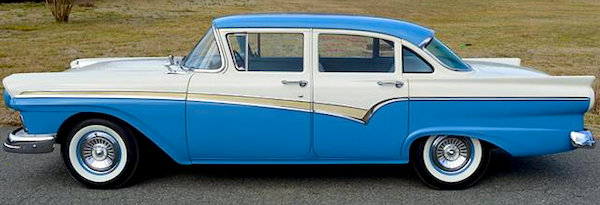
1957 Ford Custom 300 Fordor Sedan
First, the entry-level Ford 4-door sedan on the short wheelbase.

1957 Ford Fairlane Town Sedan - unknown photo source
Ford's longer-wheelbase 4-door sedan.  Rear door widths provide the clue for lengthening.  The Fairlane door is wider, and the passenger compartment top lengthened to accommodate that, while the shape of the backlight window was unchanged.

1958 Edsel Ranger 4-door sedan - Mecum Auction photo
This is the Edsel based on the car above.  Wheelbases are the same, so the basic structures are the same as well and visual differences are due to cladding.

1957 Ford Fairlane 500 Town Victoria - factory image
Here is Ford's '57 4-door hardtop sedan.

1958 Edsel Pacer 4-door hardtop
And an Edsel version using the same structure and wheelbase.

1957 Ford Fairlane Town Sedan
Repeated photo.  Compare to the Mercury 4-door sedan below with its 4-inch (102 mm) longer wheelbase.

1957 Mercury Monterey 4-door sedan
The Mercury body is different, though there are a few intriguing similarities.  Compare the door cutlines.  They are virtually the same (the photo of the Fairlane 500 4-door hardtop shows the lines more clearly), the forward Mercury cutline being more vertical, and rear door aft cut shaping differing around the wheel opening.  Windshields are essentially the same, though framing is more angular on Mercurys.  This suggests possible structural carryover to an otherwise different platform.  Otherwise, passenger compartment tops differ along with body sheetmetal cladding.  But I could well be wrong: an experienced body shop crew would probably know the truth.  Anyway, for styling analysis purposes, we can regard Mercurys as having distinct body designs.

1957 Mercury Montclair 4-door hardtop - via Curbside Classic
Edsel Corsairs and Citations were hardtops or convertibles, so compare this Mercury 4-door hardtop to the sedan above.  The main difference is that the hardtop has a wider C-pillar.

1958 Edsel Citation 4-door hardtop - unknown photo source
The main structural difference is the backlight window shape and framing along with slight aft side window reshaping and a thinner C-pillar.