Thursday, June 8, 2023

The Classic 1950s Alfa Romeo Giulietta Sprint by Bertone

So far as Your Humble Scribe is concerened, the Golden Age of Italian styling lasted from not long after World War 2 until 1960 or shortly thereafter.  As the title of this post suggests, the Alfa Romeo Giulietta Sprint by Bertone (Wikipedia entry here) was a fine example.

In 1953 or so when the design was under development at Bertone, the coachbuilder's designer was Franco Scaglione, a leading stylist of that era.

As noted in the Gallery below. Scaglione might have been influneced by the slightly earlier Alfa Romeo 1900C Sprint CoupĂ© by Touring.  Though it's possible that Alfa Romeo might have required a design in somewhat the same sprit.

In turn, our subject design might well have influenced Giogetto Giugiaro's 1960s Alfa Romeo Giulia GT, another Bertone creation.

Gallery


1951c. Alfa Romeo 1900 C Sprint Coupé by Touring - factory or Touring image
A design that might influenced Bertone's Giulietta Sprint.

1954 Alfa Romeo Giulietta Sprint by Bertone - factory or Bertone image
The Giulietta is smaller than the 1900 and its design has a cleaner fenderline and a less bulky looking passenger compartment greenhouse.

1955 Alfa Romeo Giulietta Sprint by Bertone - for-sale images
Now for a walkaround of a 1955 Giulietta.

Fenders and greenhouse have high-points roughly above the center of the door.  Wheel openings differ slightly from those seen in the 1954 photo above -- wheel opening brows and a more rounded rear opening are on this 1955 car.

Essentially a fastback with a huge backlight window.  The trunk lid is small.

A simple composition, but with ornamentation, the license plate frame and trunk locking and opening items clustered at the center.

Rear fenders with tail light assemblies interact with the fastback to create vestigial tail fins.


The front ensemble has a thrusting feeling with the advanced point at headlight level.  This and the long rear fender zone create added visual and actual length, a fairly common mid-1950s style feature.

The grille theme is typical 1950s Alfa Romeo, as would be expected.  But the flanking openings are quite similar to 1953 Studebaker grille openings, and different from early 1950s Alfa flankers.

Monday, June 5, 2023

1940 Packard Four-Door Cars by Darrin and Rollson

I wrote about Darrin's 1940 Packard Custom Eight One-Eighty Convertible Sedan design here and his 1940 Packard Custom Eight One-Eighty Sport Sedan here.  I thought it would be interesting to compare the designs.  Then I came across some Rollson 1940 Packard Custom Eight One-Eighty Sport Sedan images that would provide for an even more interesting comparison -- hence today's post.

Few of these cars were made.  And they were expensive: two or three times more costly than Packard's other luxury cars.   RM Sotheby's mentions here that: "Far rarer [than Darrin 2-door Convertible Victorias] were the four-door Convertible Sedans, with perhaps 11 or 12 constructed—and most exclusive of all were the Sport Sedans.  Counting Darrin’s initial prototype, and two 'production' examples built at Connersville, Indiana’s Central Manufacturing body plant, only three are reported to have been built, each distinctive in its details.  Only two are known to survive to the present ."

I have no information regarding how many Rollson Sport Sedans were built.  Internet images of survivors suggest there were at least three, provided that none were repainted in a different color.

Gallery

Darrin Convertible Sedan - RM Sotheby's photo
Racy-looking with the top down, but slight clunky with it raised, as shown here.  The hood was lowered, but otherwise the front end is essentially stock.

Darrin Sport Sedan - RM Sotheby's
Unlike the Convertible Sedan, this Sport Sedan's front forward of the cowling appears to be stock, and the overall body taller.  The Sport Sedan top is also high, but considerably rounded.  That had to do with passenger comfort on the lower prototype shown below and carried over to this version..  Another factor seems to have been the shallow windows with their flat glass (universal in 1940) and perhaps retraction considerations.  I think Darrin might have done better here.

Rollson Sport Sedan - unknown photo source
This Rollson, shown at the Pebble Beach concours, also has a heavy, rounded top, because it is low like the prototype Darrin.  So both Darrin and Rollson faced the same constraints and came up with similar solutions.

Darrin Convertible Sedan - unknown photo source
Now for side views.  Stock Packard items seen here are the fenders.  The rear window is in two panels, only the forward one retractable.  Compare the passenger compartment greenhouse to that of the Sport Sedan in the following image.

Darrin Sport Sedan - unknown photo source
According to the RM Sotheby's link above, "Like the Convertible Sedans, the Sport Sedans rode on the new-for-1940 Packard Custom Super Eight’s 138-inch wheelbase chassis."  Comparing the after doors, the sedan's is wider than the convertible's -- hence no two-piece window.  However, the window profiles are similar.  The difference is due to the shape of the forward doors.  That of the convertible is rear-hinged and has an angled front cutline.  The sedan's door is front-hinged with a vertical cutline, resulting in a narrow door that allows for a wider aft door.

Darrin Sport Sedan - unknown photo source
Here is the prototype car.  Its doors and windows are the same as those on the Darrin Convertible Sedans.  The "production" sedans' revised doors are due to the need to accommodate fender-mounted spare tires.

Rollson Sport Sedan - unknown photo source
The door arrangement is similar to that of the Darrin prototype in the previous image.  The most noticeable differences from the Darrin version are the fussier beltline and the more rounded aft window and roof profiles.  The Rollson Sport Sedan, like the prototype Darrin show above, is lower than the "production" Darrin Sport Sedan.

Darrin Convertible Sedan - RM Auctions photo
The trunk lid and its framing are the only stock Packard items at the rear of Darrin Convertible Sedans and Sport Sedans.  They are from Packard coupes.

Darrin Sport Sedan - unknown photo source
From this viewpoint, this Sport Sedan is clearly taller than the Convertible Sedan in the previous image.

Rollson Sport Sedan - image via Concept Carz site
The front fender appears to be that used for fender-mounted spare tires, but without the wheelwell cutout.  (The red Darrin Convertible Sedan in the second image from the top also has such a front fender.)  The rounded top is conspicuous here, further accented by the tiny backlight window.

Thursday, June 1, 2023

Making 1958 Edsels from 1957 Fords and Mercurys

Ford Motor Company's Edsel brand lasted only three model years, 1958 into 1960.  It was launched in an effort to broaden the company's brand spectrum, especially targeting the upper mid-class market.

But the brand failed due to several reasons, some of which I wrote about, along with others mentioned in the first link.

The 1958 Edsel line was comprised of four models.  In ascending price order, they were Ranger, Pacer, Corsair and Citation.  The first two were based on Ford bodies, the rest on Mercury bodies.  Fords and Mercurys were redesigned for the 1957 model year, and I'm using those as the basis for the discussion below, rather than facelifted 1958 models.

Setting the scene, entry-level Ford Customs had 116-inch (2946 mm) wheelbases, and Ford Fairlanes had wheelbases of 118 inches (2997 mm).  All '57 Mercury wheelbases were 122 inches (3099 mm).  Edsel Ranger and Pacer wheelbases were 118 inches, like those on Ford Fairlanes and Fairlane 500s.  Edsel Corsairs and Citations had the longest wheelbases, 124 inches (3150 mm).  As will be seen below, wheelbase differences were dealt with fairly easily because the cars were built body-on-frame, rather than using unitized bodies that are today's norm.

Unless noted, images below are of cars listed for sale.

Gallery

1957 Ford Custom 300 Fordor Sedan
First, the entry-level Ford 4-door sedan on the short wheelbase.

1957 Ford Fairlane Town Sedan - unknown photo source
Ford's longer-wheelbase 4-door sedan.  Rear door widths provide the clue for lengthening.  The Fairlane door is wider, and the passenger compartment top lengthened to accommodate that, while the shape of the backlight window was unchanged.

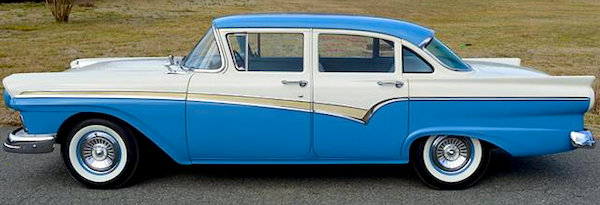
1958 Edsel Ranger 4-door sedan - Mecum Auction photo
This is the Edsel based on the car above.  Wheelbases are the same, so the basic structures are the same as well and visual differences are due to cladding.

1957 Ford Fairlane 500 Town Victoria - factory image
Here is Ford's '57 4-door hardtop sedan.

1958 Edsel Pacer 4-door hardtop
And an Edsel version using the same structure and wheelbase.

1957 Ford Fairlane Town Sedan
Repeated photo.  Compare to the Mercury 4-door sedan below with its 4-inch (102 mm) longer wheelbase.

1957 Mercury Monterey 4-door sedan
The Mercury body is different, though there are a few intriguing similarities.  Compare the door cutlines.  They are virtually the same (the photo of the Fairlane 500 4-door hardtop shows the lines more clearly), the forward Mercury cutline being more vertical, and rear door aft cut shaping differing around the wheel opening.  Windshields are essentially the same, though framing is more angular on Mercurys.  This suggests possible structural carryover to an otherwise different platform.  Otherwise, passenger compartment tops differ along with body sheetmetal cladding.  But I could well be wrong: an experienced body shop crew would probably know the truth.  Anyway, for styling analysis purposes, we can regard Mercurys as having distinct body designs.

1957 Mercury Montclair 4-door hardtop - via Curbside Classic
Edsel Corsairs and Citations were hardtops or convertibles, so compare this Mercury 4-door hardtop to the sedan above.  The main difference is that the hardtop has a wider C-pillar.

1958 Edsel Citation 4-door hardtop - unknown photo source
The main structural difference is the backlight window shape and framing along with slight aft side window reshaping and a thinner C-pillar.

Monday, May 29, 2023

Triumph's 1800/2000 Roadster: Not a Total Failure

Standard Motor Company's managing director Captain John Black supplied motors to Jaguar and its predecessor SS Cars since the beginning, and for a short while after World War 2.  By the end of the 1930s it was clear that Jaguar was becoming more a competitor than a client.  So Standard bought the ruins of the Triumph firm in 1944 with the idea of using the brand with its sporting image to provide sporty cars to help compete with Jaguar in that market segment.

The German bombing of Coventry, England in 1940 destroyed Triumph's facilities along with much else in the city.  So postwar Triumphs had to start from scratch, using motors and other material from Standard.

Besides a sedan (saloon), a Triumph sports car line was planned -- what became the Triumph Roadster, the subject of this post.

Postwar United Kingdom was in a bad way economically, and the socialist government rationed carmaking materials based on the cars' export potential, so as to bring home (especially) U.S. dollars.  Black clearly had his eye on the export market when the Roadster was developed.  Yet the production Roadster was far more English than American.

Given that Triumph 1800 Roadster production started in 1946, the ability of the American market to absorb English sports cars was unknown.  As it happened, the MG TC that entered production in 1945, sold well, despite having right-hand steering along with many prewar English details carried over from the TA and TB models.  This was unknown in 1945 while the Roadster was under development; in retrospect Black's gamble was reasonable despite the low sales of British sports cars in the USA prewar.

What the Roadster was likely not, was intended competition for the famous Jaguar XK120 sports car that did not enter production until 1948.  Perhaps car industry scuttlebutt gave Standard hints of the coming XK, but by the time it was introduced, the Roadster was on its way out.

Nevertheless, it's interesting to compare the two cars because they were in the same general market segment.

Production: 4,501 Roadsters made 1946-1949; XK120s (1948-1954),  open 7,606, drop-head 1,767 -- total 9,373 (fixed-head Jaguars not counted because Triumph did not use that body style).  On a per- production year basis: Triumph 1,125, and XK120 1,339.  Not a large difference considering the reputations of the two cars.

The link above notes that the Roadster was wide, providing three-abreast seating that required a non-sporty steering column-mounted gear shift lever.  This contributed to the Roadster's chunky overall appearance.  But note: its wheelbase was 100 inches (2540 mm), width 64 inches (1626 mm), and the XK120s wheelbase was 102 inches (2591 mm, width 61.5 inches (1562 mm).   Not great differences.   Where the Jagiar shined was its performance due to its new, powerful inline-six cylinder engine that made it one of the fastest production cars in the world at the time.  Meanwhile, Triumph Roadster top speeds were less than 80 miles per hour (about 130 KPH).

In many ways, the Triumph 1800 and 2000 Roadsters were attractive cars in the late-1930s context.  They were styled by Frank Callaby.

Gallery

1948 Triumph 2000 Roadster - HandH Auctions photos
Front fenders are bulbous.  I've always been fond of grilles being set at or behind the front axle line (I blame that on 1936 Cord 810s).

The trunk zone is large, heavy-looking.

That's because it houses what the British call a "dickey" seat ("rumble seat" in Yank talk).  Prewar Triumph Dolomite roadsters had this feature, and it was carried over to this design.  There's even a raisable windscreen, something seldom or never seen on 1920s and '30s American cars.  The spare tire is mounted on the after lid.  I'm not sure where luggage space might be.

Profile view with the dickey open.

1949 Triumph 2000 Roadster - HandH Auctions
General view with the top raised.  Though the front fenders are large, the engine compartment is narrow -- an interesting contrast.

1948 Triumph 1800 Roadster - for-sale-car photos
Now for a scaled-down walkaround.  The supports for those wonderfully-large English headlights are a bit crude-looking.

A nice, low look.  The wide, flat windshield has three wipers.

That high aft area spoils the design.

The front fenders look fine from this perspective.  I don't consider their shape a defect, though their size might be.

That dickey seat is the real problem.  It wasn't something most potential American buyers wanted or needed.  It added to the price of the car, something that usually hinders sales volumes.  The lack of trunk space was another item Americans wouldn't much like.  As for styling, lower, more tapered rear fenders echoing the front fender shape, along with a trunk lid profile to essentially match, would have made the Roadster a much more attractive and successful car.

Monday, May 22, 2023

1970 Lancia Stratos Zero Concept

The competition was tough, but I think the most extreme of the circa-1970 Italian wedge-front concept cars was the Lancia Stratos Zero built by Carrozzeria Bertone and designed by Marcello Gandini.

Some other wedge-front concept cars were the 1968 Alfa Romeo Carabo by Bertone (also designed by Gandini), the 1970 Ferrari Modulo by Pininfarina, and the 1972 Maserati Boomerang by Italdesign (Giorgetto Giugiaro).

The Stratos Zero was so extreme that it would be barely marginal as an everyday sports or grand touring car due to entry-egress difficulties and outside visibility limitations for the driver.  I imagine that little thought was given to the possibility that it would ever enter production.

That said, I think it was the most interesting sculptural composition of the bunch noted above.

In the Gallery below, images of the Stratos Zero with bronze paint might be via RM Sotheby's.  I'm not sure of the image source of the silver-finish paint scheme variation.

Gallery

The Stratos Zero as it would appear if you encountered it parked.

Its layout is mid-engine.  Rear wheels are considerably larger than the front wheels.

Being a concept car, trivial matters such as bumper protection are ignored.

Besides the large, nearly-flat windshield, there are small side windows.  The lower one is essentially useless functionally, but helps the design composition a little.

Left side view.

This is where one can enter or leave the car.  The steering wheel would have to pivot to allow entry.

All movable panels are open.  The large, triangular one is for engine access.

Monday, May 15, 2023

1964 Alfa Canguro - Early Giugiaro Concept Car

According to this Wikipedia entry, famed designer Giogetto Giugiaro's second concept car design was the 1964 Alfa Romeo Canguro, built by Bertone.

This was shortly after his work on the classic early 1960s Alfa Romeo sport coupes.  These designs have a different character, possibly because, as mentioned here in my post about the 1963 Chevrolet Corvair Testudo concept car, the Testudo was the first car where Giugiaro had a totally free hand in the design.  The coupes carried over influence from earlier designs, this potentially limited what Giugiaro could produce.

That said, it's likely that the Canguro was mostly or entirely Giugiaro's work, given his independence on the Testudo.

Most images in the Gallery below are probably via Bertone.

Gallery

The Canguro has flowing lines, unlike production Alfa Romeo coupes.  Its most distinguishing feature is the stack of air vents on the front fender.

Publicity photo.  As with many concept cars, front bumper protection is absent.

No rear bumper either.  The back is the sliced body profile at that point: no shaping or blending.

The Alfa shield on the grille has black egg-crate bars.  The general feeling is organic, rather than structural.

Photo taken at an auto show, the people standing behind the Canguro providing scale.  Also note the woman in an above image.  The car's really quite small.

Monday, May 8, 2023

1948 Hudson, Five Facelifts Later: A Softer Look

The Hudson Motor Car Company, Wikipedia entry here, was in business for 55 years (1909-1954).   In 1954, Hudson merged with Nash-Kelvinator to form American Motors.  The final Hudson-branded cars were marketed for the 1957 model year, but were based on Nash bodies.

Hudsons were completely redesigned for model year 1948.  That basic body was continued with minor face-lifting through 1953.  As I wrote here, 1954 Hudsons received a major facelift -- '55 models being redecorated Nashes.  Today's post compares the 1948-vintage design with 1953, the final model before the big, pre-Nash facelift.

The post- World War 2 Hudson design had a streamlined appearance, heavily influenced by prewar thinking regarding future shapes cars might take.  As it happened, by around 1950, American car styling fashion changed from visual streamlining to more squared-off, "bustle-back" shapes.  So Hudsons were becoming seen by potential buyers as being out-of touch, almost old-fashioned.

Interestingly, in light of that fashion change, Hudson facelifts became increasingly softer, less angular, in defiance of that fashion trend, as is apparent in the images below.  The 1954 facelift mentioned above was a sad attempt to bring the 1948-vintage body into line with what other American carmakers were selling.

(If Hudson styling during that era interests you, I also wrote about Hudson grille designs over 1948-1954 here.)

Gallery

1948 Hudson Commodore - for-sale car photo
The original postwar redesign's grille was simple and rather geometric aside from its upper frame.

1953 Hudson Hornet - photos via RM Sotheby's
This grille shape first appeared in 1951. The major detail change was subordinating the central inverted-V element for '53.  The faux hood air scoop was added for '53.

1949 Hudson Commodore - Barrett-Jackson photos
1949 Hudsons were identical in appearance to 1948 Hudsons.  Side trim was in the form of a wide chrome strip along the lower edge of the car, probably intended to draw viewers' eyes downwards, thus making an already-low car seem even lower.

The middle side chrome strip mounted along the sheetmetal character crease appeared on 1952 Hudsons.

This shows the initial backlight window.

The backlight window's size was increased in 1950 and again in 1952 to what is seen here.


The other change evident by 1953 is the heavy chroming around all the windows on top-of-the-line Hudson Hornets.