Monday, June 24, 2019

Ford Forty-Nine Concept Was Not a '49 Ford

One of Ford's 2001 concept cars was called the Forty-Nine, recalling the company's post- World War 2, post- Henry Ford I redesign.  I consider the '49 Ford as emblematic of the conclusion of the style evolution that began in the early 1930s whereby designs gradually changed from boxes with distinct fenders, headlights, etc. to smooth, integrated designs such as that Ford.  You can read all about it in my book noted at the right (best seen on a large iPad or a Kindle computer reader).

That said, the Forty-Nine doesn't strike me as being particularly Retro, as I'll discuss in the image captions below.

Some background on the Forty-Nine can be found here and here.   The latter mentions that Ford brought in Chip Foose as a consultant.  Foose was trained in Transportation Design at the Art Center, and produces hot-rod themed custom cars (I wrote about one example here).

Gallery

1949 Ford Tudor, the first one off the production line, seen here by the Henry Ford Museum.

The Forty-Nine's frontal design.  The grille area sports a large horizontal bar, echoing the grille bar on the actual '49 Ford.  Missing is the round centerpiece which is the strongest identifier of that design. Big mistake.

The sides of the concept are clean, as was the production car's.  But the ornamentation differs.  It really needs some taillight assembly side sculpting something like that of the original.  Another mistake.

Tail lights are oriented horizontally, a very feeble echo of the 1949 Ford rear design.  Mistake number three.

The Forty-Nine captures a hint of the '49 thanks to the bowed-out sides.

Another carryover is the wheel well openings -- full at the front and two-thirds at the rear.

Two Forty-Nines were made: this is the convertible version.

So car as I am concerned, the Forty-Nine was mis-named because it has so little of the design flavor of the original car.  Other than that, it's a pleasant-looking design.

Thursday, June 20, 2019

How Four-Door Sedans Got Their Trunks

I borrowed this post's title from a Rudyard Kipling Just So story title dealing with elephants, in case you might be curious.

For some reason hard to fathom 90 years and more later, American automobiles did not have storage areas worthy of the name.


For example, even this late-1920s Checker taxi in New York City has no roof rack or other obvious place to store luggage and other large objects.  I suppose these were placed between the passengers' knees and the driver's seat.

Trunks became an industry-wide feature during the 1930s, the decade when car design evolution was at tis strongest.  The focus here is on four-door sedans because coupés and some two-door sedans, due to their shorter passenger compartments, got integrated trunks sooner than their four-door siblings.

Examples of trunks from that era are shown below.  Unless noted, images are of cars listed for sale on the internet.

Gallery

1929 Auburn 8-90
This Auburn is typical of its time, having no trunk.

1929 Hudson Club Sedan by Biddle & Smart - RM Sotheby's photo
However, some larger upscale cars did have trunks.  This Hudson's trunk is conventional, being a separate item placed aft of the main body of the car.

1930 Stutz Monte Carlo, Weymann body - RM Sotheby's
This Stutz appears to have two trunks, a separate unit at the extreme rear as well as a trunk abaft of the passenger compartment accessible from outside.  This was extremely rare in 1930 for four-door sedans.

1931 Marmon Sixteen Close-Coupled Sedan by LeBaron - Hyman Auctions photo
Marmon V-16 cars were among the those at the top of the price/prestige ladder, and this one has a trunk attached to the car's body.  It is a separate element, not integrated like the Stutz's trunk in the previous image.

1933 Cadillac Town Sedan
By 1933 trunks like this were becoming common on larger cars.

1934 Studebaker Land Cruiser - my photo
Here is an example of an integral trunk several years ahead of its time.  The design of this car was derived from the 1933 Pierce-Arrow Silver Arrow.

1935 Buick 41 Club Sedan
More typical is the trunk on this Buick.  It remains visually distinct, yet its edges are smoothed into the main body -- a step towards complete integration.

1936 Cord 810 Beverly - Hyman
Standard Cord 810 Westchester sedans had a fastback design incorporating a lidded trunk.  Beverly models had fancier interiors and some were given the tacked-on trunk lid seen here to provide some extra storage space.

1936 Lincoln Zephyr - factory photo
Aerodynamically-influenced Zephyrs has integral trunks.

1938 Studebaker Commander
Less radical is the trunk on this Studebaker.  In some respects it's similar to that on the 1935 Buick above, but its blending into the body is more complete.

1938 Graham
Now we see an early version of the "bustle back" style common after the war.

1939 Mercury Eight
A "fastback" design like the Zephyr, but this Mercury's trunk is wider and more practical.

1941 Pontiac Torpedo Sedan
By the early 1940s integral trunks were the industry standard.

Monday, June 17, 2019

Alfa Rome Tonale Concept: Design Heritage

Alfa Romeo's Tonale concept SUV was presented at the 2019 Geneva auto show in March.  A similar-appearing production version is expected.  Some background on the Tonale can be found here and here.

Compared to some Japanese styling excesses (I'm thinking of you, Lexis, Toyota and Honda!), Tonale's design is clean and attractive.  Well, I'm not sure that frowning look given by the headlight ensembles was the best solution, but I'll let that pass for now.

What I think might interest readers is Alf Romeo's contention that the Tonale's design was influenced by the styling of various Alfa automobiles going back as far as the late 1930s.

This was a theme stressed in a May/June 2019 Auto&Design magazine supplement, Auto&Design being an Italian-based, bilingual publication featuring background information (especially styling illustrations) on the design gestation of newly-announced  automobiles.

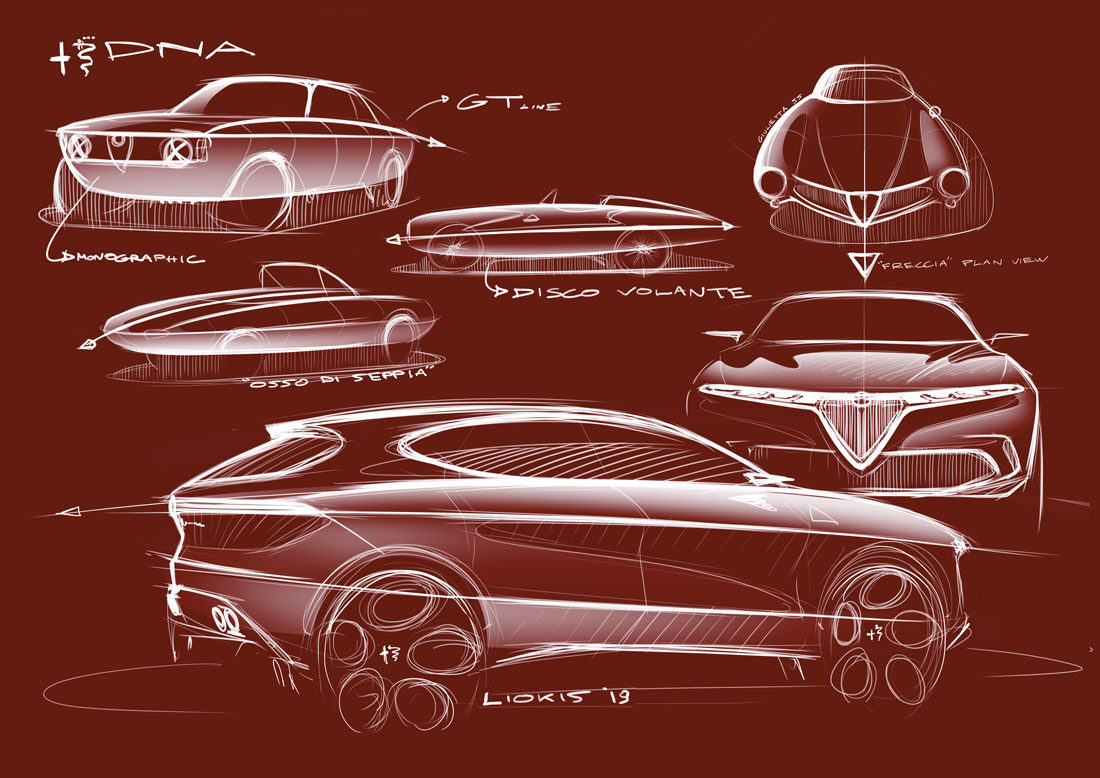
Below are photos of the car along with drawings from Centro Stile Alfa Romeo indicating sources of inspiration.  For some reason, I very slightly suspect that some of this is post-design retroactive justification for various features.  Let's assume I'm wrong, because it's usually nice to see design language continuity.  Click on images to enlarge.

Gallery


Photos of the Tonale.  Design "DNA" sketches are below.


Thursday, June 13, 2019

A Wehrmacht 1938 Opel Super 6 Cabriolet

The Opel Super 6 was in production 1937 and 1938, 46,453 being assembled.  A brief Wikipedia entry in English is here, but from there you can link to a longer entry in German.

World War 2 started on 1 September 1939, after production of Super 6s was completed.  Since the German military needed automobiles for use by staff (as did all other war participants), some cars had been purchased before the war and others were requisitioned after it began.

Paul Allen, the late co-founder of Microsoft, established what is now called the Flying Heritage & Combat Armor Museum, located at Paine Field in Everett, Washington, the site of the Boeing factory that builds 747, 777, and 787 aircraft.

That collection includes an Opel Super 6 staff car.  The museum's web site's page dealing with the car states:

"This machine, a 1938 Super 6 two-door cabriolet, was used to transport high-ranking officials near combat areas. Its license plate, with WH for Wehrmacht Heer, marks it as a staff car used by the German army.

"Staff cars were enticing targets for Allied fighter bomber pilots, who knew those riding inside could be of high importance in the German military command structure. As a result, the car’s civilian glossy paint scheme and chrome trim were painted over with drab colors to make them less visible from the air. At night, the cars operated with blackout headlights, designed to cast a diffused horizontal beam of light onto the roadway."

Below are images of Opel Super 6 cars along with photos I took of the one at the museum.

Gallery

The grille resembles that of the 1936 Chevrolet, also a General Motors car.

Another view.


Publicity images of an Opel Super 6 Cabriolet.

A Cabriolet seen from on high.

Wartime photo of a Cabriolet in military service.  Its license plate appears to be civilian, but the left fender has WH (Wehrmacht Heer) painted on it, designating it as an army car.  Its grille and bumpers are the same as those shown a few images above.

The museum's Opel Super 6 has a different grille and different front bumper than seen in the photos of civilian Super 6s.  It is possible that these items were customized after the military took possession.  An alternative possibility is that a limited number of Super 6s were purchased by the army in 1937 or 1938 and were provided these non-standard features by the factory because the army requested them.

That's a British tank in the background.

Note the landau irons on the canvas top.  The car has considerable ground clearance, but so do the civilian Super 6 Cabriolets shown above.

In the background are (left to right) a U.S. army ambulance, a navy Corsair fighter, and a German army half-track personnel carrier.

Monday, June 10, 2019

Cord 810, America's Greatest Design

I normally find it difficult to claim this or that is my favorite in response to questions such as "What is your favorite thing in Paris?"  Maybe I spent too much time in grad school or perhaps it's simply the way I've been for many years, but I nearly always need to qualify my answer.  Or not have an answer at all.  I cannot say what my favorite Paris thing is, for example.

But when it comes to American automobile designs, I actually do have a favorite, and I've had that favorite for decades.  It's the 1936-37 Cord 810-812.  As early as age 13 or so, photos of Cords fascinated me.  And once, around that time, I saw a pale yellow Cord sedan rolling along the street, the driver going about his business (never saw that again, by the way).  I was thrilled.

Just in case, here is some background on those Cords.

The images below are of 1936 Cord 810 Westchester sedans, Gordon Buehrig's core design: click on them to enlarge.

Gallery


Front and rear quarter views of Cords auctioned by Hyman, Ltd.

Side view via RM Auctions.

Cord patent drawings.  The positions of the retractable headlights are those found on the prototype car.

Overhead view of the prototype.  I think that the key to the the design is the area forward of the passenger compartment -- specifically the shapes of the hood, fenders, catwalks and those cooling-related slats.  Any variation of those details would have ruined the effect Buehrig created.

These final images are photos I took a few years ago in Reno.  First, there is the visual tension between the rounded fenders and the more angular hood.  Then there is the placement of those fenders and the sheet metal between them (covering part of the front-wheel-drive mechanism) that's well forward of the front of the hood.  Again, a contrast creating a kind of visual tension.  The grille/vent slat design is far different from mid-1930s American styling fashions.  Very simple, while enhancing the relatively angular theme of the hood.  Besides that, there is the subtlety of the front of the hood assembly -- it isn't vertical, but leans sightly forward.  This makes it seem vertical, analogous to the slightly bulged columns of the Parthenon.

As can be seen in the overhead view of the prototype, the fenders are separated from the body by a narrow catwalk.  This separation is another subtle yet essential detail so far as Buehrig's theme is concerned.  Merging the fenders and the body would have destroyed the contrast theme.  Helping this is the lack of running boards.  The 1934 LaSalle had similar fenders and a catwalk, but the aft part of the fenders were connected to running boards, thus reducing their visual separation from the rest of the car.

Thursday, June 6, 2019

Small Alfa Romeo Styling Models

In mid-May I visited the Alfa Romeo museum (link here) in Arese, a suburb northwest of Milan where Alfas formerly were built.

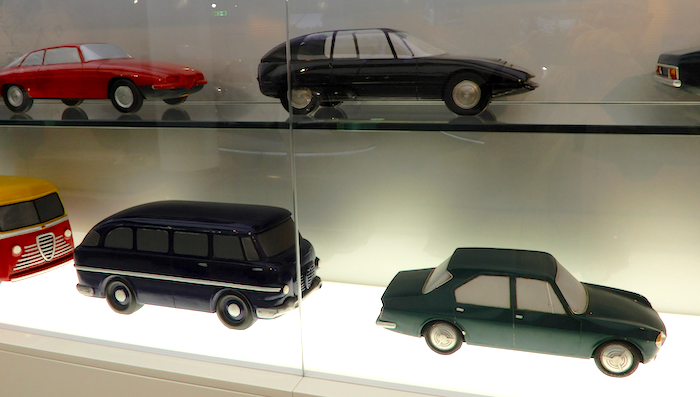
One of the displays was of small-scale styling models dating back to apparently around 1950.  These were proposals for factory-built cars, and not for bodies supplied by carrozzeria, as best I can tell.  (Alfa maven readers are encouraged to correct me or provide more details in comments, as my Alfa Romeo knowledge is on the thin side.)

Below are some photos I took.

Gallery

General view of the display.  Photos below mostly deal with items to the left of the spectator.

Extreme left side of the display, presumably the earliest examples.

The model at the upper left appears to be the Alfa Romeo 1900 under development about 1949.  A prototype with the same grille design appeared in 1950.  The six-window sedan design never saw prototype or production.

The same set of models as seen from the rear.

The dark blue model in the upper level might be of the Giulia sedan that was launched in 1955.  As best I can tell, none of the other prospects advanced beyond the model stage.

More still-born concepts, perhaps from the 1960s.

Monday, June 3, 2019

Some Italian Automobile Museums: Overviews

I recently returned from Italy, where I was able to visit three automobile museums.  Some future posts might include photos I took there.  But the present post simply offers a few of my impressions for your consideration if you might think of visiting one or another of them in the future.

Ferrari Museum


The Ferrari museum, website here, is off the beaten tourist track, being located by the factory at the edge of Maranello, itself a few miles from Modena and the nearest autostrada.

Disclosure: I am not a Ferrari fan.  Never was, though I like the styling of a number of the road cars from the late 1940s to the very early 1960s.  And it was some of those cars I had hoped to view at the museum.

Alas!  The museum is virtually free of examples from before the mid-1960s, Formula 1 racers excepted (but still not many of the early ones).  Why is this so?  My hypothesis is that Ferrari kept many of its racing cars, which is why there are plentiful examples from over the decades.  But the firm made few road cars during the early years, all with carrozzeria-furnished bodies, and apparently all were eventually sold.  (For example, "Inter" series Ferraris totaled only 143 units.)  Such that survive are worth a lot of money that the museum apparently did not want to spend on its collection, hence their absence.

The museum shop is well stocked with items for fans, however.

National (Torino) Museum


The Museo Nazionale dell'Automobile in Turin (link here), is located about two miles from the central train station.  From there you can catch the subway that gets you to about a ten minute walk from the building.

The collection is largely arranged chronologically.  The cars are displayed in overly-elaborate (in my opinion) settings with dramatic lighting, background photomurals, and such.  All that display jazz represents the fashion seen all too often in recent years, and the cars themselves are overwhelmed.  Moreover, the atmosphere is dark, so to avoid using flash, I used my iPhone rather than my compact Nikon to take pictures.

Even though the museum is located a few blocks from the old Fiat factory, the cars on display were not strongly Fiat-oriented.  Most examples were Italian, though there were a few American, German and British cars along with a Russian Pobeda from 1957.

Alfa Romeo Museum


The Alfa Romeo museum was the most satisfactory of the three, in my judgment.  Its main problem is its location, out in the Milan suburb of Arese.  Getting there by car is no problem, as it is close to the A8 autostrada.  From central Milan you might take a taxi, but that option is costly.  I followed the instructions from the museum's web site and took the subway and then a bus to get there.  The bus runs only once an hour or so, which makes timing a planning factor.

Only one display -- racing cars -- was annoyingly jazzy.  Plenty of noise, and illumination that cycled low to high and back, making photography difficult.

Car selection was good from about 1938 onward, though there were a few examples from before.  Vehicles were spaced far enough apart that one could photograph them from most angles.  Besides a museum shop, there were a coffee shop/restaurant and a showroom displaying current models.  (I skipped these last two because I wanted to catch a bus in time to get me back into Milan so as to do other touristy things.)