Thursday, November 15, 2018

Cadillac Side Trim Theme: 1948-1959

I tend to write quite a bit about visual automobile brand continuity features or their lack.  Usually this has to do with the car's grille and other "facial" ensemble details.  While it's not universal, it's fairly common that the more upscale the brand, the more likely there will be continuity.  Long-term examples include grilles of Rolls-Royces and Packards.  For most of the past 80 years, Cadillac has had an "egg-crate" theme on its grilles.

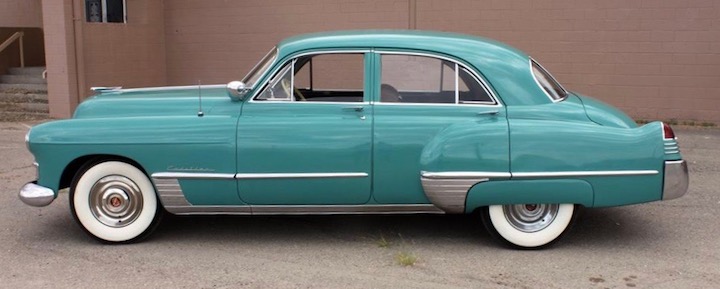
During the 1950s Cadillac also maintained a side-trim theme, the subject of this post.  It wasn't as long-lasting as Buick's Sweepspear of the 1950s that returned in recent years, but it lasted a long time for a non-frontal theme.
Gallery

1948 Cadillac Series 62 Sedan - Barrett-Jackson auction photo
Most redesigned 1948 Cadillacs had rock guards on the lower leading edge of their rear fenders -- standard practice for many US brands.

1948 Cadillac Fleetwood Sixty-Special - Mecum auction photo
But the top of the line (not counting Series 75 limousines) Sixty-Specials were given a rock guard that wrapped most of the way around the reshaped fender's leading edge.  That part was essentially vertical, and verticality at that general location became the key to an ornamentation theme that lasted through the 1950s.

1950 Cadillac Series 62 Coupe de Ville - Mecum photo
Cadillacs were redesigned for the 1950 model year.  They were big, long cars which was why they were able to carry the vertical element where the rear fender begins.  The usual styling approach was and is to emphasize horizontality in order to make a car look longer and lower than if it were unadorned.  Another interesting detail in that vertical element is that it is a fake air intake -- something that became something of a styling fad two years later on hoods and sides of the redesigned 1952 Ford Motor Company line.  For some reason, the public and car buff press didn't make a big deal of Caddie's faux scoops at the time.

1950 Cadillac Series 62 Sedan - Mecum photo
This photo shows the blackened bits that provide the appearance of an air intake.

1954 Cadillac Sedan - factory photo
This feature was carried over to redesigned '54 Cadillacs, though the black painted bits are now simply chromed.

1955 Cadillac Fleetwood Sixty-Special Sedan - Barrett-Jackson photo
Facelifted 1955 Cadillacs lost the complete vertical strip.  Now it transitioned to the horizontal chrome strip that started at the grille, passed along the top of the front wheel opening and then continued aft.  This was used for 1956 models too.

1957 Cadillac Coupe de Ville - "for sale" photo
Cadillac's next redesign found the vertical element diminished further, though it remains where an actual air scoop for rear brake cooling might be needed.

1958 Cadillac Coupe de Ville - Barrett-Jackson photo
The next year verticality is in the form of a stack of horizontal chrome strips.

1959 Cadillac Fleetwood Sixty-Special - factory photo
The air scoop theme returned for the last time in 1959, but only on Sixty-Specials.

1959 Cadillac Series 62 Sedan - Mecum photo
Here is what other Cadillac four-door hardtops looked like.

1960 Cadillac Eldorado - factory photo
Cadillacs for 1960 were all slab-sided like this Eldorado.

Monday, November 12, 2018

General Motors' 1968 "Muscle Car" Styling

Among the things noteworthy regarding American cars in the 1960s were the "Pony Car" and "Muscle Car" categories.  The former were Ford Mustangs (hence the "pony" name) and similar competing cars.  Muscle Cars were high-performance automobiles.  This Wikipedia entry cites a huge number of models as being of the muscle variety, so to my mind isn't very useful.  For what little it's probably worth, so far as I'm concerned a Muscle Car is a 1960s American automobile smaller than a "standard size" car, larger than a sub-compact, with a powerful motor and having a hardtop coupe body.

Examples would include some cars using General Motors' redesigned for 1968 A body hardtop coupe format.  In the Gallery below I present some of these, indicating what steps GM stylists and marketers used to make them visually distinctive.  As usual, images are of cars for sale unless otherwise noted.
Gallery

The entry-level basis for those muscle cars was the Chevrolet Chevelle 300 coupe.  Not a muscle car at all, and with a B-pillar.

Rear quarter view.  An attractive design, though the shape of the quarter windows somewhat restricted outside views for back seat passengers.

Chevrolet's muscle car version was the Chevelle SS 396 as seen in this Mecum auctions photo.  Muscle cars often got aftermarket wheels, so tend to ignore these as not necessarily being part of the factory designs.  The SS is distinguished largely via a black paint stripe along the lower body that then draped over the front of the hood.

Quarter view of a different SS showing the stripe.

Moving up GM's brand hierarchy, here is a Pontiac GTO shown in a Barrett-Jackson auctions photo.  Besides the distinctive two-part Pontiac grille, the quarter windows are larger and differently shaped than those on Chevelles.  No paint stripes here -- a clean body aside from chromed wheel opening surrounds.

But some GTOs received the faddish (in the 1960s and 1970s) vinyl top coverings (Barrett-Jackson image).  GM A-body coupes lacked sculpting in the C-pillar zone that would have provided a strong basis for defining the vinyl coverage.  The result can somewhat arbitrary, but Pontiac stylists used the bottom edge of the backlight and a subtle kink in the quarter window framing to anchor the vinyl.

Next we have Oldsmobile's 442 (sometimes 4-4-2) in another Barrett-Jackson photo.  Its muscle car status is revealed by that vertical stripe.

Mecum photo of an Oldsmobile 442 Hurst Coupe.  The stripe here begins along the quarter window and then follows the fender line.  The trunk also is painted black.  The quarter window shape in similar to the Chevelle's, but slightly more rounded.

Buick A-body hardtop coupes were sometimes given muscle car- type mechanicals, but there was no distinctive model name.

Shown in these Mecum photos is a Skylark hardtop coupe.  Quarter windows have a pointed shape.  The vinyl placement is less related to body sculpting than on the GTO shown above.

So GM's A-body muscle cars for 1968 were made distinctive via decal and paint-pot styling.  I notice two air scoops on the hood of the GTO, but they are small and so far as I can tell, any other unique metalwork is subtle and limited.

Thursday, November 8, 2018

Ford Handed-Down Grilles, 1938-1940

In the 1930s there was a brief, limited fad that called for different grille designs for a brand's entry and prestige models.  For example, 1933-1938 Oldsmobile eight cylinder cars had grilles that differed from those on six-cylinder models.  Differences were minor 1933-35 and major 1936-38.

Ford picked up on this idea for model years 1938-1940, but with a twist.  The grille theme on 1937 Fords was carried over on 1938 Standard Fords (the entry-level models), while De Luxe Fords received a different design.  Then for 1939 Standard Fords got a variation on the '38 De Luxe grille and De Luxe Fords had a new design.  For 1940, the lines had slightly different designs, but there was still carry-over from the previous year.  And 1941 Ford grilles were essentially the same across the board.

Gallery

A 1937 Ford Fordor sedan, factory photo.

Mecum auction photo of a 1938 Ford Standard Tudor.  Its grille differs from 1937 grilles in detail, but the design feeling is clearly the same.

Here is a 1938 Ford De Luxe Tudor with its different grille design.  Its rear end has also been slightly redesigned.

1939 Ford Standard Coupe, RM Sotheby's photo.  Its grille design is a facelift of that of the '38 De Luxe.

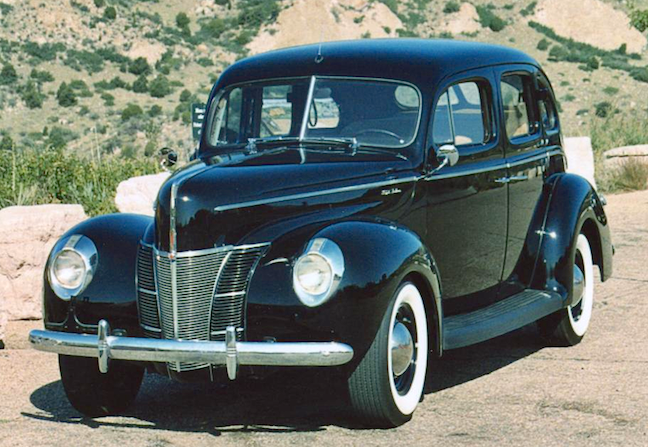
This is a "for sale" photo of a 1939 Ford De Luxe Tudor showing its new grille design.

The '39 De Luxe grille was carried over almost totally for 1940 Ford Standards such as this coupe (Mecum photo).

Instead of totally new grilles, De Luxe Ford grilles used almost the same opening as in 1939 (and on '40 Standards), but had a different arrangement of grille bars as well as slightly different hood shaping.  Barrett-Jackson photo.

Monday, November 5, 2018

Studebaker's Intriguing Postwar Business Coupe

A while ago I wrote about business coupes.  These were common in the USA through the 1930s and into the early 1950s.  All had a single bench seat for the driver and any passengers.  But no back seat -- that space and a (usually) large trunk were devoted to hauling wares.  Some business coupes used regular coupe bodies sans back seats.  Others had unique styles, essentially short passenger greenhouses that incidentally served to create long trunk areas.

A particularly stylish and interesting example of the latter case was marketed by Studebaker in the late 1940s using its fresh postwar Starlight coupe body.  Studebaker never called these cars business coupes, preferring the the term DeLuxe Coupe.  But functionally, business coupes they actually were.

Gallery

First, an example of the Starlight coupe that served as the basis for business coupes.   This Barrett-Jackson auction photo shows the 1948 Commander version.  Starlights were and remain noteworthy due to their four-segment panoramic backlight / back window that has fascinated me since I first saw them.  It works best as a brand-signifying style touch because the thick pillar abaft of the door obstructs the vision of back seat passengers, thereby earning functionality demerits.

Now for a Champion business coupe, one that was for sale a while ago.  The shortened greenhouse is obvious.  Besides its reshaping, a different backlight was used, also different sheet metal to bridge it and the trunk lid.

View of a for sale, rather ratty 1947 Champion 4-door sedan showing its backlight.  Like the business coupe's, it's a two-segment affair.  But its size and shape are not quite the same, so the business coupe's backlight was unique to that body style.

Studebaker Champions had shorter hoods than the more upscale Commander and Land Cruiser models.  That helps to exaggerate the length of the rear deck in this photo.  The driver's position is at about the midpoint of the wheelbase, however.


Additional views of the same car.

Mecum auctions photo of another '47 Champion business coupe showing its appearance as seen from the rear.

Another view of the same car.  The lead designer was Virgil Exner who later was styling vice president for Chrysler Corporation.  He did a very fine job on these postwar Studebakers.  Note their taut, well-composed features (aside from the Champ's stubby front that was probably dictated by Studebaker executives).

Thursday, November 1, 2018

Those Plain 1936 USA Rear-End Designs

It took stylists and automobile company management decades to realize that, when driving around, people were seeing the aft ends of car as well as their fronts.  By 1910 many brands had radiator ensembles with recognizable shapes, creating a strong form of visual identity.  A car's "face" remains its primary means of brand identification.

With all the emphasis on a car's frontal styling, the appearance of its opposite end was neglected in the USA for the most part until the late 1940s and early '50s when tail light designs became more distinctive and badges with crests and other brand identification ornamentation grew more prominent.  Since then, rear end styling has become increasingly more elaborate.

Given how long the process of adding interest to cars' rears has been going on, I suspect that few readers of this blog were car-conscious or even alive in the days before this transformation began.  So as a public service, below are images of rear ends of many American brands for model year 1936.  Missing are LaSalle, Lincoln-Zephyr and minor brands such as Cord, Hupp and Willys.

Photo captions are sparse because there is little to say.  Unless mentioned, the photos are of cars advertised for sale.  First are General Motors cars, then Chrysler Corporation, followed by Ford and independent brands.

Gallery

1936 Chevrolet Master DeLuxe

1936 Pontiac Master Six
Towards 1940, some Pontiac sedans had Silver Streaks on trunk lids as well as on hoods.

1936 Oldsmobile Eight Touring Sedan
Behold a highly-decorated '36 rear design.

1936 Buick
The brand medallion is clearly visible here.

1936 Cadillac Fleetwood Limousine - Barrett-Jackson auction photo
Cadillac's medallion is tiny (discrete?).

1936 Plymouth - Barrett-Jackson photo

1936 Dodge - Mecum auction photo

1936 DeSoto Airstream Special Berline
Note chrome strip extensions to the trunk hinges.

1936 Chrysler Airstream
Same treatment on this Chrysler.

1936 Ford Fordor Sedan
Cars without bulged trunks often had the spare tire at the rear.

1936 Graham - Niwot auction photo

1936 Hudson Terraplane Brougham

1936 Nash LaFayette

1936 Packard One-Twenty Touring Sedan - Mecum photo
Packard symbolism here is the red hexagon on the rack framing.

1936 Studebaker Dictator