Monday, August 17, 2015

Chevrolet Corsica and Beretta: Disguised Siblings

I use the word "disguise" in this post's title because, although Chevrolet's Corsica sedan and Beretta coupe (1987-1996) were built on the same platform, their appearances differed more than might be expected for four-door and two-door versions of essentially the same car.  That distinction was intentional because Chevrolet product planners and marketers took care to give the models different names as well as letting stylists give the cars different detailing.

Given that General Motors was in its Roger Smith era downwards slide, I question the wisdom of spending the money to make the Beretta look more different from the Corsica than necessary.  In further hindsight, as this Wikipedia entry mentions, Beretta sales declined from year to year following its launch.  For more about the Corsica, click here.

Below are paired images juxtaposing the designs, Corsicas above, Berettas below.

Gallery


The main shared exterior elements seen in these photos include the windshield, cowling and bumper.  Front fender panels have the same basis, but different detailing; the Corsica has a simple wheel opening and character line crease whereas the Beretta lacks the crease and has a curved flange around the opening.  The hoods are nearly identical, with a slight difference discussed in the following pairing.


Corsica's interface with its grille - headlamp assembly is a straight, horizontal line, whereas the Beretta's features a slight kink.  The Beretta's grille has more vertical bars than the Corsica's.


Astern of a point located at the Corsica's B-pillar, the cars are completely different even though they have the same wheelbase (ignore that the Corsica shown here is a sedan and the Beretta is a coupe).  It's hard to tell from these photos, but it's possible that the cars share some structure near the top of the backlight.

Thursday, August 13, 2015

Peugeot Quartz Concept

So there I was back in July, innocently strolling down Paris' Champs-Élysées with my wife, when I came across the Peugeot showroom.  Inside the showroom, prominently displayed, was Peugeot's Quartz concept car, first shown the previous fall at the Paris auto show.  Of course I went in and took some photos, some of which are presented below.

Peugeot's web site has this blurb dealing with the Quartz. One short paragraph that caught my attention stated: "The strong, powerful, sporty style of the PEUGEOT Quartz is clear from the outset. Its shapely design combines the body of an SUV with the cabin of a sedan."

They can't be serious.

The Quartz's body clearly is that of a sedan -- there is essentially nothing about it that is SUV.  If the Quartz had a rear opening of some kind, it might be classed as a hatchback.  But I have yet to locate an internet image showing any kind of opening at the rear; how stuff gets placed behind the rear seats is a mystery to me.

Besides, there is hardly any storage space at all behind the rear seat, further proof that the car is not any kind of SUV.  To me, a salient characteristic of a SUV is that its body and interior spaces are variations of the station wagon (or break) theme.  The Quartz is no station wagon.

An independent take on the Quartz is here.  Images are below.

Gallery

Publicity image
The Quartz's overall shape is that of a blunt object.  Some of this is due to the high hoodline mandated in Europe.  Peugeot stylists added a few curved or soft elements rear the top of what might be considered the fenderline.  But they combined all this with sharp, faceted surfaces and straight-edged openings to contrast the curves, generally a wise move.

Auto show image showing open doors
The doors are dramatic, but don't seem very practical: call this auto show eyewash.  The rear door seems poised to cause injury to back-seat passengers entering or leaving.

Front
Dramatic, aggressive.  The three or four (It's hard to tell) kinds of grille decor on the various openings makes the front a bit busier than perhaps it should be.  This photo and those that follow were taken by me in the Paris showroom.

Side views, different lighting
Too-large wheels, and note that the Quartz has high clearance -- perhaps the one thing SUV about it.  The faceted area along the lower body is an exaggeration of a current styling fashion.  Interesting that the car has minimal front and rear overhang; it's really stubby.  Maybe that's why all the jazzy details were added, to disguise the basic shape.  The slit-like windows keep the weight from glass down, but otherwise are yet another dysfunctional detail.

Rear 3/4 view
Rear door cut lines doubling as color separators continue over the top to define the upper edge of the backlight.  Intersecting this line are upper and lower side window edge extensions, creating a busy zone that's made even busier by the protrusions above the backlight.  The angular openings at the car's lower corners echo the theme of similar openings at the front.  They also seem to interfere with the effectiveness of the rear strike (bumper) zone.  Otherwise, the composition of rear elements is interesting, especially considering the lack of overhang.

There are some interesting ideas crammed into the potato-like body of the Quartz, but they are on motor show steroids.  What I see is detail-drama that will surely be tamed if anything like this car (not a SUV, remember) ever reaches production.

Monday, August 10, 2015

Styling Crime: Škoda 440-445

In the early 1950s Škoda was tucked behind the Iron Curtain, largely hidden from the prying eyes of automotive journalists here in the United States.  Those journalists probably didn't give Škoda much attention anyway because its cars were not imported to the USA and therefore weren't newsworthy.  Whatever the reasons were, I never knew whether or not the firm had a styling department.  Yet someone or some group was responsible for the appearance of Škoda cars in those days.

So who is to blame for those ugly 440-445 models produced 1955-59?  Some unknown (to me) stylist or stylists?  The company's engineering department?  Management?  Well, management, for sure, because somebody had to agree to release the design for production.  Blame might also be placed on budgetary constraints and the level of metal-shaping technology available to the firm when the 440 was under development.

For some background on the Škoda 440 series try this link.  It's in Czech, so you might have to use a web browser translation feature if one is available.

Images of 440s and 445s are below.  Date citations are approximate.

Gallery

1955 Škoda 440 side view.  One-piece, curved windshield and backlight aside, the passenger compartment greenhouse and trunk ensemble has an awkward, late-1940s look.  The pontoon fender line would have been improved if it was slightly more curved with a modest kickup near the rear wheel opening.  What was needed was the aft part of the fender to be closer and roughly parallel to the fold just below the lower edge of the window.  As it is, it allows the especially awkward area around the C-pillar unneeded emphasis.  Then there is that odd bulge atop the front fender opening; I find it inexplicable.  Finally, note the protruding, chromed headlight housings that have a cheap, tacked-on appearance.

From the rear, this 440 seems very tall, an impression created in part by the bland, curved trunk and the low, bulged fender.  More of a bustle-back for the trunk and higher, less bulged fenders might have improved matters.

I suspect engineers had a large hand in the styling defects mentioned thus far.  But perhaps a stylist or an engineer with artistic inclinations was responsible for the grille design that is busy-looking and unrelated to the rest of the car.  On second thought, maybe a ne'er-do-well nephew of a commissar was responsible.

A Škoda 445 from 1957 or so.  The visible changes are the 50s-fashionable two-tome paint job and upper-grille ornamentation that harmonizes better with the dominant bars on the lower grille.

A publicity photo of a 445.  The car is ugly.  The girl isn't, thank heaven.

Thursday, August 6, 2015

Harrah Collection in September 1972

Long gone, Bill Harrah's huge automobile collection was dispersed after his death with only a portion remaining here.

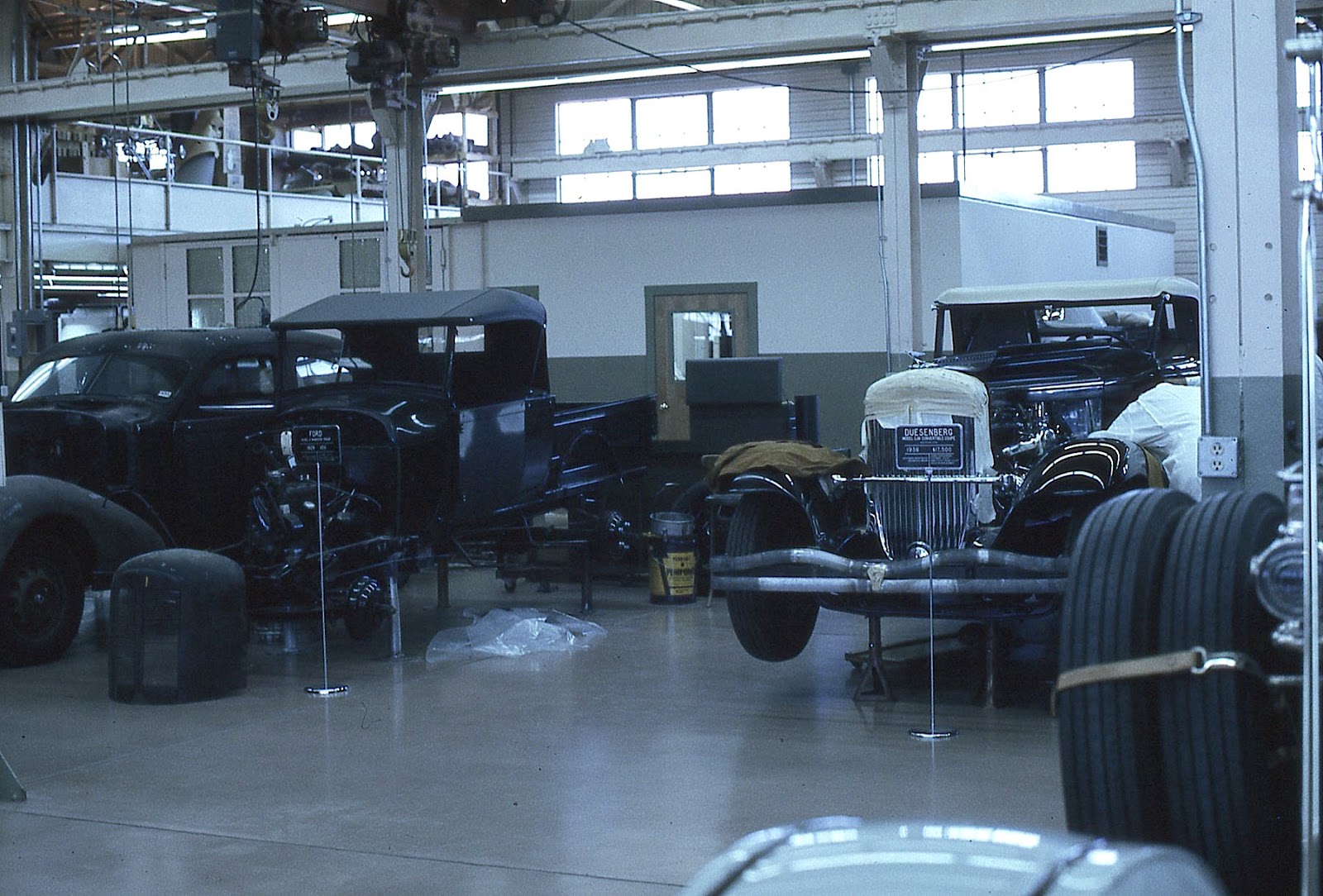
I was fortunate to visit it once, in September of 1972, while on my way from the Bay Area back to upstate New York where I worked.  The collection was housed in the city of Sparks, Nevada which is just east of Reno.  If I remember correctly, it was in a warehouse or industrial district and occupied three or four one-story warehouse-type buildings.

One building was devoted to cars deemed deserving of better display.  The others simply had cars jammed together.  Some of the collection was systematic.  For example, there was at least one Packard from each of the years Packards were built.  And I thing the same was largely true for Fords up through 1949 or thereabouts.

Not long ago I scanned many of the 35 mm slides I took with my Nikon F cameras.  The Harrah collection photos were taken under poor conditions for the film I was using.  The cars were mostly indoors under fluorescent lighting, so the colors I was getting tended into the blue range.  Worse, most images were blurred either slightly or strongly.  I used my iMac's image software to partly clean up the photos presented below, but the quality is still pretty bad.

Nevertheless, give them a look to get a slight sense of what Harrah had gathered at a point six years before he died.

Gallery

Outdoors.  That's one of those convertible tour busses used in the 1920s and 30s to show tourists around Yellowstone and Glacier national parks (among others).

A row of cars perhaps awaiting restoration along with a P-38 fighter plane in the background.  The nearest car is a 1955 Studebaker.  Behind it is a 1938-vintage Graham.  Farther back is what seems to be a late-1930s Packard.

Views of restoration areas.  That's a 1932 Marmon 16 convertible coupe in the lower image.  A Duesenberg is at the right in the upper photo.

A hall jammed with sports cars.

The red car is a 1935 Auburn 851 boat-tail Speedster.

A 1954 Hudson Italia, one of only 26 that were built.

1918 Crane Simplex.

A row of Duesenbergs.  So if your collection has a bunch of Duesies on the show floor, not to mention the one under restoration, you might as well have ...

a Bugatti Royale.

Monday, August 3, 2015

Chrysler's Jaguar-Like LH Models

There being little that's new under the sun, as the saying goes, there are bound to be similarities in automobile designs from different makers.  Sometimes, this might be purely accidental, styling staffs reacting to the zeitgeist, engineering or ergonomic considerations, or even perhaps to compliance with government regulations.  Then there are deliberate borrowings of features from other marques.  Some fall into the category of similarities, but others come close to outright thievery.

Here I deal with a case that's not design theft, but it comes fairly close to it.  For 1993, Chrysler finally abandoned its K-car bodies for the new LH platform.  The initial Chrysler brand car using LH was called the Concorde.  Its passenger compartment greenhouse was conventional for its time.  The following model year, Chrysler added top-of-the-line models using the New Yorker series name that had been around since 1940 along with a nearly identical LHS model.

To distinguish the New Yorker and LHS from lesser Chryslers, they were given a different roof treatment.  This created some controversy (among car buffs, at least) because the aft part of the roof was similar to that used by 1950s-vintage Jaguars.

The design looked nice and did give the New Yorker and LHS a measure of distinction.  On the other hand, the same result could have been attained using a different theme.

Gallery

1995 ca. Chrysler Concorde
This was the base model Chrysler design first offered for the 1993 model year.

1994 Chrysler New Yorker
And here is the New Yorker variation.  The grille ensemble is different as is the trunk and rear of the greenhouse.

1994 Chrysler New Yorker
Profile view showing how the aft of the top tucks down towards the trunk.

1994 Chrysler New Yorker
Rear three-quarter view.  Note the following: the tuck-down curve; the backlight / rear window position; the curved shape of aft side window.  Compare these to the Jaguar below.

1955 Jaguar Mark VII - Barrett Jackson auction photo
True, the details just mentioned are not identical.  After all, the Jaguar predated the New Yorker by 40 years and automobiles in general had evolved.  Yet the cars share similar aft side window curves, greenhouse tuck-down, and the setting (if not quite the shape) of the backlight.

Thursday, July 30, 2015

Streamlined ​Škodas of the 1930s

I'm pretty sure that when the subject of streamlined 1930s cars from Czechoslovakia is raised, most people think only of Tatra and its rear-engine models.

​But Tatra was not alone.  The rival Škoda firm also tried streamlining, but in a more limited way.  The present post present some examples that were either prototypes or very limited-production cars.  I am not very knowledgeable regarding automobiles from central Europe, so will not deal with the backgrounds of the cars.  However, you might wish to consult the following: the 1935 Škoda 935 prototype, here; the Škoda Popular line, here; the 1936-38 Škoda Popular Sport 909 Monte Carlo, here; and the 1938-42 Škoda Rapid 922, here.

Given the comparatively tiny production levels Škoda attained prior to World War 2, I find it surprising that the company was able to afford to fund the interesting cars shown below.

Gallery


Above are photos of the 935 prototype of 1935.  It had a water-cooled motor located at the rear and looked a bit more advanced than similar cars from Tatra and the 1933 "Sterkenburg" design by John Tjaarda.  This was due to its use of flow-through or pontoon fenders.


Another advanced Škoda design with pontoon fenders was the 1935 Popular Special Sport, two variations of which are shown here.

This is a 1937 Škoda Popular "Malá Dahoda" that is essentially the same as the car shown below.


1937 Škoda Popular Sport 909 "Monte Carlo."  It differs from the "Malá Dahoda" in only a few details, the most noticeable being the headlight treatment and the shape of the trailing edge of the front fenders.  A nice, racy 1930s design for such a small vehicle.


These images are of a 1938 Škoda Rapid 922.  This car needs bumpers, the headlight housings are awkward, and the grille is unimaginatively functional.  Otherwise, it's a nice clean design that's a year or so ahead of its time.

Monday, July 27, 2015

Lincoln's Last Mark

At first, there were the original Lincoln Continentals, produced for the 1940-42 and 1946-48 model years (with time out for World War 2).  Then came the ultra-expensive Lincoln Continental Mark II for 1956-57.  After that, Lincoln confusingly branded some of its models as Lincoln Continental Mark this and that, or simply Lincoln Continental or even Lincoln Mark whatever -- the Wikipedia entry on Marks is here, and the entry for Continentals is here, some cars being cited in both.

By the 1990s, someone at Lincoln who also was keeping score had the Mark count up to VII, and so the next Lincoln coupe design became the Mark VIII (1993-1998 model years), and to date, the last of the series. Wikipedia deals with the VIII here.

The Mark VIII looked low, long, and a bit wide, though some curving of the sides kept the sense of visual bulk somewhat under control.  It also was a clean, aerodynamic design without much ornamentation.  I can offer little in the way of criticism.  The first few model year sales were comparable to late Mark VII levels, but then fell off considerably.

Below are images grabbed from here and there on the Internet.

Gallery

Front end of a 1996 Mark VIII.  Its rounded body shape is offset by the sharp grille and headlight treatment.

1995 model seen from the side.  This shows the folds along the sides that help lighten the bulk of the car.  The rub-rail towards the bottom also helps to counteract the general roundness.  The various wheel treatments seen in the images here all strike me as being much too complicated and out of character with the rest of the car.  At the rear is a hint of the original Continental's spare tire housing.

The spare tire echo on the trunk lid shows up clearly on this photo of a 1996 Mark VIII.  Its rear face's transition to the top surface of the trunk is crisp, a useful contrast to the roundness, and the same can be said for the outline of the backlight.  Functionalist purists would probably object to having a purely decorative, stylized echo of a rear spare tire mount.  They have a point, but it does add interest as well as serving as a brand identifier.

This photo of a 1998 Mark VIII shows the front facelift that appeared on 1997 models.  The crispness of the original detailing is lost, but the new headlights, grille and hood sculpting are pleasantly done.