Showing posts with label GMC. Show all posts

Thursday, March 10, 2022

Some General Motors SUV Brand Variations

Back in the days when General Motors ruled the automobile world and was rolling cash, there still was need to economize.  For example, from the early 1940s into the mid-1950s GM made use of three basic bodies for its five brands (1940s Cadillac Model 75 limousines were a minor exception).  Which meant that each body was shared by more than one brand.

Each GM brand was given its own set of styling cues -- grilles especially, plus lesser decorative items -- and these would be provided to the various bodies for brand identification purposes.  For example, around 1950, Chevrolets and Pontiacs used only GM's A Body, whereas 1951 Oldsmobiles used bodies A, B and C.

Those bodies were sedans and derivatives such as convertibles and station wagons.  Nowadays, a brand's models are spread across several distinct body types, perhaps along with more than one body within a given type.

Currently, General Motors has several SUV bodies in production, each used by more than one of its four current brands (Chevrolet, Buick, GMC and Cadillac).  The present post deals with brand variation on a current intermediate-size SUV platform and its immediate predecessor.

Models discussed are the Chevrolet Traverse, GMC Acadia and the Buick Enclave.

Gallery

2009 Chevrolet Traverse
General Motors was drifting towards bankruptcy when this body was under development.

2008 Buick Enclave
Even so, the Buick version received slightly different sheet metal on the lower body.  Also note small differences on the rear door windows.

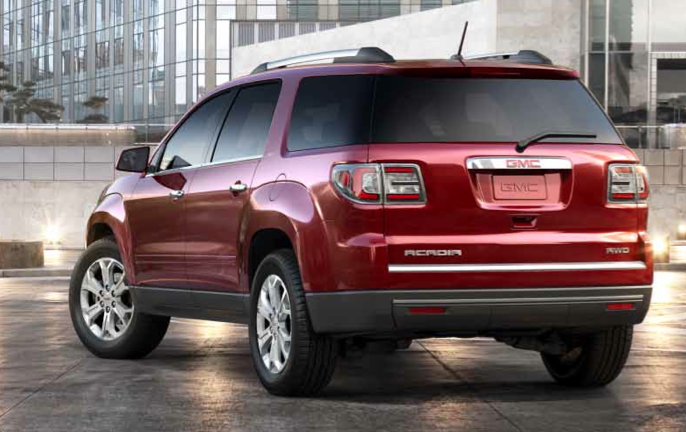
2007 GMC Acadia
Yet the Acadia received different bodywork aft of the middle of the rear side door.  My guess is that since GMC was once General Motors' truck brand, the car was given a larger-capacity cargo carrying zone in the form of a higher roof and more vertical rear, in line with GMC's industrial image (that is much less strong today).

2018 Chevrolet Traverse
The 2007-09 SUV bodies were replaced for the 2018 model year.  By that time, GM was in better financial shape and could afford to fund more visual variation.  The Traverse is the largest seller of the group, so consider it the baseline for our discussion.

2018 GMC Acadia
The Acadia again received the most expensive differentiation.  Its wheelbase is 112.5 inches (2857 mm) compared to 120.9 inches (3071 mm) on the Traverse and  Enclave.  The difference is most visible in the profile of the aft quarter window and the aft cutline of the rear side door.

2018 Buick Escalade
The Escalade's bodywork abaft of the cowling is different from and racier-looking than that of the Traverse.  Note the chrome strip extending across the upper edges of the windows and on to the rear.   This enhances the "racy" appearance (compared to many competing SUVs). 

2018 Chevrolet Traverse
The Traverse grille theme is similar to that of some other Chevrolet models.  That horizontal sweep from headlight to headlight is a variation on an industry-wide styling cliché, though the overall frontal design is comparatively simple and pleasing.

2018 GMC Acadia
That across-the-front sweep cliché is mercifully absent on the Acadia.  Instead, there is a strong, truck-like grille befitting the GMC legacy.

2018 Buick Enclave
Enclave's design feel is softer than that of the others.  More obvious curved areas and little angularity and tight-radius folds.  Its front end is fairly simple in today's context.  The sweep cliché is absent, and the grille is less bold than the GMC's.  All-in-all a likable design, though not an outstanding one.

Rear-quarter view showing more of the generally rounded body-shaping theme.

Thursday, August 1, 2019

C-Pillar Black Divider Swath Fad

Some of the library books about industrial design from the 1930s that I read when I was young seemed to go along with the contemporary Architecture ideology that designers should strive for functional, truth-to-materials purity in their creations.   No doubt there were car designers in the USA and, more likely Europe (due to the Bauhaus influence), who pursued such ideals.  But the men in charge of styling departments knew that a major function of a car's design was to sell in appropriate numbers.  And to do that, a certain amount of attention to fashion had to be paid.

To be in step with fashion means that popular features introduced by a competitor might be borrowed to appease potential buyers who value being au courant.  I myself was caught up with that when I was in my teens.  If a car maker wasn't offering four-door hardtop convertibles or the correct type of wraparound windshields, then I would urge my father to not consider those products.

Nowadays when wind tunnel tests largely determine overall body shapes, exterior stylists are reduced to coming up with distinctive cladding features to differentiate brands and models.  Usually this takes the form of sheet metal sculpting and angular front and rear detailing elements.

A recent fad is for black patches or swaths, sometimes with chromed edges, placed on cars' C-pillars as a kind of faux (non-structural) division between the roof and the lower body of the vehicle.  Even though I left the Church of Functionality decades ago, this latest styling touch strikes me as being utterly phony: an important line has been crossed.

Below are some examples.

Gallery

1953 Packard Balboa Concept Car
Here we see a sculpted element at the base the C-pillar that clearly separates the passenger compartment roof from the lower body.  Because it is sculpted, it gives the appearance of being structural, and therefore is "believable."

2017 Chevrolet Bolt
The recent separators of roofs and lower bodies are clearly cosmetic.  The Bolt's separator conflicts with the rest of the styling and adds visual clutter.  The car would look nicer without it.

2018 GMC Terrain
I couldn't locate a factory photo that clearly illustrates the Terrain's divider.  But you might be able to see that it, along with strongly tinted side windows, hints at being wraparound rear windows.
UPDATE:
It wasn't visible in the photos I consulted, but it turns out that in that C-pillar black zone there lies a very small window intended for passengers in third-row seats.

2018 Honda Odyssey
No chromed edges here.  Just a clearly tacked-on element that clashes with the aft side window and actual shape of the C-pillar.

2018 Lexus RX L
Lexuses have featured extreme angularity in recent model years.  Here the black swath gives the C-pillar a wedged shape that it lacks in reality.

2019 Nissan Altima
This black element is comparatively discrete and almost yields a coherent theme.  Some work is needed where it touches the side window.

Thursday, February 20, 2014

GMC Acadia's 2013 Facelift

GMC is the General Motors division devoted to making utility vehicles such as trucks, though its Chevrolet division also produces a number of models based on the same platforms.  Since 1992, GMC, with its Tahoe and Yukon lines, has been marketing four-door, station wagon (break) format SUVs.  To these was added the slightly smaller Acadia line starting for the 2007 model year.

I found the Acadia styling quite pleasing, given its dimensions and other market niche requirements.  As best I can analyze this for now, factors include: the body is somewhat rounded rather than being squared-off; the large lips around the wheel openings help reduce the feeling of bulk, as do the character line along the door handles and the shaping at lower-door level; and finally, the grille-headlamp ensemble that is clearly separated from the bumper-air-intake ensemble below it.

Then, for 2013, the Acadia was given a facelift to "freshen" its appearance.  As with most facelifts, it was a change for the worse, or so I think.  Below are comparison images of the 2007 and 2013 designs.  The original design is at the top and the facelift is at the bottom of each image pairing.

Gallery

The most drastic changes involve the Acadia's "face."  The headlamp units are more angular and incorporate those faddish LED light strings.  Whereas the 2007 headlamp units presented a tranquil appearance, the 2013 has a harsh, rather angry expression for its "eyes."  Lost is the upper-lower distinction of the vehicle's face; now there is a larger grille opening that drops down into the bumper zone.  The removal of the edge-to-edge horizontal divider panel transforms the design from a comparatively light or airy one to a heavy, truck-like one that clashes with the side details established in 2007 to lighten the effect of a large vehicle.

Changes to the rear are minor and do not alter the character of the design.  The most obvious change is the addition of faux-wraparound rear window glass whose only "function" is to reduce the number of elements in the name of visual simplification.