Showing posts with label Delahaye. Show all posts

Monday, September 14, 2026

Figoni et Falaschi: From Delahaye 135 to Talbot-Lago "Goutte d'Eau"

In 1951, New York's Museum of Modern Art had an exhibit titled "8 Automobiles."  The concept was to present a variety of design approaches to cladding basic automotive functionalism.  Probably the most famous selection (to car design buffs, anyway) was Pinin Farina's Cisitalia 202 Coupé.  Another selected design was that of a Talbot-Lago T150-C-SS Goutte d'Eau (Teardrop) Coupé designed by Giuseppe (Joseph) Figoni of the new (1935) Figoni et Falaschi Carrossiers firm.

MoMA's exhibition press release's statement regarding the Talbot-Lago:

"A third way to combine the essential elements of a car is illustrated at its most extreme by the Talbot, a French three-passenger sport and touring car lent by Carroll Bagley.  This car combines separate envelopes for each part in a composition of similar shapes, and, as a whole, forms an expressive symbol of streamlining."

Here are some links.  Wikipedia on Talbot-Lago is here.  Its entry on Figoni et Falaschi is here.  My post about the Cisitalia 202 is here.

Figoni's design ideas for the Talbot were tried out on a Delahaye 135 chassis in 1936.  The classic New York type Goutte d'Eau appeared in 1937, and versions were built as late as 1939.  All told, there were 11 such cars, plus four "Jeancart" variations along with at least three T23 coupés with similar styling and one T150-C-SS cabriolet.  As of 2002, ten of the 11 coupés were known to have survived (number 90102 seems missing).  That's a surprising large proportion surviving, given usual attrition rates, even for classic cars.

Images below compare the Figoni et Falaschi Delahaye 135 M Coupé to similarly posed Talbot-Lago T150-C-SS Coupés.

Gallery

1936 Delahaye 135 M - Unidentified original source photo
I think Figoni tended to splash too much chrome on some of his designs, including this one.  But maybe that's what his customers wanted.

1938 Talbot-Lago T150-C-SS (90117) - RM Sotheby's Auctions photo
Proportions are similar, as are the fender and hood shapes.  Note the "shovel" hood to windshield transition shape.  Also the V'd two-piece windshield compared to the flat windshield on the 135 M.

1936 Delahaye 135 M - Unidentified original source photo
This Delahaye 135 M short-chassis wheelbase is said by Google AI to be around 105 inches (2667 mm), and the length about 158 inches (4013 mm).


1937 Talbot-Lago T150-C-SS (90107) - Gooding Christie's Auctions photo
Some Talbots also had spatted front fenders like the Delahaye's.  This T150's wheelbase is 104.3 inches (2650 mm) and its length is about 172 inches (4369 mm).  The added comparative length is found in the rear overhang and more graceful rear profile seen here.  The rounded window shape is in keeping with the generally rounded/streamlined design theme.

1936 Delahaye 135 M - Unidentified original source photo
An earlier photo, when the car sported a different paint scheme.

1938 ex-Rob Walker, Countess of Strafford, Talbot-Lago "Special" (90109) - Bonhams Auctions photo
Again, the added rear overhang is important in creating a more attractive design, as seen from this angle.  The backlight window is curved and one-piece, compared to the 135 M's two-segment, flat-paned backlight.  Also note that chrome trim is used much more sparingly here.

Thursday, June 29, 2023

Saoutchik's Streamlined Dalahaye and Talbot Compared

Early in 2022 I wrote about coachbuilder Saoutchik's Delahaye 175 Coupe de Ville of 1949.  It was fairly typical of the wild designs Saoutchik was making in those days.  That said, it had a passenger compartment with an uncluttered fastback that was in the same spirit as 1940s General Motors fastbacks.  I regard it as one of Saoutchik's better post- World War 2 designs

Recently, I came across a Saoutchik design that was similar, yet much better.  It was for a 1950 Talbot Lago T26 Record Grand Sport Coupé.  As was the case for the Delahaye, I don't know how many such bodies were built.  Based on photos found on Internet searches, there seem to have been at least two survivors, and possibly more were made.

The Dalahaye is longer, having a 116.1-inch (2950 mm) wheelbase, whereas that of the Talbot is 104.3 iinches (2650 mm), as the Wikipedia links above state.

Images of the Delahaye are from Barrett-Jackson auctioneers, and most or all of the Talbot are via RM Sotheby's.

Gallery

Frontal design of the Delahaye 175 is largely standard Delahaye, aside from the flamboyant fender work by Saoutchik.

The upper grille frame outline is Talbot, but the rest of the design is by Saoutchik.

Interesting side styling.  The chrome strip extending from the side of the hood to below he beltline to the top of the rear fender does all this in one sweep.  This ties the otherwise somewhat fragmented design together.  The rear fender bulge and the fadeaway front fender reduce visual bulk on what otherwise would have been a slab-sided 1949 design.  That front fender side sculpting and its different paint color assist in this.

Note the narrower door and shorter passenger compartment.  The fenderline is more "modern" than that of the Delahaye.  It's higher, but has subtle shaping below the beltline.

The rear styling is clean and well-shaped aside from the heavy fender chrome.

This Talbot is remarkably brightwork-free for a Saoutchik design, though note the strip tailing abaft of the door, extending along the trunk lid.  At least it's narrow.

Now for two additional Talbot images.  This is a well-styled design in the context of 1950 and in the context of Saoutchik's normal flamboyance.  

This example looks good in part because it lacks bumpers.  What effect might they have?

Here's a photo of another Saoutchik Talbot, this via Bonhams.  It has bumpers, but they don't degrade the design much.

Thursday, April 21, 2022

Some Postwar Delahaye Sedans

A few years ago I wrote about 1949 Delahaye cars with "pontoon" fenders by carrossier Guilloré.  This was one aspect of the firm's attempt at keeping up with post- World War 2 styling trends that were largely driven by General Motors and other American carmakers.

Unfortunately, Delahaye was undercapitalized and, being a builder of upscale cars, received little benefit from France's Plan Pons that favored production of entry level automobiles.  So motors, chassis, and other engineering details were pre-war.  And this yielded long hoods and comparatively short passenger compartments while American cars were getting shorter hoods and longer trunks and rear overhang.

Shown below are four-door sedan designs by Letourneur & Marchand, illustrating how difficult putting postwar features on prewar chassis could be.  The Delahaye 148 L (for Léger) cars are probably 1948 models, though one of my best sources on French automobiles claims they first appeared in the Fall of 1949.

Gallery

1948 Delahaye 148 L Berline - by Letourneur et Marchand - likely a for-sale image
This design was used for a small "production" run by the coachbuilder.  Unlike Delahaye's prewar custom sedan bodies from its various carrossiers, the beltline below the windows did not curve downward.  This made the car look more postwar.  The front fender extend across the forward door, terminating at the aft door cutline, an awkward touch.  However, the doors are hung on the B-pillar creating a front "suicide door" that at least lacked the complicated fender-related hinging that an A-pillar attachment would have required.

1948 Delahaye 148 L Berline - by Letourneur et Marchand - for-sale photo
Probably the same car as in the previous image.

The "notch-back' is somewhat in line with General Motors' thinking, though the curved backlight window is a little small by contemporary American standards.  Perhaps a matter of French car window glass forming technology compared to that in the USA.

1948c Delahaye 148L Berline - by Letourneur et Marchand - Hyman photo
This car, found in the USA, features wire wheels.  It lacks the chrome rock guard on the rear fender.  The front fenderline is more horizontal than that of the other 148 L.

1949c Delahaye 148 L 4-door by Letourneur et Marchand
Here Letourneur & Marchand placed a "pontoon" fender on a 148 L.  Slab-sided to begin with, the long expanse between the front door cutline and the wheel opening exaggerates the slabiness.  More modern, more ugly.

1949 Delahaye 135 M 2-door coupé - Dyler photo
Probably by Guilloré, whose designs I featured in the first link above.  Perhaps Letourneur & Marchand were reacting to cars like these when the sedan in the previous image was built.

Thursday, March 24, 2022

Pinin Farina' 1947 Delahaye 135 MS Coupé -- and an Alfa 6C 2500 SS

A few years ago in this post I noted that Pinin Farina used a nearly identical design for both a Delahaye 135MS Coupé and an Alfa Romeo 6C 2500 Belinetta Speciale.  Today's post presents more images of those cars.

Alfa Romeos are probably known to to most readers of this blog, but perhaps Delahayes are less familiar.   So here is some background on the company's 135 model.  As for the 135MS Coupé, here is information via Bonham's acution page.  I don't have similar information regarding the Alfa.

Images below are via Bonhams and otherwise perhaps from Pinin Farina.

Gallery

Delahaye 135 MS Coupé

Alfa Romeo 6C 2500 SS
Front ends feature grille designs and other features appropriate to each brand.

Delahaye 135 MS Coupé
The Delahaye's window profile is very slightly more curved than that of the Alfa.  And the distance from the door's cut line to the wheel opening is slightly greater here.

Alfa Romeo 6C 2500 SS
The Alfa has greater front overhang and perhaps a trifle less at the rear.

Delahaye 135 MS Coupé
The car's restoration eliminated the wand-type turn indicator abaft of the door.

Alfa Romeo 6C 2500 SS
Tail lights differ and the Alfa's rear bumper wraps a bit more.

Given that Farina's immediate post- World War 2's clientele was probably mostly Italian, my guess is that the Alfa body was created first, while the Belgian who bought the Delahaye decided he wanted one like it.

Thursday, February 24, 2022

Saoutchik's Delahaye 175 Coupe de Ville

I used to think that most postwar designs by Saoutchik were outrageously decadent.  Actually, I still do.  But the overly-sculpted bas-relief décor on many recent cars and SUVs tends to make Saoutchik's work more mainstream.

Today's post presents some images of a 1949 Saoutchik-bodied Delahaye 175.

Because it is a closed (or semi-closed) car, its proportions are more normal than Saoutchik roadster and cabriolet designs of the same vintage.  As noted below, my main complaints about the featured car are its fussy chrome swaths on the front fenders.  And the grille / front end design is fussy as well, though that's due to Delahaye, not much to Saoutchik.

As best I know, the car is unique.  However, the Barrett-Jackson auction web site does not mention that the car they were featuring was displayed at the Bay Area's Blackhawk museum.  Yet the Blackhawk site has photos of what seems to be the same car, though information about it is deleted because the car seems to be no longer in its collection.  Might there have been two such cars?  Or did Barrett-Jackson miss the Blackhawk detail?

Gallery

Photo by Gooding auctions.

Side view.  This image and the next two are from Barrett-Jackson.  An interesting feature is the low-relief hint of a rear fender that extends forward over the door: both details were unusual.

Low front quarter view showing the standard Delahaye grille along with flanking intakes that Saoutchik seems to have styled.  And there are those chrome fender accents.

This rear quarter view shows a simple, nicely-shaped fastback in contemporary General Motors mode.  The chrome rear fender accents are modest compared to at the front, yet still are more bold than necessary.

Similar view via the Blackhawk web site.

Blackhawk side view.  The car is nicely proportioned.  Of course I like the long hood.  Nice touches are the angles of the A and B pillars, providing some visual tension.

Blackhawk front quarter view.

The rear, via Blackhawk.  Very simple indeed for a Saoutchik design.

Thursday, January 27, 2022

French Shovel Nose Grilles

I recently wrote about the early-1930s American "shovel nose" grille styling fad.   The present post presents some French versions.  The term shovel nose refers to grilles where lower segments of vertical bars curved forward creating a shovel-like effect.

These first appeared in America for the 1932 model year, were somewhat common for 1933, and the final new appearance was on a 1934 brand.  By 1936 grille fashions had changed to convex "fencer's mask" designs.

Only a few French marques had shovel nose grilles.  They first appeared for 1934-35, but stayed in production at Peugeot a while longer.

Gallery

1932 Packard Light Eight Coupe Roadster - RM Sotheby's photo
Early, classical American shovel nose styling.

1934 Peugeot 301 Cabriolet
Peugeot's 1934 version was much more restrained.

1934 Chenard et Walcker Aiglon Berline - for sale photo
A more aggressive interpretation.

1934 Delahaye 134 Berline by Sical - for sale photo
Another restrained design.

1935 Unic Cabriolet at the 1934 Paris auto show
Another strong shovel nose.  These were seen at the Salon de l'Automobile and in advertising, but 1936 Unics and perhaps some '35s had conventional grilles.

Wednesday, September 29, 2021

Postwar East German Horch Designs

Germany's luxury Horch brand, Wikipedia entry here, was based in Zwickau, Saxony.  At the end of World War 2 Zwickau was part of the Russian occupation zone that in 1949 became the DDR (Deutsche Demokratische Republik), commonly called East Germany.

I posted about some magnificent prewar Horch's here and here.  Marxist ideology required "equality," so Communist bloc countries built very few luxury cars, and only for top leadership use.  Therefore, Horch ceased to be a luxury brand, being reduced to something like lower-midlevel Western makes.
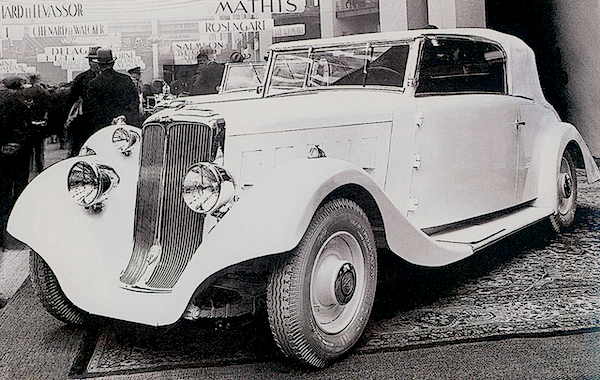
This present post presents the Horch (later Sachsenring) P240 produced during the second half of the 1950s.  Also shown is the prototype of a luxury model that never saw production.

Gallery

1938 Horch 930 Limousine
An example of a prewar luxury Horch.

Horch P240 - photo via Autobilder
The Horch P240 was launched in 1955.  This is an early model with vertical grille bars.  (By the way, Autobilder translates as "car pictures.")

Horch P240 - photo via Autobilder
Styling was slightly awkward, but in line with similar size Western European cars.  Included was a curved windshield and wraparound backlight, both probably imported from West Germany.  The two-tone paint scheme was in line with current USA fashion.  Note the side chrome trim, as something similar will be seen below.

1958c Horch-Sachsenring P240
The design lookes better in monochrome.  The restyled grille design seems to have been inspired by ...

1952 Delahaye MS Coupé by Henri Chapron - Bonhams photo
Delahaye was a French luxury brand in its last legs in the early 1950s.

1954 Opel Kapitän
A roughly equivalent West German car was General Motors' Opel Kapitän.  This appeared while the P240 was under development.

1956 Opel Kapitän
Here is the Kapitän's 1956 facelift that appeared the model year after the P240 was launched, but perhaps its design was frozen in the spring of 1955 when the P240 was first displayed.  Its side chrome trim is not identical to that of the Horch, but quite similar in concept.

1950c Horch 920S prototype
An evolution of the prewar Horch 930S Stromlinie design.

1950c Horch 920S prototype
The tall windows and low hood reduce what otherwise would be considerable visual bulk related to the slab sides.

Thursday, September 26, 2019

Italian Variations on a Coupé Theme, Circa 1950

There are all sorts of reasons why automobile designs from different sources can seem quite similar.  In some cases, a stylist from one firm would be hired by another and he continued in his usual manner.  Another possibility is stylists from different firms meeting in the same bar and trading stories, though this is difficult to document if it ever happened at all.  A third would be a zeitgeist argument, that certain idea were simply "in the air" at a given time.  Fourth might be the state of the technological art driving what kinds of shapes and packages were possible at one of these given times.

The present post presents coupé designs from three Italian carrozzeria: Pinin Farina, Touring, and Ghia.  Those designs featured similar passenger compartment "greenhouses" along with some other similar features.  Please correct me, but as far as I can tell, there was no transfer of stylists between the firms during the period 1947-52 when the cars shown below were designed.  The "same bar" hypothesis can also be ruled out.  Technology was a consideration, as I'll explain.  What happened was that Pinin Farina came up with a design suited to the immediate post- World War 2 glass-forming technology in Italy.  Then Touring and Ghia, within changing limits of technology, refined Farina's concept.

Gallery

Pinin Farina - 1947 Alfa Romeo 6C 2500 SS Coupé
I don't know if this car or the one in the following image came first, but their bodies are identical aside from wheelbase and brand identification details.

Pinin Farina - Delahaye 1947 135MS Coupé
Windshields are two-pane, flat glass.  Side windows are also flat glass.

Pinin Farina - Delahaye 1947 135MS Coupé
Back windows are fairly small, with glass curved slightly horizontally.  The shape of the top is large-radius and uncomplicated by the presence of a second set of side windows abaft of the doors.

Touring - 1949 Alfa Romeo 6C 2500 Super Sport Coupé
The passenger compartment greenhouse in this Touring design is better shaped, more graceful than Farina's original effort.  The lower body is entirely different.

Ghia - 1949 Alfa Romeo 6C 2500 SS Coupé
A Ghia version of the same Alfa type features through-fenders like Farina's '47 Alfa 2500.  The greenhouse is shorter and airier due to larger windows.

Ghia - 1952 (circa) Alfa Romeo 1900C Coupe prototype
A few years later Ghia created this refinement on the theme.  Now glass-forming technology allowed a one-piece curved windshield and a larger, more-curved backlight.

Ghia - 1953-54 Alfa Romeo 1900 Sprint Speciale Supergioiello
Few examples of this design were built.  The greenhouse is not like the Farina version aside from the side windows and presence of the large aft quarter pillar -- yet the general spirit remains.  The name "Supergioiello" might be freely translated as "fabulous jewell."