Showing posts with label LaSalle. Show all posts

Thursday, February 26, 2026

LaSalle Grilles 1934-1940

As long-time readers of this blog know, I like grille themes and other brand-identification details that persist over many model years.  Today's example is LaSalle's grille designs used 1934-1940.  It might have persisted into 1941, but the brand was discontinued, facelifted into Cadillac's model 61.

For some background, I wrote "General Motors' Companion Cars (4): Cadillac and LaSalle" here.  The original LaSalle grille along with other styling aspects is mentioned in "Hispano-Suiza and the 1927 LaSalle" here.  That grille design theme was continued through 1932: eight model years. The only unique grille was 1933's; I posted "1933 LaSalle Walkaround" here.

The 1934-1940 grille theme lasted for seven years, but might have lasted eight, had the brand not been discontinued.  That theme is the one most people think of with respect to LaSalle.

Gallery

1927 LaSalle - photo via forums.aaca.org
The original LaSalle grille design.

1930 LaSalle - RM Sotheby's auction photo
Several model years later, the grille frame seems unchanged.

1933 LaSalle - car-for-sale photo
The transitional design.  It's wider than the 1934-1940 versions, but the grille bar theme was carried over to the redesigned 1934 cars.

1934 LaSalle - Driehaus Collection photo
The 1934 frontal design was iconic.  Besides the grille, fender chevrons continued for two more years, and vertical marks and variations on the catwalks are found most future model years.

1935 LaSalle - RM Sotheby's
Little change from '34 aside from the more substantial (but less interesting) bumper.

1936 LaSalle - via thelastdetail.com
Similar grille, but more horizontal bars.

1937 LaSalle - car-for-sale photo
LaSalles got new bodies and Cadillac V-8 motors.  The grille bars appear to be a mesh with slight horizontal dominance.

1938 LaSalle - Mecum Auctions photo
The same theme, but wider.

1939 LaSalle - car-for-sale photo
The grille was drastically narrowed for '39, the thin bars horizontal.  The vertical catwalk chrome strips cover a lower air intake opening -- a functional use for what had been brand identification decoration.

1940 LaSalle - Mecum
This is a Model 52 LaSalle on a new body design.  (Model 50s on the previous body continued in production for '40, but its front end was essentially what we see here.)  This frontal design, along with the 1934 version are what come to my mind when I think "LaSalle."

Proposed 1941 LaSalle front end design - General Motors photo
A more "squared-off" theme.  Had LaSalle continued into 1942, I think there was a good chance the vertical grille element would have disappeared.  That's because the American industry standard  at that point was bold, horizontal grilles.

Thursday, March 27, 2025

Jeep-Like Segmented Grilles: Chevy Biscayne Concept, Cisitalia 505 DF, and More

I last wrote about the Chevrolet Biscayne concept car here.  It was displayed at General Motors' 1955 Motorama show along with other classic concepts from that Golden Age of Dream Cars.

Recently, I came across images of a 1953 505 DF Cisitalia by Ghia, designed by Aldo Brovarone -- one of 10 built.  This 505 (unlike some or all other 505s) featured a grille that, to me, evoked the Biscayne's grille.

Those grille designs differ in most details, yet their general feelings seem similar.  It's possible that GM stylists were aware of this Cisitalia, because another 1955 Motorama concept car (the LaSalle II Roadster) had a grille with openings fairly similar to the 505's.

Oh, one more thing.  Once one considers aspects of grille segmentation, it's hard not to think of Jeep grilles.

These and other matters are discussed below.

Gallery

1955 Chevrolet Biscayne - factory photos
I'll try really hard to ignore that bug-eye headlight assembly design and focus on the grille.  It's a simple horizontal opening featuring nine vertical chrome bars; one inset at each side and seven equally spaced over the opening.  This creates seven open segments -- like Jeep grilles.

1953 Cisitalia 505 DF by Ghia - factory photos
The Cisitalia grille is seven tall, vertical openings trimmed in chrome.  Between the openings are thin, chromed strips.  Although entirely different (aside, perhaps, of the just-mentioned strips), those seven primary vertical elements for each grille present a visual linking of the two designs.

Now for a few comparison images ....


1944 Willys Jeep - photo via Haggerty Insurance
World War 2 Jeep grilles varied, but Willys-built Jeeps eventually received seven-slot grilles and the firm trademarked that concept.  This clearly predates the grilles pictured above.

2014 Jeep Cherokee - factory photo
Compare the grille on this Jeep to that of the Cisitalia shown above.  As noted in the previous photo caption, World War 2 Army Jeeps were not consistent in the number of vertical grille openings.  Many had nine, others had seven.  Jeeps in use when I was in the Army (early 1960s) had seven openings.  Recall that the Biscayne featured seven openings -- not quite the same structure -- but numerically the same.

1955 LaSalle II Roadster - Petersen Automotive Museum photo
This is the other '55 Motorama car mentioned in the text above.  Its grille openings are similar to those on the Cisitalia, though there are only six of them.  This theme is a carryove from the 1940 LaSalle.  I can't rule out the possibility that those '40 LaSalles inspired the Cisitalia's grille.

2024 Kia Sorento - factory photo
I recently noticed this Jeep-like seven-segment grille while vacationing in Hawaii. I wonder what Kia stylists and marketing management were thinking.  I also wonder what the folks at Jeep are thinking.

Monday, February 3, 2025

General Motors Four-Window Coupe Evolution 1935-1940

During the mid-through-late 1930s General Motors had the largest portfolio of car brands in the USA.  It also was the largest and most profitable firm.  As best I can tell, once GM had switched to expensive-to-tool all-steel bodies, it was still able to afford to produce more than one body platform while offering redesigns every two or so model years.

Styling was at the height of the great evolutionary transition from boxy cars with discrete elements such as fenders, running boards, headlight assemblies, non-integrated trunks and such to designs that blended those features with the appearance of streamlining.  Given the pathbreaking, it's not surprising that most designs of that era seem awkward to us because stylists were groping for attractive themes while constrained by the state of metal and glass shaping art of the time (that also was in a period of change).

Today's post deals with coupĂ© styling by GM's Art and Colour group led by the famous Harley Earl.  Such cars might be expected to be stylish because coupes are intrinsically less massive than four-door sedans.  Yet it wasn't until the 1940 introduction of GM's C-body line that its coupes were really nice looking.

Gallery

1935 Chevrolet Master DeLuxe - Barrett-Jackson Auctions photo
Chevrolet Master DeLuxe, Pontiac and Oldsmobile sported new, all-steel bodies for 1935, including this 4-window coupe.  Steel pressing technology at the time required the rounded passenger greenhouse seen here.  Probably stylists drew rounded window profiles as a continuation of the shaping theme.

1935 Oldsmobile Six - car-for-sale photo
However, many coupes with those bodies were two-window affairs such as this.

1937 Chevrolet Master DeLuxe - Mecum Auctions photo
GM introduced new bodies for 1937.  Chevrolet had its own body set, some cars from other brands sharing them.

1937 LaSalle Opera Coupe - Mecum
This is a coupe using the longer-wheelbase 1937 B-body.  Window framing is less rounded, but the curve transitioning the greenhouse to the trunk is similar.

1938 Oldsmobile Six Business Coupe - car-for-sale photo
Small Olds Six coupes looked like this with their 1937-1938 bodies.

1939 Oldsmobile 60 Series - car-for-sale photo
This new body was shared with 1939 Chevrolet and Pontiac's Quality Six series coupes, all with wheelbases in the 111 to 115 inch range.  The front door is similar to that in the previous photo.

1939 Pontiac DeLuxe Eight - Mecum
Coupes with longer wheelbase B-bodies such as this Pontiac got a passenger greenhouse with a horizontal beltline and other crisper, less rounded, details.

1939 LaSalle - car-for-sale photo
Now for a closer look at LaSalle.  Tis coupe has the same basic body as the Pontiac in the previous image.

1940 LaSalle 50 - car-for-sale photo
That body was carried over to Series 50 LaSalles for 1940.

1940 LaSalle 52 - Mecum
But LaSalle was also given GM's new C-series bodies for 1940 on the brand's new Series 52.  These were very attractive cars -- an interesting combination of massive and lean features.  Especially the passenger compartment greenhouse is larger, better-proportioned than previous GM four-window coupes.

Monday, December 16, 2024

1935 Packard 120 Upper-Middle Class Sedan and Its Competition

The Great Depression of the 1930s crippled or snuffed out American carmakers.  Upscale automobile manufacturers were especially heavily affected.  Their brands leaving the market included Auburn, Cord, Duesenberg, Franklin, Marmon, Pierce-Arrow, Reo and Stutz.

America's most popular luxury brand in the early 1930s was Packard.  By 1933 it was suffering from reduced sales so much that for model year 1935 it launched a model for the upper-middle price range, the One-Twenty.  It was a sales success, probably saving the company, which then continued on into the mid-1950s.

Today's post compares 120 sedan styling with those of competitors in its price range.  As will be seen,  the cars most resembling 120s were some 1935 General Motors models.  New 1935 GM's bodies were more advanced than the 120's because they had all-steel roofs, whereas 120s had fabric inserts on their roofs like other American sedans had in those days.

While researching the '35 Packard 120, I was unable to determine with certainty who created its styling.


The man in charge of styling at Packard was Werner Gubitz, pictured here.   The drawing in the photo is not that of a production 120.  Rather, it's a more shapely variation perhaps under consideration for the planned 1938 redesign.

Although evidence is strong that Gubitz did the styling for the 120, that similarity to new designs for 1935 Oldsmobiles and some other GM brands remains slightly puzzling.  That's because Packard had hired George Christopher from GM to set up volume-production infrastructure to handle hoped-for demand for 120s.  I can't rule out the possibility that Christopher might have had some knowledge of forthcoming '35 GM designs and passed along some thoughts to Gubitz.

Another consideration:  Cadillacs and LaSalles received new bodies for 1934 that previewed the 1935 redesign for models of all other GM brands aside from Buick.  However, these retained the industry-standard roof inserts.  So Gubitz was aware of this design trend from America's largest carmaker, but the 120 design was likely largely determined by the time those '34 GM cars were announced.

Let's take a look.  Unless noted, images below are of cars listed for sale.

Gallery

1935 Packard 120 Touring Sedan
First, some front quarter views.  The 120 necessarily featured the Packard grille-hood design theme.

1935 Oldsmobile Eight - publicity photo
The new for 1935 GM body.  The passenger compartment greenhouse's roof is bulged because it is all-steel and subject to metal stamping technology of the time.  Windows are strongly rounded, something of a styling cliche.  Note the faintly V'd two-pane windshield.  The lower body more resembles the Packard 120.

1935 LaSalle Touring Sedan
Slightly more expensive than the 120 was the LaSalle that was rebodied for 1935.

1935 Nash Ambassador - via ConceptCarz
Nashes were given a vaguely "streamlined" look for '35.

1935 Studebaker President Land Cruiser - via Studebaker Drivers Club
This thin-looking design appeared for the 1934 model year.

1935 Hupmobile J 521 - unidentified photo source
Another 120 competitor with a facelifted 1934 body.  The headlights integrated to the body are another example of early streamlining.

1935 Chrysler CZ Airstream Eight - Hyman Ltd photo
Most Chrysler Corporation cars received this new body design for 1935.

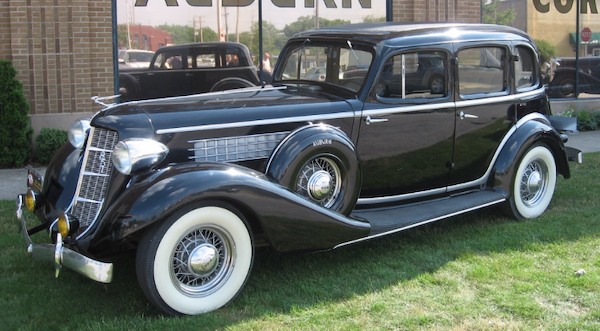
1935 Auburn 851 - unidentified photo source
Fenders are old-style, unlike the "helmet" shaped ones seen on most of the designs shown here.

1935 Graham Supercharged Eight Touring Sedan
A 1934 carryover design.

1935 Packard 120 - Downington Auctions (Australia)
Side-view comparison to a LaSalle.  Windows are better integrated here.  Fenders are more similar to those on the Oldsmobile shown above.

1935 LaSalle
The all-steel roof is visible.  Packard's hood styling is crisper, in line with hood-grille designs of other Packard models.

1935 Packard 120 - Downington Auctions
Right rear quarter view (I don't have a decent left rear quarter image).  Note the separate trunk door for the spare tire..  

1935 LaSalle Touring Sedan
Different in details from the 120, but the design is similar in spirit.

So far as I'm concerned, none of the designs shown above is very attractive.  That's because the mid-1930s was a period of rapid change, including the Chrysler Airflow's placement of the motor farther forward which allowed the back seat to be moved from over the rear axle line.  Also, "streamlining" became a body shaping fashion that few carmakers could successfully resist.  And production technology was slow to catch up with the needs of the latter.  The result: awkward designs.

That said, the Packard One-Twenty was solidly of its time for the first year or two of its initial run.

Thursday, January 25, 2024

LaSalle-Successor Cadillac Series 61's Short Saga

Setting aside the single-year marketed 1939 Cadillac Series 61, this post deals with the Series 61 that from 1941 served as Cadillac's entry level model into the 1951 model year.

This Series 61 began as replacement for the discontinued Cadillac companion brand LaSalle that ceased production in 1940.   I posted about that here.  Some Series 61 background from Wikipedia is here.

The standard Cadillac during those years was the Series 62 that usually out-sold the 61s despite having a higher price range.  Here are some sales data (Series 61 first, then Series 62, finally the ratio of 61 to 62 sales):

1941:  29,250  24,726  1.18

1942:  5,700  4,960  1.15

1946:  3,001  18,566  0.16

1947:  8,555  39,835  0.21

1948:  8,603  34,213  0.25

1949:  22,148  55,643  0.40

1950:  26,772  59,818  0.45

1951:  4,700  81,844  0.06

As can be seen, 61s sold comparatively well early in their career and again shortly before the line was cancelled.  The reason for cancellation might have been because its body platform was being phased out.  Aside from model years 1948 and 1949, Cadillac 61s and 62s did not share the exact same body platform.   Cadillac 61s used General Motors' B-bodies through 1947, then after 1949 used what I call the Lesser C-body, whereas Series 62 Cadillacs used the basic C-body.  Lesser-C sales dropped dramatically in 1951 because models such as the Buick Special switched to a redesigned B-body that year.  So Cadillac management apparently decided to base production on mainline C-bodies to economize on tooling expenses.

Some of my thoughts on the Lesser C-body are here.

Below are images comparing Series 61 Cadillacs with Series 62 examples.  Unless noted, images are of for-sale cars.

Gallery

1941 Cadillac 61 Touring Sedan
The link to my earlier post shows similarities between this design and designs proposed for 1941 LaSalles.

1941 Cadillac 61 Touring Sedan
B-body Cadillac 61s had a 126-inch (3200 mm) wheelbase.

1941 Cadillac 62 Touring Sedan
C-body '41 Cadillacs had the same wheelbase.  An easy spotter's guide to 4-door sedans is that C-body sedans were 4-window, whereas B-body sedans were 6-window.

1942 Cadillac 61 - Barrett-Jackson Auctions photo
An attractive design, even with those extended front fenders. 

1942 Cadillac 62 - BaT Auctions photo
C-body wheelbases were increased to 129 inches (3277 mm) for 1942.  The added length was ahead of the cowling, and this resulted in longer front fenders.  Those larger fenders strike me as looking too heavy, unlike the Series 61 version.

1946 Cadillac 61
Early post- World War 2 Cadillacs were nearly identical to the 1942 models.

1946 Cadillac 61

1947 Cadillac 62

1948 Cadillac 62
Most Cadillacs got a new C-body for 1949 and 1950.  Series 61s looked like the 62 shown here except they didn't have the chrome plaque abaft of the front wheel opening.  Wheelbases were 126 inches.

1950 Cadillac 62 - Mecum Auctions photo
Cadillacs were redesigned again for 1950.  Here is a general view.

1950 Cadillac 62
Side view.  Again, a 126-inch wheelbase.

1950 Cadillac 61
The Lesser C-bodied 61, on a 122-inch (3099 mm) wheelbase again.  The most obvious differences have to do with the passenger compartment greenhouse.

1951 Cadillac 62 - Mecum

1951 Cadillac 61
The final year.