Showing posts with label General Motors. Show all posts

Monday, April 29, 2019

General Motors' Headlight Evolution 1932-1942

Automobile headlights were becoming nested in car body parts in America as early as the 1934 model year.  But it wasn't until around 1941 that General Motors got around to doing it.  This was despite that GM designs under the direction of Harley Earl were considered style leaders in those days.

Why was this the case?  It happened that GM engineers, in particular "Boss" Kettering, thought that headlamps embedded in fenders would be subject to being put out of alignment if the fender was damaged by a collision.  This is true.  Whether this was truly a major problem or just a comparative rarity is probably debatable in any absence of insurance data.

Actually, GM headlight styling was aligned with most of the rest of the industry until about 1939.  Perhaps accepting Earl's dominance, or perhaps due to tooling cost considerations, many other firms retained separate headlamp housings through 1938.  Nevertheless, Earl had wanted integral headlights long before, and could cite 1936 Lincoln Zephyrs and 1937 Fords as competitors leading the way he wanted to go.  Finally he got what he wanted.

General Motors' mid-range Oldsmobile is used as the example shown below.

Gallery

1932 Oldsmobile
Nearly all American cars looked something like this in 1932.

1933 Pierce-Arrow - Bonhams photo
For many years Pierce Arrows had headlights perched atop front fenders as a visual trademark.  For 1933, they were partially embedded.

1933 Oldsmobile Eight
Oldsmobiles got new bodies for 1933 when streamlined appearance was starting to become a style fashion.  Headlamps were placed in aerodynamic-seeming housings that sat on posts.
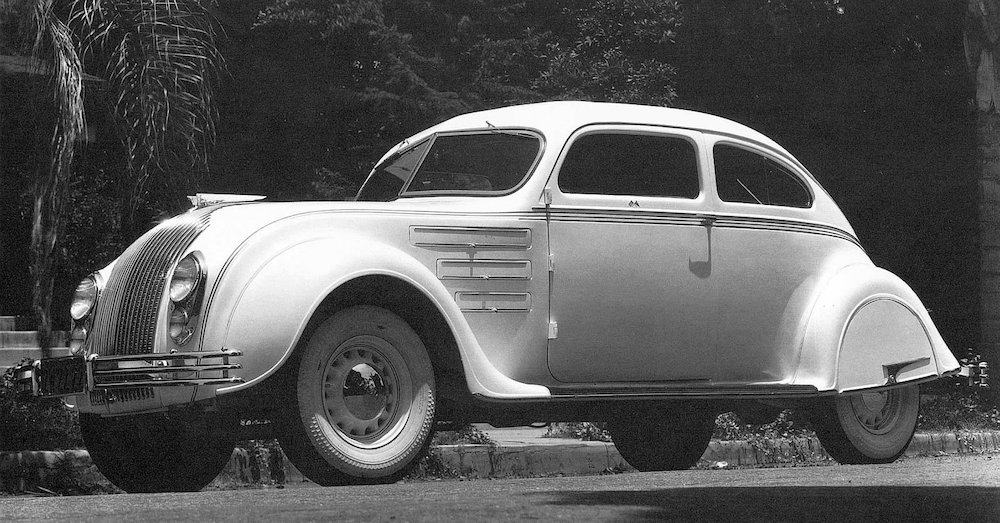
1934 Chrysler Airflow
Airflow design was wind tunnel tested.  Headlights are embedded in the car body.  Other Chrysler Corporation models followed General Motors practice until 1939.

1934 Hupmobile
Hupps were less-streamlined, but headlights also were faired into the body.

1934 Oldsmobile
For '34, Olds headlamp housings were more teardrop-shaped.

1935 Oldsmobile Six
Headlight housing attachments moved from posts to the sides of the body.  The background in the photo is San Francisco's Golden Gate Bridge under construction.

1936 Oldsmobile Six
No real change for 1936.

1937 Ford
Headlights are nested in the catwalk area.  This is similar to 1936 Lincoln Zephyr practice.  At this point, General Motors frontal designs began to look dated.

1937 Oldsmobile Six
Meanwhile, Olds headlights were still free-standing, attached to the hood area.
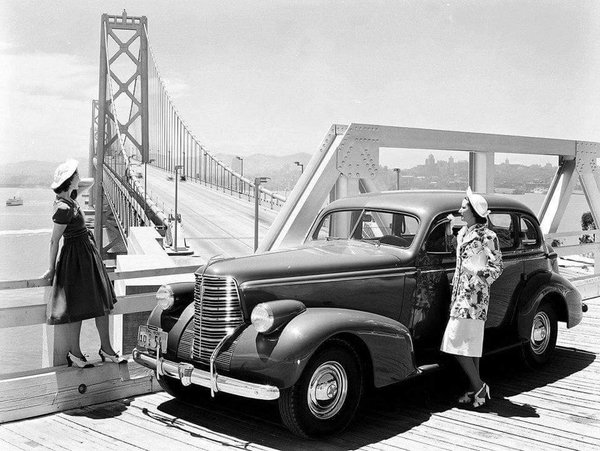
1938 Oldsmobile Eight
Now headlight housings are on the catwalk area, but remain separate elements even though they are very slightly integrated at their bottoms.  In the background is the new San Francisco Bay Bridge.

1939 Oldsmobile Six
Housings are moved ever-so-slightly down into the catwalks.  Meanwhile, many non-GM brands including Nash, Studebaker and the entire Chrysler Corporation line have headlights buried in front fenders.

1940 Oldsmobile 90
Headlight housings became more deeply buried for 1940, but only about halfway so.

1941 Oldsmobile
Finally GM headlights are fully integrated into the body shape.

1942 Oldsmobile B-44
Some GM brands had headlights placed near the fender edges for 1942, but Oldsmobile stylists held off until the 98 series was redesigned for 1948.

Monday, February 4, 2019

Book Review: "Fins" - About Harley Earl


A couple of months ago on a whim I bought the book "Fins: Harley Earl, the Rise of General Motors, and the Glory Days of Detroit" by William Knoedelseder (Amazon link here).

I see that it got a number of five-star reviews on its Amazon page.  I am more inclined to put it somewhere in the three-star range.

What I found most interesting were details of Earl's family background, youth, and his adult personal life.  Some of the quotations from GM Art & Colour stylists were new to me, so that was useful.

Otherwise, I found too much padding on its 277 pages.  The author doubtless justified writing about outside events in order to provide context to the subject of Earl and automobile styling.  Nothing wrong with that in principle.  Nevertheless, there was too much of that for my taste.  One example was a fair amount of space devoted to the decline and fall of Detroit as a city.  Yes, that was happening, but I find it hard to fathom how that affected the styling of General Motors automobiles.

Another gripe has to do with the writer including too much 21st century sociopolitical perspective.  I prefer histories grounded in the times being dealt with because that was the context of the lives as being lived, not those lives in the context of present times.

In a work of any size there will be mistakes.  I make them, maybe you make them.  Even so, they can be annoying.  Too many can render a book worthless to a reader because one has to wonder how many unrecognized mistakes there might be.  Two mistakes that bothered me were: (1) John Tjaarda, whose designs led to the Lincoln Zephyr, was called "Tom Tjaarda," the name of John's son; (2) Edmund Anderson, who later directed American Motors styling is called "Elwood Anderson."  The author seems to have had Elwood Engel of Ford and Chrysler on his mind.

I'm not telling you to avoid the book.  I suggest you buy the cheaper Kindle version, a price more in line with its worth.

Monday, October 22, 2018

General Motors' 1959 Body Styles

As legendary design vice president Harley Earl neared retirement while lacking clear ideas regarding the direction car styling would take, General Motors began losing its reputation for styling leadership.  This reached a crisis point when Chrysler Corporation revealed its 1957 line featuring taut lines, thin roofs and -- oh, yes -- those tailfins.

Meanwhile, GM cars were rather rounded, having a heavier appearance than Chrysler products. General Motors went into crash project mode in reaction to Chrysler's initiative, first garishly facelifting much of its 1958 line and then redesigning the entire line for 1959.  What is interesting about the hurried '59 design was that GM used the same general body set across all its brands.

Before that, the corporation usually had two or three bodies that were allocated to different parts of its line.  For example, around 1950, its A-body was used by Chevrolet, Pontiac, and entry-level Oldsmobiles.  B-bodies were used by mid-range Oldsmobiles (and eventually all Oldsmobiles) and entry level Buicks.  C-bodies were for larger Buicks and for Cadillacs, though around 1950 top-range Olds' got them too.

The 1959 basic one-range-suits-all bodies most visibly differed in the designs of their passenger compartment greenhouses, though a common element there was a doubly-wrapped windshield.  Oldsmobile examples are shown below.  Otherwise, styling differences included brand-specific variations in ornamentation, wheelbase, and other items related to brand identity.

Gallery

1959 Oldsmobile Dynamic 88 Holiday Sport Sedan, factory photo
Four-door hardtops were popular from the mid-1950 until the 1970s, when federal regulations regarding roll-over damage killed that B-pillarless body type.  From the belt line down, Oldsmobiles looked pretty much the same aside from variations in model-specific ornamentation.  Note the windshield.  As mentioned above, this is consistent across all body types -- a cost-saving detail.  Also note the thin, flat roof, a response to 1957 Chrysler styling.  Also the wrapped back window.

1959 Oldsmobile Holiday Coupe, Barrett-Jackson auction photo
Hardtop coupes did not get the wraparound backlight (back window) seen in the previous photo.  Instead, they featured a more normal looking, but thin, C-pillar.

1959 Oldsmobile 4-door sedan
Four-door sedans with B-pillars were six-window affairs.  C-pillars and backlights are similar to those seen on the Holiday Coupe, above, and identical to those items on the 2-door sedan below,

1959 Oldsmobile 2-door sedan
Sedans with B-pillars had slightly thicker, more rounded roofs than the hardtops.  Backlights were shorter than those of hardtop coupe, but were wider due to C-pillar differences.  The roofs and upper window profiles of this car and the one in the previous image are the same.  The 2-door sedan has a wider front door than the 4-door, and there was no need for quarter windows.

1959 Oldsmobile Dynamic 88 Fiesta station wagon
Oldsmobiles also made station wagons that had their own specialized greenhouse design.

1959 Oldsmobile 88 convertible
The final GM body stye was the convertible that, of course, had no greenhouse at all.

Unless otherwise noted, images are for cars advertised for sale.

Monday, February 12, 2018

Le Sabre: First Public View, 1950

General Motors' first post- World War 2 dream car (as they were called then) was the LeSabre (brief Wikipedia entry here).

It was astonishingly futuristic.  And that astonishment took place for the first time for many people when Life, a leading American general-interest magazine, published photos of the car.  This happened in late December of 1950 when the 1 January 1951 issue appeared in mail boxes and on news stands.  The LeSabre public announcement, for that's what it amounted to, appeared in an article about General Motors, king of corporate America at that time.

Below is my scan of that landmark image along with some publicity photos of what appears to be a LeSabre mockup.

Some puzzling items: Only one functional LeSabre was built, yet the Life image shows two cars, neither painted its normal silvery blue.  My guess is that the upper car is a detailed mockup.  Note the lack of chrome on the rear bumper: the real LaSabre had chromed bumpers and trim.  The nearer car has a chromed front bumper and grille, so it must be the real thing, but painted like the mockup and not yet in silvery blue.

Knowledgeable readers are urged to correct me in comments if my speculations are wrong.

Gallery

Image as it appeared in Life magazine's 1 January 1951 issue that was on news stands in late December of 1950.

GM styling boss Harley Earl posing with what looks like a LeSabre mockup -- note the dull finish on what are chromed areas on the actual car..

Publicity photo of the same likely LeSabre mockup.

Publicity photo of the apparent LeSabre mockup with model at the wheel.

Thursday, August 11, 2016

General Motors' 1964 New York World's Fair Show Cars

Now for something a bit different.  New York City held a World's Fair 1964-1965 (information about it here).  As it did for the 1939-1940 New York World's Fair, GM had a Futurama exhibit.  But it was not as exciting as the '39 version of the World of Tomorrow.

GM did display some concept cars that featured crisply-streamlined shapes of the sort its styling group was playing with under Bill Mitchell's direction.  I'll probably get around to treating some of them in detail in a future post.

For now, I thought I'd post some photos I took when I visited the fair in June of 1965.

Gallery

Fairgoers crossing over Grand Central Parkway with the General Motors pavilion in the background.

Inside, we find this abstract shape illustrating the long-range theme GM stylists focused on in the early 1960s when the concept cars were being designed.

GM photo of the three-wheeled Runabout -- an "urban car" 30 or 40 years ahead of its time.


Two photos of the Runabout that I took.

Firebird IV.  This was supposedly to be gas turbine powered like previous Firebirds, but actually was a "pushmobile." GM photo.

My photo of the displayed Firebrid IV.

GM-X Stiletto, another of the three non-functional concept cars.   GM publicity photo.

The Stiletto as I saw it in 1965.

Thursday, October 3, 2013

General Motors' Chopped-Off 1978s

One consequence of the 1973 "Yom Kippur" Arab-Israeli war was a gasoline shortage in the United States that in turn led to downsizing of many American cars a few years later.  Given the three or four years it took from start of planning to appearance in showrooms, General Motors' most visible reaction didn't appear until the fall of 1977, when 1978 models based on a new, redesigned A-platform were introduced.

I don't think it would be fair of me to criticize the styling of the new models because the mid-1970s were difficult times for Detroit's engineering and styling staffs, though I couldn't quite resist the temptation, as you will see below.  Some of the difficulties have to do with the car market, because buyers shifted to smaller, usually imported cars with better fuel consumption than the large, traditional American automobiles that dominated the market when the gasoline crisis hit.  Most of the difficulties were related to government regulations related to engine emissions, passenger safety and crash worthiness, the latter having to do with stronger bumpers being mandated.

One way to improve fuel economy is weight reduction.  At the time when the new '78s were conceived (1974 or thereabouts), production models tended to be long, with plenty of rear overhang.  So the 1978 redesign had the wheelbase reduced about 8 inches (20 cm) and overall length shortened as much as 17 inches (35 cm) for Buick models.  Most of these reductions were applied to the rear of the cars, creating what seemed at the time to be a stubby or 'bob-tailed" look.

Gallery

1978 Chevrolet Malibu
The 1970s were a time when Mercedes-Benz styling was influential in Detroit, so the new A-platform cars and many others had a crisp appearance based on what was called the "three box" configuration (the general shape resembling two boxes placed end-to-end with a box centered on top). In any case, GM's styling supremo Bill Mitchell had a preference for sharply creased edges and transitions, so the new designs must have met his approval.

1978 Pontiac LeMans
This is a four-door version by Pontiac. Note the attempt at a "flowing" fender line with a rear apex at the C-pillar, this to distinguish Pontiacs from other makes sharing the platform.

1978 Buick Century Custom
1980 Buick Century
Two-door and four-door A-platform Buicks are shown here.  Rear side window glass on the 2-door models did not roll down, a source of customer dissatisfaction and probably lost sales.  Unlike A-platform Chevrolets and Pontiacs, the Buick and Oldsmobile versions were given "fastback" rather than "notchback" or "bustleback" styling.  Although the styling effort might have been well-intended, the result emphasized the fact that the cars' rears had been chopped off compared to previous models.

1978 Oldsmobile Cutlass Salon Aeroback
This is the Oldsmobile version.