Showing posts with label Corvette. Show all posts

Thursday, March 5, 2026

Opel GT Walkaround

Above is a 1969 Opel GT 1900 listed for sale

Back in 2015 I posted "Opel's Corvette-Like GT."  Since then, better images have appeared on the Internet, so this might be a good time for a Walkaround post about the design.

Opel GT's Wikipedia entry is here.  And its link to Clare M. "Mac" MacKichan, who was in charge of Opel styling when the GT project was launched, is here.  It mentions: "Based on Opel Kadett mechanicals, and with a body designed by Erhard Schnell, MacKichan was the driving force behind creation of the GT."

Also mentioned is that MacKichan worked on Corvette styling before being assigned to Opel in 1962. That included work on the redesigned 1963 C2 Corvette, some of whose prorportions are echoed in the GT design.  However, the main Corvette influence was the C3 Corvette that entered production in 1968.

C3 Corvette, probably a car-for-sale photo.
Opel GT production also began in 1968, so there surely was communication between General Motors styling staffs in the USA and Germany during development of styling.  Main similarities are the front end and fender designs.

The walkaround car below is a 1970 Opel GT 1900, photos via Gallery Aaldering.

Gallery

Another front-quarter view: compare to the Corvette image above.

Headlight assemblies rotated to exposed position.

Proportionally long hood with the driver's head positioned abaft of the wheelbase center.

No attempt made to relate the shapes of the backlight and rear-quarter windows.

Aft sculpting, bumpers and tail lights are similar to those of C3 Corvettes.

Simple shapes and no chrome trim aside from window framing.

Body is that of a coupe and not a B-pillarless hardtop.

An attractive design, very much in the 1960s General Motors idiom set by styling honcho Bill Mitchell.

As noted, quite similar in concept to the C3's front end.

Monday, November 13, 2023

Corvettes in Profile

I live next to an artsy-poo town in the north Puget Sound area of Washington State.  It attracts plenty of visitors from the Seattle area and British Columbia, some of whom drive Chevrolet Corvettes.

My wife often asks me about those Corvettes, and I usually can't tell her what vintage the car is we're looking at.  Put bluntly, I am not interested in Corvettes other than the earliest versions.  I don't really know why.  One possible reason is that for many years automobile magazines have been stressing Corvette performance -- for me a largely abstract matter because I never could afford to buy a high-performance car.

Anyway, I was becoming ashamed that I couldn't be sure that a parked Corvette was a C6 or some other generation model.  ("C" numbers are retrospective/current generation assignments for Corvettes.  The image captions below include the C number of each car shown.)  So I decided it was time to get more Corvette-savvy and write this post.

Given that there are eight Corvette generations plus important differences within the first generation, I'm limiting Gallery images to left-side profile photos.

Gallery

C1 - 1953 Corvette - Mecum Auctions photo
The original Corvette.

C1 - 1956 Corvette - Mecum photo
It was given a major facelift for '56.  This has always been my favorite Corvette design.

C1 - 1958 Corvette - for-sale car photo
Then for 1958 there was another major facelift featuring revised front end styling that included quad headlights (ugh!!).  Ruined the design, I've always thought.

C2 - 1963 Corvette - Bring a Trailer Auctions photo
A classic Corvette design.  Fussy, but intriguing -- especially the split rear window found on '63s only.

C3 - 1968 Corvette - Bring a Trailer Auctions photo
In some ways a cleaned-up C2.  Conventional fenders, for example.

C4 - 1984 Corvette - Mecum photo
Long front overhang plus the aft-of-center driver's position resulted in a hood too long for even a hood-fan like me.

C5 - 1997 Corvette - Bring a Trailer Auctions photo
Styled during Wayne Cherry's tenure as General Motors' design leader.  He seemed to favor softer, aerodynamic shapes for GM cars including Corvette.

C6 - 2005 Corvette - Bring a Trailer Auctions photo
Many similar details to the C5, but differently proportioned. 

C7 - 2014 Corvette - Bring a Trailer Auctions photo
Jazzy, slashy sculpting in line with the fad/fashion of the day (and now).  It does have an harsh, purposeful appearance.  Definite break from the cleaner C3-C6 generations.

C8 - 2020 Corvette - for-sale car photo
The basic shape dictated by the "mid"-engine layout.  Plenty of visual noise, screaming that the owner drives a truly hot car.  Good marketing, at least.

Thursday, November 9, 2023

General Motors' Continuing Boat-Tail Interest

Boat Tail was a popular sporty style detail found on American roadsters in the late 1920s and early '30s.  Its general shape became impractical as cars became more streamlined-looking and body components more integrated as the 1930s wore on.  That shape also was impractical regarding trunk carrying capacity, another reason for its demise.

For some reason General Motors' styling boss Harley Earl and his successor Bill Mitchell occasionally used Boat Tail motifs on concept and production cars as late as 1971.

Images below are via General Motors unless noted otherwise.

Gallery

1933 Auburn Speedster - Mecum Auction photo
A pure example of Boat Tail.  Flipping the main body's aft end reveals a shape similar to the bow of a canoe.

1936 Auburn 852 Speedster - Mecum
By the mid-1930s Auburn's Boat Tail became more of a "streamline" detail.  As best I can tell, this '36 Auburn model was the last classic American Boat Tail design.

1938 Buick Y-Job
Harley Earl used the Boat Tail motif on this, his first concept car.  Note how integrated with the rest of the car it is.

1951 Le Sabre
Earl's sensational Le Sabre "Dream Car" also featured a Boat Tail on its trunk lid.

1951 Buick XP-300
So did the Le Sabre's sister Dream Car.

1963 Chevrolet Corvette Sting Ray
Bill Mitchell's initial Boat Tail interpretation.

1971 Buick Riviera
He tried the same thing a few years later on this Buick, but the car was too large to incorporate it aesthetically.

Monday, December 26, 2022

1963 Chevrolet Corvette Walkaround

Chevrolet Corvette sports cars have been marketed since 1953.  I must confess that I haven't paid much attention to the styling evolution over most of the eight body design generations produced so far.  (Note to self: do a blog post on the subject -- that'll bring me up to speed).   I'm most aware of the first two generations and wrote about first-generation Corvettes several times (see the marque-list sidebar on the right), including this one lamenting its 1958 facelift.

The other Corvette generation that interests me is the second.  It is known as the Stingray, and the most iconic model was its 1963 introductory model year coupe with a two-piece backlight window.

I rate the '63 Corvette coupe styling as "interesting" rather than beautiful.  Because the design carries too much detailing for my taste, as will be seen in the Gallery images below.  That said, I do like the design.  On an emotional, rather than an aesthetic level.

Agree?  Disagree?  Well, let's do a walkaround.  This post's featured car is a 1963 Corvette coupe, photos via Bring a Trailer Auctions.

Gallery

First, three factory images indicating how Chevrolet wanted the Sting Ray to be seen and appreciated.

This, and the image above show that the design features a horizontal character line that extends all the way around the car.  The 1960 first-generation Chevrolet Corvair had a similar feature.

Overhead view showing the split backlight.  The stylistic reason for the split is the centerline roof crease extending from the windshield to a tiny distance from the aft edge of the car.  The divider bar tended to obscure rear-view mirror visibility, so for 1964, the backlight became a one-piece affair and the bar was consigned to styling history.  Nevertheless, from a styling standpoint (not an ergonomic one), the roof and backlight treatment was interesting and consistent.

Now for the featured Corvette.  Headlight assemblies are rotated open.

The profile is well-shaped.  

The rear quarter is rather busy, yet thematically consistent due to the repeated "boat tail" convergences of the rear fenders and the passenger compartment greenhouse.

I doubt that the passenger compartment boat tail was the result of wind tunnel testing, due to the rapid convergence.  But I might be wrong.

There are sculpted faux air outlets on the B-pillar and front fender abaft of the wheel opening.  These items contribute to the excess detailing mentioned above.

Though the B-pillar is wide, the wraparound backlight keeps the greenhouse looking airy.

The hood featured a forward-thrusting, low profile reverse- boat tail.  But that's echoed by the raised front fender shaping, carrying the theme also seen at the car's rear.  Front and rear bumpers are similarly shaped.

There also are air vents on the hood -- functional ones.

Opened headlights mar the styling, but that probably couldn't be avoided, given early 1960s technology.

The dashboard is cluttered.

Monday, March 7, 2022

Want to Look Sporty? Chop the Greenhouse

"Greenhouse" is a styling term referring to the part of a car's passenger compartment above the beltline where the windshield and other windows are.

Typically, the greenhouse is fairly tall, comprising more than a third of total body height.  This sort of proportion tends to work against any "sportiness" that stylists might wish to impart to a design.

An alternative is to reduce that proportion.  The price paid might be cramped headroom for passengers and reduced outside visibility for the driver.

Below are examples to serve as food for your thoughts.

Gallery


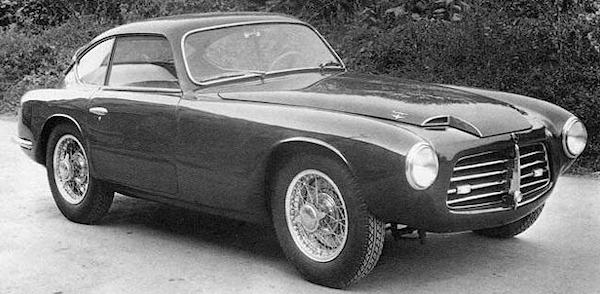
1953 Pegaso Z 102 Berinetta by Touring
This is an example of an expensive sporting car by a major Italian coachbuilder.  Its tall greenhouse proportions are fairly typical of Italian 1950s golden age styling.

1963 Chevrolet Corvette Sting Ray
General Motors' sports car also had a comparatively tall greenhouse.

1967 Chevrolet Camaro RS Z28 - Mecum Auction photo
So did the later sporty Camaro.

1931 Voisin C22
Now for examples of short greenhouses.  This Voisin had an underslung chassis and low lower body.  Its greenhouse proportion is low, adding to the racy appearance.

1935 Voisin C28 Aérosport - RM Sotheby's photo
This later Voisin features a more normal lower body height, but the short greenhouse imparts sportiness.

1952 Ferrari 340 Mexico by Vignale
Unlike the Pegaso, this Italian body has a low greenhouse.  Perhaps that's because it's an actual race car.

1952 Hudson Hornet
The famous-in-their-day "step down" Hudson sedans had racy looks due to shaping as well as greenhouse proportions.

2005 Chrysler 300C
Lower bodies were rather brick-shaped, but the low greenhouse counteracted that impression.  I owned one, and can assure you that the windshield was too low for easily viewing close-by stoplights.

2016 Chevrolet Camaro Convertible
I was in Hawaii recently (early 2022) and was struck by the racy, sporty look of the plentiful Mustang and Camaro rental convertibles I saw.  Blunt lower bodies are common nowadays thanks to rules by European bureaucrats.  But the extreme windshield rake and very short greenhouse oddly combine to enhance an aggressive, sporty appearance.

2016 Chevrolet Camaro Coupe
The same can be said for the fixed-top version.