Showing posts with label Rover. Show all posts

Thursday, August 21, 2025

Four-Door British "Airline" Sedans

I posted "Gallery of English 'Airline' Designs" here, presenting examples of fastback (or at least rounded) aft end profiles applied to basic 1930s production cars.   The idea was that those less-angular rear ends offered streamlining -- improved aerodynamic efficiency.  In practice, since old-style front ends were essentially retained, such improvement was probably minimal.  Basically, it was a styling fad.

The majority of British "Airline" cars were two-door models, though I did discuss the 4-door 1935 Clémont-Talbot 105 Airline Saloon here, and the 1938 Riley 16/4 2.5-litre Kestrel Blue Streak Six-Light here.

Today's post presents a larger collection of four-door Airline designs.

Gallery

1936 Riley Kestrel Six-Light Saloon - HandH Auctions photo
Given the need for rear doors and headroom for back-seat passengers, 4-door Airlines were seldom as sleek as many of the 2-door variety.  That said, another factor was wheelbase; short-wheelbase 2-door Airlines also lacked sleekness.  Rileys were sporty cars, hence the long hood seen here.  But the passenger compartment was fairly compact and set aft, so the car's profile is smoothly curved, but not what I consider sleek.  The term "six-light" is the British version of "six-window" in American.

1938c. Standard Flying Twenty - publicity image
Mid-1930s 4-door British and French sedans tended to feature beltlines that fell off towards the rear.  Details varied, as can be seen in the image collection here.  The only exception is the Rover shown three images below.

1935 Talbot (British) Airline Saloon - car-for-sale photo
As mentioned above, I dealt with this car in a previous post.  Back seat headroom seems limited, but results in the sleekest profile shown.

1937 British Salmson by Whittingham & Mitchell - publicity image
Another British offshoot of a French brand.  This is the one side view I could find. This car has the most vertical aft profile of the set pictured here.

1934 Rover Speed 14 Streamline "Coupé" - Bonhams photo
Marketed as a "Coupé, the body type is what I would call a close-coupled sedan.  The reason for that curious "coupé" designation was that Rover also offered a 14 Streamline Saloon.  It had a boxier body than the Coupé's, but at least featured a rounded aft profile.  Details: this car is a "four-light," whereas the saloon was a "six-light."

1935 Bentley 3.5 Litre Aerodynamic Saloon by Rippon Brothers - Bonhams
Another "four-light" design.  Falling-off beltline yields a large rear-door window.  The aft profile is a subtle S-curve, adding a touch more sleekness.

1934 Rolls-Royce Phantom II Continental Streamlined Saloon by Park Ward - Gooding photo
Long wheelbase, considerable sleekness on this early (1934) Airline-type design.  Magnificent.  I wrote about it here.

Thursday, January 23, 2025

Sterling: a Car From Rover and Honda

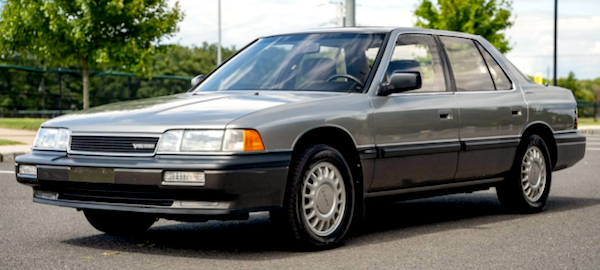
In the early 1980s, Japan's Honda desired to enter the executive/luxury car market, following Toyota's Lexus and Nissan's Infiniti brands.   The brand name selected was Acura.  The car itself was a joint effort with England's Rover Group -- the latter marketing its versions as the 800-series Rover and the Stirling (in North America, but also as a Rover model in the UK at times).

Background on Rover 800s is here, on the Acura Legend model here, and the Sterling here.  All featured a 107.8 inch (2760 mm) wheelbase and basic body structure, though some other details varied.

The first generation, featured here, was produced 1985-1990 by Honda, and 1986-1991 by Rover.

The Americanized Sterling sold fairly well in 1986, but quality control and other defects caused sales to fall off drastically thereafter.  The third link above (as of January 2025) contains annual sales data.  Acura sales were okay, as were non-Americanized Rover/Stirling cars in Europe.

Styling detail variations of the Acura Legend, Rover 800 and Stirling are discussed below.

Gallery

1987 Acura Legend - BaT Auctions photo
The Japanese version.

1987 Sterling 825 - car-for-sale photo
The Sterling for North America.  Most body panels are the same, the greatest difference seen here being in the area of the C-pillar and backlight window.

1986 Rover SD1 Vitesse - Iconic Auctioneers photo
The four-door hatchback version.  It was marketed as the Stirling 827 in North America, where hatchbacks of any kind almost never had strong sales for some reason.

1987 Acura Legend - BaT Auctions
Front quarter view.

1987 Rover 820SE via Car and Classic
Hoods (including cutlines) differ, but only slightly.  Other front end detailing is also similar for both brands.  Little tooling variation seen here.  

1987 Acura Legend - BaT Auctions
Rear quarter.

1986c. Rover Sterling - factory image
As noted above, the main difference is in the C-pillar zone and use of different backlight windows.  Otherwise, tail light and reflector panels differ in details, as well as license plate locations.  The aft crease on the Stirling's trunk lid seems crisper due to what looks to be a sharp fold above the type of fold seen on the Acura.

Thursday, December 5, 2019

Rover: From P4 to P5

Rover's place in the British automobile market was that of an Executive Car.  That is, larger companies would provide cars to some members of management.  In any case, Rovers were marketed to upper-middle class buyers in the UK, USA and elsewhere.

The first new-design post- World War 2 Rover was the P4 series announced in the fall of 1949.  I wrote about the postwar-design Rover P4 here.

Encouraged by P4 acceptance and buoyed by income from Land Rover sales, Rover added the P5 series for the 1959 model year.  The P5 was an augmentation to the line, not a P4 replacement.  It had more modern styling, was more luxuriously appointed, and was priced higher.

Its styling was the first new-car effort by David Bache, who joined Rover after the P4 was in production and was only able to contribute to a major facelift described in the post linked above.  His P5 was essentially a continuation of P4 themes.  Color images below are of cars listed for sale.

Gallery

A P4 Rover from around 1958 when the P5 was introduced.

Rover P5 in a publicity photo from around 1959.  The grille and fender front designs are nearly the same as in the P4 in the previous image, though the fenders are higher and the hood is comparatively low visually.  The overall design is a squared-off, "three box" affair featuring slab-sided fenders.  The windshield is wraparound, but with normally slanted A-pillars in the mode of contemporary Chrysler cars in America.

Rear quarter view of a 1964 P4, showing features Bache styled after joining Rover.

Rear quarter view of a 1959 P5.  The trunk handle and license plate framing are about the same as on the P4.  Ditto the vertical tail lights.  Even though the shaping differs, the Rover P4 design spirit is retained.

Side view of an early production P5.  Compare to the image below.

In the fall of 1962 a "Coupé" line was added.  Coupés traditionally are sporty two-door cars, so I was puzzled by the Mercedes CLS launched in 2004 that Mercedes-Benz called a coupé due to its racy lines and limited passenger capacity.  Now I find that Rover pulled off that trick more than 40 years earlier.  The car shown is from 1964.  Its roof is slightly lower, the windshield and backlight are reshaped.

Rear quarter view of a Rover P5B Coupé.

Thursday, November 7, 2019

Rover P4's Big Facelift

By the 1949 model year nearly all American cars had received a postwar redesign.  The exception was Packard, which got a major facelift in an attempt to appear "postwar."

Conditions were different in England.  The war had drained its economy, shortages were rampant, and the Labour government had the automobile industry focus on exports if they wished to enhance their steel quotas.  Even there, postwar designs began to appear, but more slowly than in the USA.  One such, the Rover P4, was announced on 28 September 1949 at the Earls Court car show.

The Wikipedia entry on the P4 is here.  It notes that the new styling was influenced by the sensational (at the time) 1947 Studebaker.  In particular, the trunk (boot) sloped distinctly downwards toward the rear.

There was a minor 1952 facelift involving a new grille.  A more extensive facelift, actually a "tail lift" marked the 1955 model year.  This was made under the direction of Rover's new (in every sense) stylist David Bache.  The trunk was raised, somewhat squaring off the rear end, and a three-piece curved backlight was added.  Thereafter, styling changes to the P4 line were minimal.

Gallery

A rusty 1947 Studebaker up for sale.

And here is a 1950-vintage Rover P4 seen from the same angle.  The details of the two cars' aft ends differ, but the theme/spirit is the same.

Side view showing the angle of the slope.

Early P4s' grilles featured horizontal bars and a central fog light, creating the nickname "Cyclops."  This was a design mistake because input of cooling air to the radiator was insufficient.

To fix the cooling problem 1952 P4s lost the central fog light and grille bars were made vertical, as on the earlier P2 and P3 Rovers,

This photo shows the raised trunk profile of the 1955 facelift.

Here is a view of the enlarged rear window.

Thursday, January 23, 2014

Rover 75: Dignified Millennial

The Rover 75 (1999-2005) was an attempt to give new life to a major mid-priced British automobile brand that had been falling on hard times.  Falling to the extent that it suffered the indignity of offering the public a re-badged Honda as a Rover.

That this attempt was made at all was because Rover was owned by BMW at the time, and the Germans hoped a new Rover would make their investment pay off. The Wikipedia entry for the Rover 75 is here.  According to the Wikipedia link, both BMW and Rover management thought that conservative, dignified styling would be appropriate for the new model.

Also according to the link, the design was fairly well received, but sales were not as strong as hoped, behaps due to concerns about the company, which BMW sold in 2000.

I visited England several times when Rover 75s were in production and could seen fairly often on streets and motorways.  I thought the styling was blandly pleasing and Rover-like: just what a conservative mid-line British car should be.  My biggest quibble is the zig-zag cut line in the front fender area for the front end impact cap.  An effort should have been made to integrate it in some way with the upper character line on the fender.


A later model with a different grille and headlamp treatment.