Showing posts with label Facelifts. Show all posts

Thursday, November 7, 2024

Oldsmobile Cutlass' Front/Rear Facelifts 1968-1972

Back around 1970 General Motors had plenty of cash and continued its long-time policy of facelifting cars annually during the course of a design's production run.  The idea was to entice potential buyers with something that was visibly "the very latest" and to shame (in a subtle way) owners of previous models to update and "be with it."

Today's example is the Oldsmobile Cutlass circa-1970 line.  Wikipedia's Cutlass entry refers to the 1968-1972 models as the "Third Generation" (scroll down for information).

Rather than dealing with all styling features, I'm focusing on front and rear ends.  Those facelifts were not massive in the sense of considerable reshaping, as in the case of the 1950 Studebaker's front end (that I wrote about here).  Nevertheless, all but the final Cutlass facelift were not trivial.

Front and rear images below are of the same car each model year.
Gallery

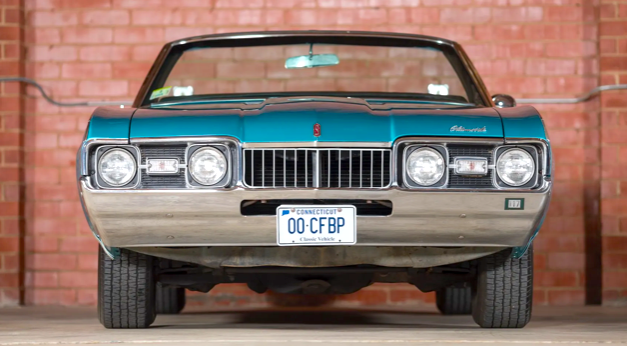
1968 Oldsmobile Cutlass Convertible - BaT Auctions photos
The initial front end design.  Fairly small opening for cooling.  Widely spaced quad headlights.

1969 Oldsmobile Cutlass Convertible - car-for-sale photos
Around this time Oldsmobile was establishing a new grille theme: divided openings.  Nothing really new, because BMWs used that theme for years, and Olds' sister brand Pontiac began it in 1959, not to mention 1953 Studebakers.  Headlights are close together and the opening is more substantial.  The hood has been reshaped, along with the bumper.

1970 Oldsmobile Cutlass Supreme Convertible - BaT Auctions
New bumper, again.  Grille units are more clearly defined due to explicit framing.  Different mesh pattern.

1971 Oldsmobile Cutlass Supreme Convertible - car-for-sale photos
Yet another new bumper.  Central hood reshaping.  Grille elements are taller, but less attractive.  Reminds me of BMW's recent atrocious grille segment enlargements.

1972 Oldsmobile Cutlass Supreme Convertible BaT Auctions
Sometimes final-year facelifts include details that preview some next-year's redesign features.  But not here.  Just a little freshening in the form of new grille bars.

1968 Oldsmobile Cutlass
The initial rear end.  Sorry that this example has a lot of stickers, but I hope the design theme is still obvious.

1969 Oldsmobile Cutlass
A new bumper and tail light assemblies change the character of the car's aft.


1970 Oldsmobile Cutlass Supreme
Again, a completely revised bumper- tail light ensemble.

1971 Oldsmobile Cutlass Supreme
The basic bumper is the same, but tail light orientation got the "old switcheroo."  The word "Oldsmobile" is now spread across much of the trunk lid.

1972 Oldsmobile Cutlass Supreme
Minor final-year changes at the rear as well as the front.  Here in the form of added internal vertical frames on tail light assembles.

Thursday, July 25, 2024

Oldsmobile's Mid-1950s Facelifts

A while ago I wrote about the extensive Buick facelifts during its 1954-1956 bodies' production cycle.  I mentioned:

"The idea [of facelifting] was to make the next year's model different enough from the existing one that potential buyers would be pleased to be seen driving a car that was truly 'new.'  And drivers of previous-years cars might be made to feel that their car was 'old,' and so be tempted to replace it with a 'new' one.

"That was what stylists referred to when they said that the first design on a multi-year production run was the most 'pure' -- the often-arbitrary facelifting degrading that purity.

"Another purpose for facelifting was to preview some styling features that were set to appear on the next complete redesign.

"So what often happened for three or four year production cycles would be as follows.  The first model year would feature the supposedly 'pure' design.  Intermediate years would find arbitrary detail changes.  The final-year styling would include a few 'preview' details.  An example is its Pontiac brand for model years 1955-1957."

Perhaps because General Motors was prosperous during the 1950s, those non-trivial Buick facelifts were justified for marketing reasons.  Also, as my post indicated, planned future changes regarding grilles and front bumpers were considered while the 1954 design was still gestating and then implemented for the 1955 intermediate model year facelift.

Something similar, but less drastic, was the case for Oldsmobile during that same 1954-1956 production cycle.

Gallery

1953 Oldsmobile Super 88 2-door sedan - car-for-sale photo
Oldsmobile styling for the final year of the previous body production.

1954 Oldsmobile Super 88 Holiday Coupe - car-for-sale photo
GM's new B- and C-bodies were, at their introduction, seen as futuristic, especially due to their wraparound (panaormic) windshields.  To maintain brand identity, Olds stylists carried over important details from the 1953 design.  These themes included the grille shape, bumper guards and side chrome trim.

1955 Oldsmobile 88 2-door sedan - Gallery Aaldering photo
Facelifted Oldsmobiles got an oval-shaped grille and somewhat split front bumpers.  The side trim theme was replaced.

1956 Oldsmobile 88 2-door sedan - car-for-sale photo
The final year of the body found a cleaned-up grille whose oval opening was surrounded by a massive bumper.  Side trim was changed again.

1953 Oldsmobile Super 88 2-door sedan - car-for-sale photo
Now for rear end changes and similarities.

1954 Oldsmobile Super 88 Holiday Coupe - Mecum Auctions photo
Tail lights and backup lights are similar to those on '53 Oldsmobiles.

1955 Oldsmobile Super 88 Holiday Coupe - car-for-sale photo
No intermediate-year change at the rear aside from the bumper.

1956 Oldsmobile 88 2-door sedan - car-for-sale photo
Aft edge of the fender are slightly extended.  Tail lights and backup lights are in the same positions, but reshaped a little.

Monday, February 12, 2024

Pontiac's Mid-1950s Facelift Pattern

Nowadays car designs often are unchanged for a few years after a redesign, and even for an entire multi-year production cycle.  If a facelift does occur, it would often be sometime near the middle of that cycle.

But in America from the 1930s into the 1960s and even beyond, facelifts happened each model year following the new design's introduction.

The idea of facelifting was to make the next year's model different enough from the existing one that potential buyers would be pleased to be seen driving a car that was truly "new."  And drivers of previous-years cars might be made to feel that their car was "old," and so be tempted to replace it with a "new" one.

That was what stylists referred to when they said that the first design on a multi-year production run was the most "pure" -- the often arbitrary facelifting degrading that purity.

Another purpose for facelifting was to preview some styling features that were set to appear on the next complete redesign.

So what often happened for three or four year production cycles would be as follows.  The first model year would feature the supposedly "pure" design.  Intermediate years would find arbitrary detail changes.  The final-year styling would include a few "preview" details.  An example is Pontiac for model years 1955-1957, the subject of today's post.

Gallery

1954 Pontiac Star Chief Catalina - Mecum Auctions photo
The last year of a two-year cycle (1953-1954).  The general body shape is similar to the previous 1949-1952 series, so we might instead think in terms of a 1949-1954 cycle.  What's interesting in the context of the discussion above is that there was virtually no thematic carryover from this design to the totally redesigned 1955 Pontiacs.  One subtle preview is the stretched oval in the grille bar -- it harkens to the overall grille opening shape on '55s as seen in the image below.

1955 Pontiac Star Chief Catalina - Mecum
Instead of traditional Silver Streaks running down the center of the hood, we find two, separated, sets of streaks.

1956 Pontiac Chieftain Catalina Coupe - Mecum
The mid-1955-1957 cycle facelift retained the dual Silver Streaks.  The grille and side trim are new.

1957 Pontiac Star Chief Catalina Coupe - Mecum
Pontiac and Chevrolet shared the same basic body that was given a major facelift for 1957.  The cowling and hood were lowered and the trim theme completely changed.  The new grille design harkens to the 1935-1956 Silver Streaks, but there are no true streaks remaining.

1958 Pontiac Star Chief 4-door sedan - car-for-sale photo
The redesigned 1958 Pontiac.  The side trim theme is retained with detail changes, as is the wide grille.

1954 Pontiac Star Chief Catalina - Mecum
THe 1954 Pontiac as seen from the rear quarter.

1955 Pontiac Star Chief 4-door sedan - car-for-sale photo
Carried over are round tail lights.  The Silver streaks are off the trunk lid and on the small tailfins.

1956 Pontiac Chieftain Catalina Coupe - Mecum
Few changes here, though there's some new rear fender sculpting forward of the tail lights.

1957 Pontiac Star Chief Catalina Coupe - Mecum
Entirely new theme here containing elements previewing 1958.

1958 Pontiac Star Chief 4-door sedan - car-for-sale photo
Both the '57 and '58 have rear fenderline extensions.  Tail light assemblies have oval shapes in both designs.  Trunk lid trim is about the same.  But the tail lights are round again.

Thursday, February 1, 2024

Buick's Mid-1950s Facelifts

What purposes do automobile facelifts serve?

For the American car industry from the 1930s into the 1970s and even later in many cases, they were tied to the system of annual model introductions.  Often in those days, changes were superficial and seemingly arbitrary.  The idea was to make the next year's model different enough from the existing one that potential buyers would be pleased to be seen driving a car that was truly "new."  And drivers of previous-years cars might be made to feel that their car was "old," and so be tempted to replace it with a "new" one.

That was what stylists referred to when they said that the first design on a multi-year production run was the most "pure" -- the often arbitrary facelifting degrading that purity.

Another purpose for facelifting was to preview some styling features that were set to appear on the next complete redesign.

So what often happened for three or four year production cycles would be as follows.  The first model year would feature the supposedly "pure" design.  Intermediate years would find arbitrary detail changes.  The final-year styling would include a few "preview" details.  An example is General Motors'  Pontiac brand for model years 1955-1957.

During the mid-to-late 1950s General Motors executed some intermediate facelifts that were more elaborate and more expensive than normal.  The corporation was very wealthy in those days and could afford such facelifts.  Its Buick brand got major facelifting in the two model years following its 1954 redesign.  These facelifts are the subject of today's post.

Gallery

1953 Buick Roadmaster Riviera - Gooding Auctions photo
This was the final model of a four-year (1950-1953) production cycle.  Headlight assemblies and the grille theme and some side-trim themes were carried over to the redesigned 1954 Buicks, as can be seen in the following image.

1954 Buick Roadmaster Riviera - Mecum Auctions photo
Note the headlight assemblies, grille framing, the front bumper's position and location of bumper guards on this redesign.  These details plus the Sweepspear side trim and fender "portholes" proclaimed that this, indeed, is a Buick.

1955 Buick Roadmaster Riviera - Mecum
The 1955 facelift involved a different "face" for Buick.  Gone were the traditional (starting in 1942) vertical grille bars.  The bumper is now in two segments revealing a taller grille opening.  The Sweepspear and portholes are retained for brand identity.

1956 Buick Super Riviera Coupe - Hyman Ltd photo
The final year for this body finds yet another new "face."  Front planview is now slightly V'd and headlight assemblies are restyled, being carried over to the 1957 redesign.  Side feature themes are retained for 1957.

1953 Buick Roadmaster Riviera - Gooding

1954 Buick Roadmaster Riviera - Mecum
The main rear detail carried to the new body is the taillight theme. 

1955 Buick Roadmaster Sedan - car-for-sale photo
But for 1955, rear fenders were redesigned in a major way. 

1956 Buick Super Riviera Sedan - Mecum
Those taillight assemblies were simplified for 1956 and the sharply angled fender termination theme was retained in modified form for the '57 redesign.

Styling models for 1954 Buicks - originally via General Motors
It seems that the 1955 split-bumper concept was given serious consideration while the 1954 redesign was gestating.  I suspect the '54 front was chosen because of its greater similarity to the 1953's.  That transition accomplished, the new theme was used starting in 1956.

Monday, January 15, 2024

1950-51 Frazer Manhattan 4-Door "Hardtop" Facelift

The Frazer was the upper-medium price range car offered by the post- World War 2 startup firm Kaiser-Frazer Corporation.  Its Kaiser brand was its medium price offering.  From the outside, all K-F cars 1947-1950 looked nearly identical aside from grilles.  Interior fittings were what distinguished the price levels.

Both brands were given major upgrades for model year 1951.  Kaisers were totally redesigned, and Frazers were given a major facelift that I wrote about here.

The present post elaborates on Frazer's facelift with reference to a body type that, with a little imagination, might be considered an early example of the American hardtop (B-pillarless windows) sedans.  General Motors began selling those in 1955 followed by other brands for 1956 and later.

K-F hardtop sedans first appeared as Kaiser Virginians for the 1949 model year.  Frazer Manhattans were that brand's upscale four-door sedan range starting in 1947 (there was a lesser Standard sedan model).  Frazer's Manhattan 4-door convertible sedan appeared for 1949, but it seems that only one "hardtop" version was built.  Images of it are shown below.

While Kaisers were redesigned for 1951, Frazers were facelifted largely because K-F had a significant stock of unused 1949-1950 vintage bodies that needed to be sold.  Kaiser Virginian bodies were the basis for Frazer's Manhattan hardtop sedans, only 152 of which were made (along with 131 convertible sedans).

All images below are via Mecum Auctions.

Gallery

1947 Frazer Manhattan Sedan
This was the only Kaiser-Frazer body style during the first two model years.

1950 Frazer Manhattan "Hardtop" Sedan
The single example, perhaps built for a K-F executive.  Aside from the grille, Kaiser Virginians looked the same.  Note the lower, flatter top compared to that of the 4-door sedan in the previous photo.  Below the beltlines the bodies are the same aside from the covered rear wheel opening on the hardtop.  Some 946 Virginians were built models years 1949-1950.

1951 Frazer Manhattan "Hardtop" Sedan
The facelifted, production version.  The 1951 Frazer facelift used new sheetmetal forward of the A-pillar and included new rear fenders abaft of the back side door.  The B-pillar above the belt is fixed, comprised of two vertical metal elements with glass sandwiched between them.

1951 Frazer Manhattan Convertible Sedan
Side window framing was fixed for both the convertible sedans and hardtop sedans, though the door glass was retractible.

1949-50 Frazer Manhattan
The top was metal, covered in Vinyl or some other treated fabric.

1951 Frazer Manhattan
The redesigned front end.

1949-50 Frazer Manhattan
Initial K-F design was slab-sided and otherwise plain compared to most other postwar designs.

1951 Frazer Manhattan
The restyled fenders included character lines that reduced the slab-sidedness.  K-F should have done this fron the beginning, though the eventual lack of a V-8 motor would have eventually killed the firm.

Monday, October 2, 2023

Jaguar Mark 1 to Mark 2 Facelift

Jaguar's circa-1960 mid-size model was a market success.  These were produced from 1955 into 1969.   Retroactively, two main generations are identified: Mark 1 (1955-1959) and Mark 2 (1959-1967), also the 240 and 340 models based on the Mark 2 body (1968-1969).

The Mark 2 was a facelifted Mark 1, though the main area that was modified was the passenger compartment greenhouse.

These cars featured unit-bodies rather than previous Jaguars that had body-on frame construction.  Unit bodies are more expensive to modify because the body is a structural unit with the strength to support the mechanical parts of the car -- what the frame did in the body-on-frame case.  This meant that body changes could not be too drastic if it were to be affordable for a firm of Jaguar's capitalization.

The facelift is shown in the images below.

Gallery

1958 Jaguar Mark 1 3.4-Litre - Gallery Aaldering photos
This is a left-hand drive version sold in Holland or perhaps elsewhere on the Continent.

1961 Jaguar Mark 2 3.8-Litre - car-for-sale photos
Aside from minor details at the front, the main difference shown from this angle is the slightly wider windshield and narrower A-pillar framing.

1959 Jaguar Mark 1 3.4-Litre - photo via Classic Car Garage

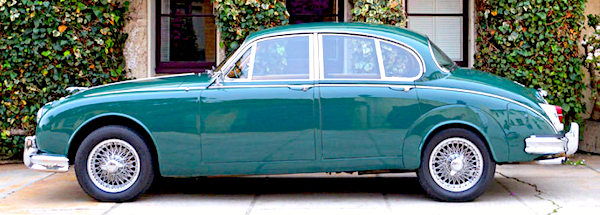
The roof appears flatter, due to the higher profile of the side windows and related revised door framing.  That chrome framing reduces the visual bulk of the B-pillar.  Rear door windows are longer as well, reducing the size of the C-pillar.  The shape of the retractable window segment also was changed.  The result is an airier greenhouse.  Door handles are slightly repositioned.


The major change from this perspective is the larger backlight window that further reduces the size of the C-pillar.  Tail light assemblies are redesigned.

As best I can tell, these changes, especially regarding the A-pillar, imply less structural rigidity in the case of a rollover accident.  Remember, this facelift took place more than a decade before American regulations regarding accident safety were implemented.  Even so, later Jaguar four-door cars featured similar thin-looking A- and B-pillars: Perhaps there was enough structural strength to satisfy the bureaucrats.