Showing posts with label Edsel. Show all posts

Monday, March 30, 2026

1958 Edsel Corsair Walkaround

A while ago I posted "Making 1958 Edsels from 1957 Fords and Mercurys."  Ford Motor Company's Edsel brand was marketed only 1958-1960, and very few '60 Edsel's were built because production was halted very early in the model year.

Ford intended Edsels to fill some mid-range market gaps in its Ford, Mercury and Lincoln hierarchy.  For '58, there were four Edsel models.  From entry-level to top, those were: Ranger, Pacer, Corsair and Citation.  As noted in my post, Rangers and Pacers were based on bodies shared with Fords, and the others were Mercury-based.

My post "1958 Edsel Pacer Walkaround -- A Rather Pleasing Design" (link here) features a Ford-based model. And now it's probably time for a Mercury-based Edsel.

Rangers and Pacers came in six or seven (depending) body types, whereas Corsairs and Citations were available only as hardtop (pillarless) coupes and sedans.  The car featured below is a hardtop sedan, the best-selling of the lot.

Images of the 1958 Edsel Corsair hardtop sedan shown below are of a car listed for sale.

Gallery

The famous (in late 1950s USA) Edsel grille.  Most grilles had horizontal layouts, and even more traditional grilles such as Mercedes-Benz's were more square than strongly vertical.  As I mentioned in an earlier post, Edsel front end design would have been improved with dual, not quad, headlights.

1958 Edsel Ranger hardtop sedan, photo via Ford.  This is the Ford-based, entry-level equivalent to today's subject car.

Ford Motor Company cars (save 1955 Lincolns) had panoramic windshields model years 1955-1959.

No fashionable tail fins.

The backlight window is panoramic, but the C-pillar zone seems, fussy, awkward to me.

The curves dropping towards the center of the car are a consistent theme.  But they are not well-related to one another from top to bottom.

Bold, two-tone areas are consistent with flamboyant late-1950s American car stying fashions.  At least the dark area's chrome outlining ties into elements at the rear.

There is also some sculpting around the dark paint area, which is why the forward chrome strip does not touch the two-tone framing.  The sculpting also echoes the slight fenderline profile flow point.

A busy design with many elements seemingly "tacked on" rather than integrated.

Thursday, February 12, 2026

Edsel's Only Facelift

It's ancient history for most folks these days, but Ford Motor Company's 1958-1960  Edsel brand fiasco was famous.  Nevertheless, car buffs and business schools still find it of interest.

I posted "Edsel's Three Model Years" here, and "Making 1958 Edsels from 1957 Fords and Mercurys" here.  The present post builds on those, focusing on 1959 Edsel design, the brand's only facelift.  (The few 1960 Edsels were new designs, based on the redesigned 1960 Fords.)

Model year 1958 Edsels came in two body platforms.  Entry-level Edsels used Ford bodies and came in two ranges: Ranger and Pacer.  Upscale Edsels were Mercury-based: Corsairs and Citations.  But for 1959, all Edsels were Ford-based, the model line reduced to Ranger and Corsair.

For detailed coverage of the Edsel saga, read "Disaster in Dearborn: The Story of the Edsel" by Thomas E. Bonsall (Amazon link here).

It seems that Ford management was starting to sour on the project even before the 1958 models were introduced to the public in early September of 1957.  By late 1957, sales data revealed that the cars were not selling as well as anticipated.  Given the lead-time to the introduction of 1959 models, it's likely that the decision to drop Mercury-based Edsels was made some time in 1957, not 1958. 

In the Gallery below, 1958 and 1959 Edsel styling themes are compared.  Some 1959 Ford images are included to indicate changes made to create Edsels.

Gallery

1958 Edsel Corsair hardtop coupe - car-for-sale photo
A Mercury-based Edsel with the then-controversial grille design.

1959 Edsel Ranger hardtop coupe - car-for-sale photo
Frontal design was simplified.  Headlights were moved from the fender fronts to the grille zone.  The vertical grille element was somewhat integrated with the rest of the grille by adding horizontal bars.  My opinion is that this resulted in a bland Edsel-look.  I'd be tempted to put sone vertical bars in the vertical element.  That would have toned-down the original grille's visual shock while still being proudly (enough) Edsel.

1959 Ford Galaxie Club Victoria - BaT Auctions photo
The basis for 1959 Edsels, in this case a two-door hardtop.

1959 Ford Galaxie 4-door sedan - Barrett-Jackson Auctions photo
Galaxie was Ford's most expensive line.  For 1959, it and mid-range Fairlane 500s were given wide C-pillars in Thunderbird fashion.

1959 Ford Custom 300 4-door sedan - car-for-sale photo
Ford's entry-level Custom 300 line received thinner C-pillars with panoramic backlight windows.  This version was used on '59 Edsels.

1959 Edsel Ranger 4-door sedan - BaT
The Ford fenderline was retained.  Wheel openings were slightly different, along with the rear door's aft cutline.  Edsel sides received new sculpting below the fenderline and, of course, new side trim.

1959 Edsel Corsair 4-door sedan - BaT
Entry-level Ranger side trim differed from that of the senior-level Corsair shown here -- though the upper chrome pieces seem similarly placed.

1958 Edsel Pacer 4-door sedan - BaT
Original Edsel rear end design on a Ford-based body.

1959 Edsel Ranger 4-door sedan - BaT
For '59, trunk lid shaping was little changed, but not the rest of the rear.  Ford invested in some new tooling here as well as on the sides and front end.

1959 Ford Custom 300 4-door sedan - car-for-sale photo
Ford rear ends were clearly unlike Edsels despite having the same basic body structure.

Thursday, June 1, 2023

Making 1958 Edsels from 1957 Fords and Mercurys

Ford Motor Company's Edsel brand lasted only three model years, 1958 into 1960.  It was launched in an effort to broaden the company's brand spectrum, especially targeting the upper mid-class market.

But the brand failed due to several reasons, some of which I wrote about, along with others mentioned in the first link.

The 1958 Edsel line was comprised of four models.  In ascending price order, they were Ranger, Pacer, Corsair and Citation.  The first two were based on Ford bodies, the rest on Mercury bodies.  Fords and Mercurys were redesigned for the 1957 model year, and I'm using those as the basis for the discussion below, rather than facelifted 1958 models.

Setting the scene, entry-level Ford Customs had 116-inch (2946 mm) wheelbases, and Ford Fairlanes had wheelbases of 118 inches (2997 mm).  All '57 Mercury wheelbases were 122 inches (3099 mm).  Edsel Ranger and Pacer wheelbases were 118 inches, like those on Ford Fairlanes and Fairlane 500s.  Edsel Corsairs and Citations had the longest wheelbases, 124 inches (3150 mm).  As will be seen below, wheelbase differences were dealt with fairly easily because the cars were built body-on-frame, rather than using unitized bodies that are today's norm.

Unless noted, images below are of cars listed for sale.

Gallery

1957 Ford Custom 300 Fordor Sedan
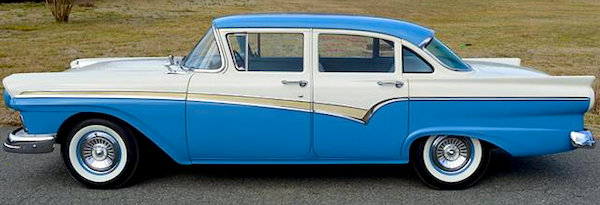
First, the entry-level Ford 4-door sedan on the short wheelbase.

1957 Ford Fairlane Town Sedan - unknown photo source
Ford's longer-wheelbase 4-door sedan.  Rear door widths provide the clue for lengthening.  The Fairlane door is wider, and the passenger compartment top lengthened to accommodate that, while the shape of the backlight window was unchanged.

1958 Edsel Ranger 4-door sedan - Mecum Auction photo
This is the Edsel based on the car above.  Wheelbases are the same, so the basic structures are the same as well and visual differences are due to cladding.

1957 Ford Fairlane 500 Town Victoria - factory image
Here is Ford's '57 4-door hardtop sedan.

1958 Edsel Pacer 4-door hardtop
And an Edsel version using the same structure and wheelbase.

1957 Ford Fairlane Town Sedan
Repeated photo.  Compare to the Mercury 4-door sedan below with its 4-inch (102 mm) longer wheelbase.

1957 Mercury Monterey 4-door sedan
The Mercury body is different, though there are a few intriguing similarities.  Compare the door cutlines.  They are virtually the same (the photo of the Fairlane 500 4-door hardtop shows the lines more clearly), the forward Mercury cutline being more vertical, and rear door aft cut shaping differing around the wheel opening.  Windshields are essentially the same, though framing is more angular on Mercurys.  This suggests possible structural carryover to an otherwise different platform.  Otherwise, passenger compartment tops differ along with body sheetmetal cladding.  But I could well be wrong: an experienced body shop crew would probably know the truth.  Anyway, for styling analysis purposes, we can regard Mercurys as having distinct body designs.

1957 Mercury Montclair 4-door hardtop - via Curbside Classic
Edsel Corsairs and Citations were hardtops or convertibles, so compare this Mercury 4-door hardtop to the sedan above.  The main difference is that the hardtop has a wider C-pillar.

1958 Edsel Citation 4-door hardtop - unknown photo source
The main structural difference is the backlight window shape and framing along with slight aft side window reshaping and a thinner C-pillar.

Monday, October 10, 2022

1958 Edsel Pacer Walkaround -- A Rather Pleasing Design

Ford Motor Company's Edsel brand (Wikipedia entry here, a post by me here) had long been a cautionary tale of product planning failure.  The links above mention reasons for that failure.

One frequently mentioned cause was styling.  Edsel stylists were given the task of making the cars look distinctive when viewed from a distance, perhaps a city block away.  That was because mid-1950s American cars had horizontally-oriented grilles and tended to look similar when seen at that distance and farther.

So Edsel stylists pulled the Old Switcheroo, giving the frontal design a vertical element, an idea being that some European brands such as Mercedes had more vertically-oriented grilles.

The problem was, this struck many potential buyers as being shockingly different, Something That Was Not Done.  And wisecracks popped up such as "Edsels look like Oldsmobiles sucking on lemons."  (Oldsmobiles in those days had horizontal oval grilles.)  Nowadays, some Edsels don't look all that bad -- such as the model featured here.

It was based on the 1957 Ford Fairlane 500 4-door hardtop, and I always liked the styling of '57 Ford Fairlane 500 hardtops.  That's one reason I find the design pleasing 65 years later.

Gallery

1957 Ford Fairlane 500 Town Victoria - unknown photo source.
This was the basis for the featured Edsel in the following images.  The optional rear wheel skirt detracts from the appearance of the car shown.

1958 Edsel Pacer 4-door hardtop - car listed for sale
It would have looked better without the quad headlights.

Wraparound (panoramic) windshields were de rigueur in America in those days, as were splashy two-tone (and even three-tone) paint schemes.  That said, this Edsel has a nicely balanced side design incorporating those details.

The white accent color framing integrates with the aft styling.

Taillight assemblies relate to the bumper shapes below.


The extended curve of the upper backlight window frame beyond the C-pillar echoes the windshield framing, a nice touch used by later Mercurys.  This is one of the few aesthetic virtues of wraparounds.


The (in)famous Edsel grille.

Dashboard view.  Note the bubble-shaped speedometer housing.  And the transmission pushbuttons on the steering wheel hub.

1958 Edsel Citation 4-door hardtop - car listed for sale
This is the Edsel 4-door hardtop based on the Mercury.  Heavier, less-graceful than the Ford-based design featured above.

Thursday, April 8, 2021

Three-Tone Paint Schemes - A Four-Year Fad

Mid-1950s American cars are a subject of fascination for many car buffs.  Their variety of shapes was far more interesting than today's near-identical wind tunnel tested versions.  Social critics at the time and later expressed disgust or perhaps even horror at what seemed to be styling excesses.  (In those days Consumer Reports magazine evaluated cars about the same way as they did refrigerators and toasters.  I suspect those social critics were of the same mind.)

One brief fad was that of the three-tone paint job.  Because it's difficult to coordinate three colors on an automobile, what stylists and color consultants fell back on was making at least one of those colors black or an off-white.  An alternative was to use black and off-white with one other hue.

Three-tone paint schemes first appeared on 1955 Dodges, DeSotos, Buicks and Packards.  Ford Motor Company was at the fad's tail end, offering that feature on 1958 Fords and Edsels.

Unless noted, the images below are of cars listed for sale.

Gallery

1955 Packard Caribbean - Barrett-Jackson auction photo
The Caribbean was strictly a convertible with unique side trim.  Besides the red shown here, most other '55 Caribbean stripes came in pale blue, light green, and pink.  Some Internet images show totally black cars and two-tone versions with black or off-white as the dominant hue.  A few had off-white uppers and light stripes of blue or green plus, below,  dark shades of the same hue.

1955 Buick Super Riviera - Mecum auction photo
A few Buicks that year could be had with three-tone paint.

1955 Dodge Custom Royal Lancer - Auctions America photo
Dodge was the only mass-market brand featuring three-tone paint on many of its cars for the entire 1955 model year.

1955 DeSoto Fireflite Coronado - image via Hemmings
The Coronado was introduced in the Spring of 1955 as a means of increasing the interest of potential DeSoto buyers.  That was a fairly common industry practice in those days.

1956 Chrysler New Yorker Newport - Mecum photo
Chrysler added three-tone paint the following model year.

1956 Nash Ambassador
So did American Motors.  Above is a Nash version.

1956 Nash Rambler Custom
AM's Rambler was redesigned for 1956 and the bold paint scheme was found on this top-of-the-line model.

1957 Hudson Hornet Hollywood - Mecum auction image
Final-year Hudsons as well as '56 models could be had in three-tone paint.  This is an example with two shades of blue offset by white.

1958 Ford Fairlane 500
As noted, Ford was late to the three-tone game.  Here we find two shades of green plus white.  The  gold anodized insert adds what might be considered a fourth color.

1958 Edsel Citation - Barrett-Jackson photo
Some Edsels also were three-toned.

Monday, March 26, 2018

Edsel's Three Model Years


Seated in the newly introduced 1958 Edsel are Benson Ford, William Clay Ford and Henry Ford II, the sons of Henry Ford's son Edsel, for whom the brand was named.  It became a famous marketing disaster for Ford Motor Company.

American automobile branding was far more structured from the late 1920s into the 1960s than it is today.  Almost all cars were based on what are now called "platforms" of fairly similar size.  For example, all Fords shared the same platform, the variation being amongst 4-door sedans and hardtops, 2-door coupes/sedans and hardtops, convertibles, and station wagons.  Nowadays, a single brand might market standard-size 4-door sedans, coupes and station wagons, compact sedans, compact coupes and hatchbacks, minivans, and crossover SUVs.

Today's proliferation of brand platforms leads to dilution of price/prestige hierarchies.  For example, aside from Minis, BMW cars range from moderate-price small cars to luxury sedans and high-performance sports cars.  But during that 1920s-60s period in America, brands were hierarchical in terms of price/prestige with some overlapping.

In 1955 Ford Motor Company marketed only three brands: Ford, Mercury and Lincoln (listed from low to high hierarchically).  Chrysler Corporation, smaller than Ford, had Plymouth, Dodge, DeSoto, Chrysler and Imperial.  Dominant General Motors brands were Chevrolet, Pontiac, Oldsmobile, Buick and Cadillac.  So Ford management decided to add another brand to their portfolio to help cover the then fast-growing mid-price field.

That brand became Edsel.  I won't go into all the reasons why the Edsel failed so quickly: some of that is mentioned here and here.  An even deeper analysis can be found in Thomas Bonsall's book "Disaster in Dearborn" that includes Ford management infighting as a factor.

For the purposes of this post, I will cite three considerations.  First, Edsel's target mid-price market suddenly hit the skids thanks to a recession that began around the time Edsels were introduced to the public.

Second, Edsels did not form a part of a coherent brand hierarchy.  Edsel and Mercury pricing for 1958 overlapped almost completely, if Mercury's top-of-the-line Park Lane models are ignored.  Thus the justification for adding a new brand to For's lineup was defeated.

Third, Edsel styling was controversial, particularly its vertical central grille element.  This was contrary to the current fashion for horizontal grille orientations.  The reasoning for the Edsel design was that the cars should be so visually distinctive that they could easily be identified at a distance.  (I should note that the Studebaker Hawk model, introduced for 1956, featured a square grille format that the public seemed to find acceptable.  However, Edsel's narrow version was too extreme and invited derision.)

Apparently Edsel management quickly realized that the grille theme had backfired.  So the grille design for 1959 was a subdued version of the original requiring minimal body retooling investment.

Edsel staggered into the 1960 model year being based on Ford bodies (as shown below, early Edsels made use of both Ford and Mercury bodies).  Production lasted only about two months before the brand was killed.

Gallery

Edsel Corsair 2-door hardtop for 1958, RM Sotheby's photo.  The top Edsel models, Corsair and Citation, used Mercury bodies.

This is a "for sale" 1958 Mercury Monterey Phaeton Coupe using the same basic body as the Edsel in the previous image.

Edsel Pacer 4-door hardtop; Pacer and Ranger models used Ford bodies.

"For sale" photo of a 1958 Ford Fairlane 500 2-door hardtop.

Rear view of 1958 Edsel Corsair featuring a three-tone paint scheme.

For 1959, the vertical element of Edsel's grille design was made less distinctive.  This was accomplished by dropping the headlights into the grille ensemble and adding horizontal bars to the vertical element to echo the horizontal bar theme of the main grille areas.

Edsel Corsair 2-door hardtop.  Tail lights were lowered from the horizontal fins to the vertical aft panel.  Side trim was restyled in various ways on all Edsels, considerably changing the brand's character here.

Rear view of a '59 Edsel Ranger in a Barrett-Jackson photo showing in better detail the tail light redesign.

Here is a 1960 Edsel Ranger offered for sale.  The grille suggests the now-iconic two-element Pontiac grille introduced for 1959 (except Pontiac abandoned the theme for 1960 and then ran with it again starting in 1961).

Rear view of the same car.  A nice touch is the vertical tail lights and backup lights that harken to the original Edsel grille theme.

A 1960 Ford whose body was used by Edsel, having dropped all connections with Mercury that model year.