Monday, November 6, 2023

1970 Ferrari 512S Modulo Concept

Around 1970, there appeared some concept cars that were extremely low and featured wedge-shape fronts.   Aside perhaps for racing purposes, those configurations had little practicality in the real motoring world.   I consider those designs being explorations of extreme cases -- something worth testing.  And for the sponsors and builders, those concept cars generated a lot a welcomed publicity.

Today's subject is the 1970 Ferrari 512S Modulo (brief Wikipedia entry here).  It was built by Pininfarina and styled by the firm's Paolo Martin.

Most of the images below appear to be via Pininfarina and/or Ferrari, though a few might be from other sources, as the Modulo was eventually sold by Pininfarina.

Gallery

The Modulo was painted black for the 1970 Geneva auto show.

Shortly later, colors were reversed.  The car appears to be highly streamlined, though I wonder if the design was thoroughly tested in a wind tunnel.  That's because the front lacks an air dam and seems like it might be subject to lift.

The engine is placed between the passenger compartment and the rear axle line.  Note the partly exposed upper part of the rear tire, this in part due to rear wheels being larger than the front wheels.

This frontal view indicates wedging was also applied to the car's sides as well as the front.

All-open view.

Publicity photo: the car seems to be painted silver here.

All-open again.  A publicity photo showing a woman at the wheel.

Same tall lady, here providing a sense of scale to the extremely low Modulo.  (The passenger compartment "door" is open.)

Thursday, November 2, 2023

Concept to Production: Cadillac Eldorado Brougham

The 1957 Cadillac Eldorado Brougham was an extremely expensive car ($13,074 in 1957 dollars, when a mid-range Oldsmobile sedan was listed at a little more than $3,000).  Total production was 704 units over its two-year run.

I recall that the Brougham was considered General Motors' answer to Ford's 1956-1957 Continental Mark II, a revival of the classic 1940-1948 Lincoln Continental.  Mark IIs were priced around $10,000 and production was 3,005.

The 1957 Brougham was preceded by a concept version that appeared in GM's 1955 Motorama traveling show.   The present post compares the two designs.

Images below alternate from the concept car to production Broughams.  Concept Brougham photos are from General Motors.

Gallery


The concept Brougham is reasonably clean-looking and very much of its time.  The reverse-slope C-pillar was found on some 1957-58 Cadillacs as well as some mid-50s GM concept cars, not to mention 1959-60 Mercurys.  The windshield has a very thin A-pillar, and its slope is unlike any GM production car's during the wraparound/panoramic era.

The top of the production Brougham in this likely-factory photo differs from the concept version.  The windshield A-pillar is vertical, like some other production cars.  Fender lines are similar apart from the tail fins.  The side trim theme is similar for both cars, though details differ.

Quad headlights did not become legal across the USA until the 1958 model year, though they were previewed here in 1955.  The production version lacks the hood ornament on this car.

Air intakes in front of the cowling are the main difference.  Note that both cars have "suicide" back seat doors.

Rear ends are less similar than fronts.  Compare the shape of the trunk lid, tail lights, and exhaust outlets with the production version below.

Similar tail fins appeared on non-Brougham '57 Cadillacs.  The concept car's are mercifully smaller.  Backlight windows seem to be the same.

Concept and production front ends are nearly identical.

Mecum Auction photo.  Headlight assemblies are more compact than the concept's.  The small disks (what are they?) below them are new.  Otherwise, the frontal designs are essentially the same aside from a few subtle shaping differences.

Monday, October 30, 2023

Airflow Four-Window Town Sedans by Chrysler and DeSoto

A seldom-seen body style variant of Chryler and DeSoto Airflows was the Town Sedan.  Town Sedans were standard 4-door, six-window sedans with the aft side window on each side eliminated -- the areas covered over by sheet metal.

Although interesting to look at, Town Sedans sold poorly, even by the Airflow's underperforming standards (compared to expectations).  Only 354 were made during model years 1934 and 1935, 43 in the latter year.  There were 195 Chrysler Town Sedans total, and 159 DeSotos.  As noted below, very few seem to have survived.

Below are some images of Airflow Town Sedans.

Gallery

1934 Chrysler CU Airflow Sedan - publicity photo
A standard Chrysler Airflow 4-door sedan.

Another perspective, taken at an auto show.

1934 DeSoto SE Town Sedan - publicity
Apologies for the poor quality, but I had to scan this from a reference book.  I include it because the car is unobstructed.  DeSoto Airflows had comparatively short wheelbases that translated into stubby looking front ends.  That said, the broad C-pillar zone made for a curiously interesting design.

Publicity photo used perhaps for advertisements or brochures.

Brochure image: a flipped version of the photo shown in the previous image.  The steering wheel in the previous image looks like it was painted by a retouch artist.  So this is probably the original photo.

1934 Chrysler CU Airflow Town Sedan - car-for-sale photos
This is the only CU Town Sedan I found on the Internet.  I did see a 1935 DeSoto Town Sedan, but it had been customized.  The only other was a long '34 CX Imperial LeBaron.  It's possible that a very few other Town Sedans exist.

Despite the design's interesting appearance, the limited outside view for back seat passengers might have hindered sales.  Chrysler Town Sedans were priced the same as regular sedans, and DeSoto Town Sedans were trivially cheaper than six-window sedans for 1934 and trivially more expensive in 1935.  So price was not a sales volume factor.

Even on the longer (by 7.5 inches, 190 mm) than DeSoto wheelbase on the  Chrysler CU, the covered side window area makes the Town Sedan seem more stubby than mainline Airflow 4-door sedan.  Compare this car to the one in the image below.

1934 Chrysler CU Airflow Sedan - car-for-sale photo
This shows the aft side window that was blanked-over to create Town Sedans.

Thursday, October 26, 2023

Daimler DS420 Limousine

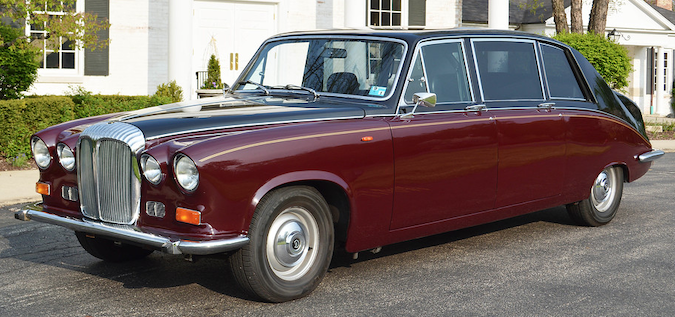
Daimler DS420 - factory photo

When I first saw a photo similar to the one above, I was tempted to make this a "What Were They Thinking?" post.

On reflection, I'm still tempted, but decided not to pull that trigger.  That's because the Daimler DS420 Limousine came from an aristocratic English brand that continued its heritage of supplying cars to British and other royalty, governments, and various upper-crust species.  So the DS420 makes sense in those contexts, even though it's not an attractive automobile.

DS420s were marketed 1968-1992, and 4,141 limousines and 903 chassis (for later attachment of custom bodies) were made, a total of 5,044, or a bit more than 200 cars per year, on average.

They were large, having a wheelbase of 141.0 inches (3581 mm).  And luxurious, as some images below will show.

The DS420 was launched after Daimler was purchased by Jaguar (some background on the Daimler Motors firm is here).  Some Jaguar components were used, but its body design was unique, unlike Daimlers that usually were little more than Jaguars with Daimler grilles.  So to some extent, the DS420 has been considered the last of the real Daimlers.

Gallery

1990 Daimler DS420 - car-for-sale photos
An interesting overhead view featuring the tapered hood and Daimler grille.

From this angle we see that the DS420's rear is an elongated English "Razor Edge" design.  Classical versions were shorter, more upright.  Also note the subtle two-toning on this car.

1985 Daimler DS420 Limousine - photos via Park Ward Motors (Australia)
Now for a walkaround.  Again, the traditional Daimler grille with its fluting on the upper frame.

Each end of the car has its interesting features, but the long middle section is quite bland aside from the chrome window framing.

The fenderline and beltline fall off towards the rear, a British styling feature from years past, but out of date even for England in the late 1960s.

I think this is the most interesting aspect of the design.  Note the concave side sculpting contrasted by the convex trunk shape.

A plain rear end, but the upper license plate frame carries over the grille motif, a cute touch.

The trunk seems fairly small, though perhaps the size of the rest of the car makes that seem so.  On the other hand, how much trunk space do luxury limousines require?

The passenger compartment greenhouse is quite tall compared to the lower body, part of a general styling trend in those days.

The headlight frames seem a little droopy.

The cockpit is very nice, very English.  Better than typical historical chauffeur territory.

The passenger zone.  Jump seats are folded next to the chauffeur partition.

Photo via Ascot Limousine Services
View of a tricked-out interior of a DS420 used for special occasion rental.

Monday, October 23, 2023

Some Syd Mead Designs

Sydney Jay Mead (1933-2019) was an automobile stylist, industrial designer, illustrator, and film concept artist ("Blade Runner" is perhaps what he's best known for).  His Wikipedia entry is here.

I first learned of him many years ago while stationed at Fort Meade, Maryland.  One of my Army buddies had got hold of a U.S. Steel publication featuring Mead's illustrations and let me leaf through it.  Years later, I bought the book "Sentinel" by Strother MacMinn that contained much of Mead's work up to 1979.  I still have it in my library.

I find Mead's illustrations and designs interesting, though not always quite likable.  "Impressive" might be my best word for his work.  Other folks might disagree regarding likability.

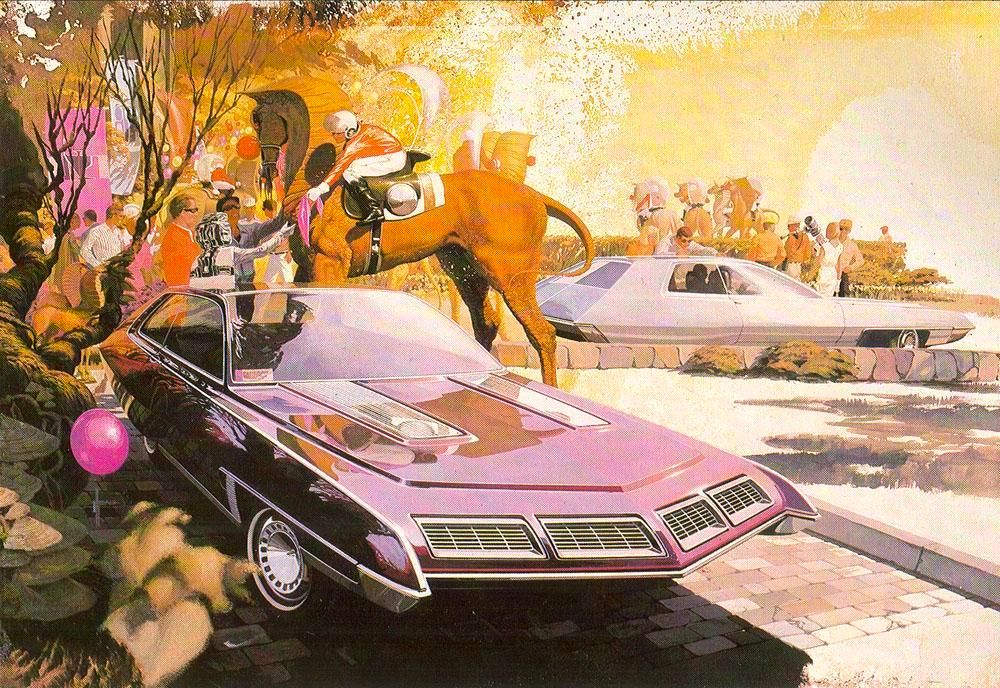
Below are some examples of his car designs pictured in futuristic/fantasy settings.  Few of these designs are practical, but that's the nature of far-out thinking and styling.  Note the imaginary creatures found in some of the backgrounds.

Click on images to enlarge.

Gallery

Some preliminary drawings
Many Mead designs feature smooth frontal profiles.  Even those he made before aerodynamic efficiency became a prime design matter.

U.S. Steel Innovari project illustration
One of his most practical designs, this from circa 1966.

LeMans Street Coupe - version 1
I don't understand the reason for the huge rear fender zone.

LeMans Street Coupe - version 2
Interesting appearance, but impractical from the perspective of a driver or passenger.

Rolls-Royce
Impossibly low, given comparative size of the humans depicted.  Huge amounts of overhang, but other 1960's stylists were drawing dream cars with similar proportions.

Wedegnose Sports Wagon
Tiny wheels.  Must also have a tiny motor.  And tiny luggage space.

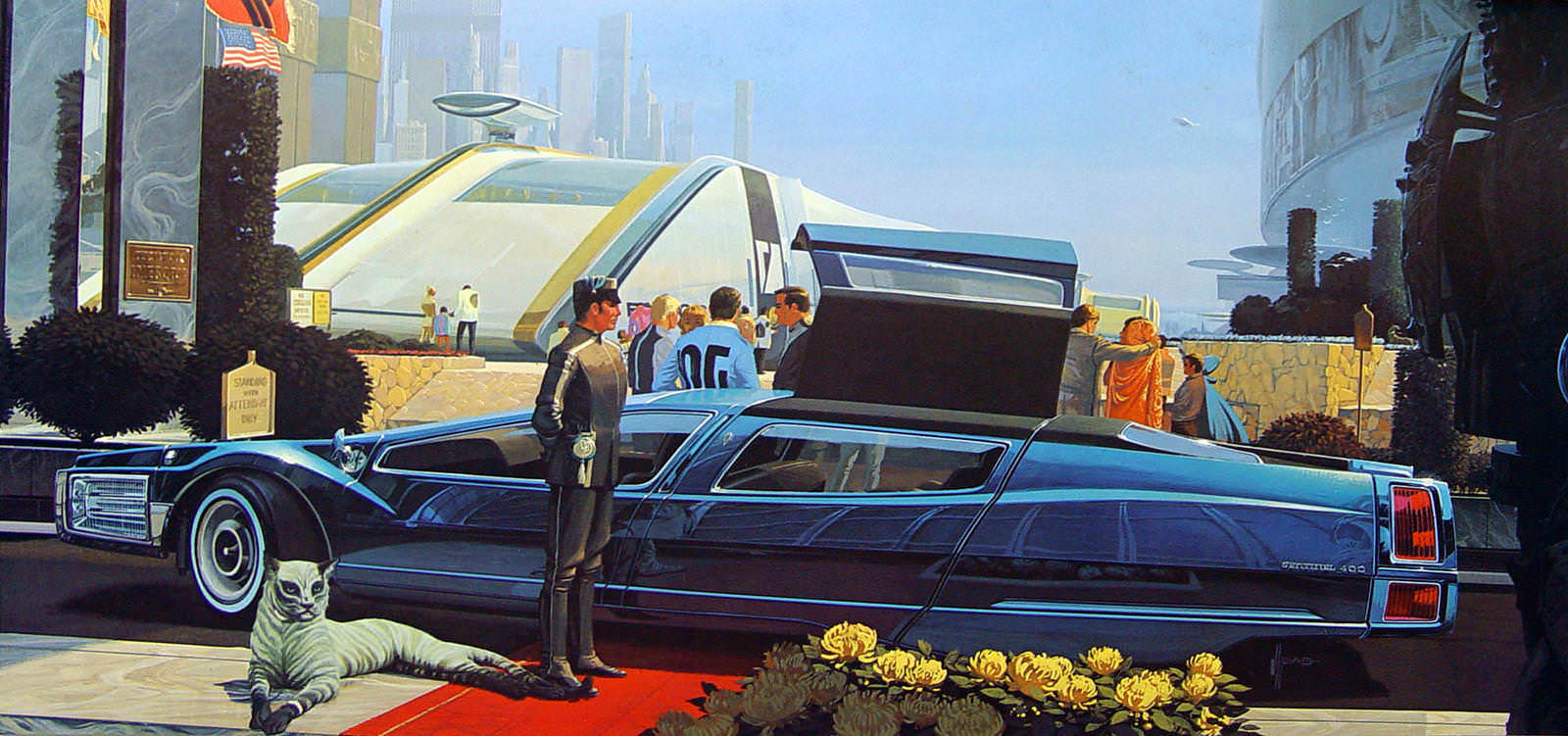
Sentinal 400
Now an extremely low and long limousine.  An interesting design that's impractical for ordinary needs.

Another, more practical, wedge design
Nice rendering, nice car shape.  But how is it powered?  Electric motors might do, but I don't see much room for batteries.

Thursday, October 19, 2023

More About the Shared-Platform Jaguar S-Type and Lincoln LS

Today's post is a more systematic than my previous treatment of styling differences of the 1999 Jaguar S-Type and 2000 Lincoln LS that shared the same platform.

Some background on the S-Type is here, and on the LS is here.  Geof Lawson is credited for the Jaguar styling and Helmuth Schrader is cited regarding the Lincoln.   Not mentioned is whether the basic platform work was done in the USA or in the UK.  Or if shared, what input percentages were by each side.

The Jaguar example below is a 1999 S-Type, photos via Car and Classic Auctions in England.  The Lincoln is a 2003 LS, photos from Bring a Trailer Auctions.

Gallery

Side views generally best reveal structural similarities.  Above is the 1999 Jaguar S-Type.

Here is the 2003 Lincoln LS.  Both cars have the same 114.5-inch (2908 mm) wheelbase, and their lengths are virtually the same.  The most similar area is between the cowling and the after cutline of the front door, including the B-pillar. That is, the windshields are the same, the doors have nearly the same cutlines at the front and what looks like the same cutlines at the pillar.  Wheel openings seem to be the same shape.  The front bumper horizontal cutlines also look the same.  Other details differ to varying degrees.

Front comparisons.

No similarities here.  That's because frontal design is important for brand recognition.

Rear views.

Underlying rear bumper structure is probably the same, given the sizes of the impact areas.  Trunk shapes and cutlines differ.  The Jaguar's roof profile looks slightly more rounded from this perspective.

Rear quarter.

Most of Ford's tooling budget for differentiating these cars is seen here.  Nearly everything abaft of the B-pillars is unique.  Wheel openings were noted above.  Trunk lengths are about the same.  But even the gasoline filler doors don't match.

Front quarter.

That the windshields are the same is clear from this viewpoint.  The stylists did an excellent job of disguising the fact that these two cars shared the same platform.  Hardly a touch of "badge engineering" here.