Monday, July 24, 2023

Aston Martin Lagonda Series 2: Low and Angular

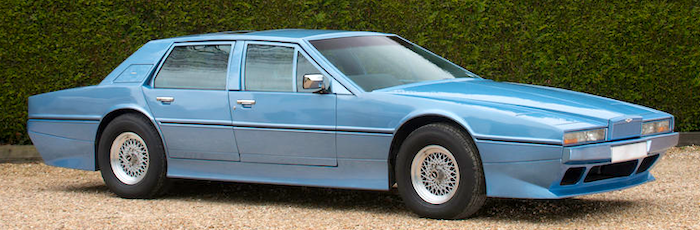
Nearly ten years ago I wrote about the Aston Martin Lagonda Series 2 design.  Since then, more images of  those cars have appeared on the Internet, so now I can present a walkaround sequence showing the styling in much greater detail.

There were four production series: Series 1 (1974-75), Series 2 (1979-85), Series 3 (1986-87) and Series 4 (1987-90) with 645 built, all told.  The first series amounted to fewer than ten cars, as the second link above mentions.  It also states that its cars were based on Aston Martin components, whereas Series 2 and later cars had a unique platform.  A prototype was displayed in 1976, but production cars were not marketed until 1979.

In my earlier Aston Martin Lagonda post, I noted: "[I]n my judgment the design suffers because of the dimensions of the 'package.'  The car is simply too long and too low; its proportions would make almost any styling seem wrong."

Keep in mind that a long-term design trend was to increasingly low car bodies.  By the early 1970s this yielded some sports cars and show cars whose height had reached levels essentially impractical for everyday use: for example, the 1966-73 Lamborghini Miura and 1968-78 Lamborghini Espada.  At the same time, the current styling fashion was for cars to be angular-looking: razor-edge all-over.  Both factors dominated the Aston Martin Lagonda design created by William Towns.

Here are Series 2 dimensions as reported in the Wikipedia link: wheelbase, 114.8 inches (2916 mm); length, 208 inches (5282 mm) and height, 51.3 inches (1302 mm).  Clearly, overhang was enormous.

Gallery

Circa 1966 Volvo 144
An example of angular styling on a car with practical passenger packaging dimensions.

1984 Lagonda Series 2 Saloon - Gallery Aaldering photo
And here is an Aston Martin Series 2 Lagonda.

1980 Lagonda Series 2 Saloon - Bonhams auction photos
Now for the walkaround.  Plenty of razor-edge angularity.

Yet the styling is professional, with few errors aside from the overall proportions.

Long hood, short, all-overhung trunk.  Note the chin spoiler at the front.

The full-length rub-bar transitions to the upper edge of the rear bumper.  I'm not sure of the purpose of the panel on the C-pillars; seems set too low for a potential knock-out opera window.  Perhaps one is a fuel filler cover.

Tail light and reflector assemblies are geometrical.  But other lines are subtly curved, as on Greek temple columns.

Sigh: If only the car were slightly taller, all might have been well.

The steeply raked windshield helps aerodynamic efficiency.

Consistency: the rub strip meets the top of the front bumper, as it does the rear bumper.  The body flares outwards near its lower edge.

The cockpit is quite angular in spirit with high-tech details.  The steering wheel's single spoke recalls that of the Citroën DS.

Thursday, July 20, 2023

Giugiaro's Alfa Romeo Giulia GT by Bertone

One of famed designer Giogetto Giugiaro's best designs when he worked for carrozzezia Bertone was the Alfa Romeo Giulia GT Coupé, the subject of this post.

Although a 1960s effort, it was still in the tradition of classic late 1940s and 1950s Italian coachbuilding.  Moreover, its styling language derived from earlier Alfa Romeo coupés by Bertone such as mid-1950s Giulietta Sprints designed by Franco Scaglione.

Giugiaro's design was so good that it remained in production from 1963 to 1977 with minor changes, according to the link.

Gallery

1967 Alfa Romeo Giulia Sprint GTV - Bring a Trailer auction photos
The passenger compartment greenhouse was tall and airy.

Note the large backlight window.

1967 Alfa Romeo Giulia Sprint - Bring a Trailer auction photos
Earlier Giulia Sprints had an air vent opening along the front edge of the hood.

Wheels were simple by today's standards.

1971 Alfa Romeo Giulia Sprint - Gallery Aaldering photos
This later model lacks the hood air intake, cleaning the design a bit.  Post-Giugiaro, however.

The quad headlights are unfortunate, but at least have differing diameters to provide some visual variety.

GT Sprints were short, having a wheelbase of 92.5 inches (2350 mm).  But the design was crafted so that the car seemed longer and more graceful than its actual size should have permitted.

Rear end details in the bloc where the license place and tail lights are found are only slightly linked to side sculpting.  This might have been necessary to maintain the subtle side profile effect mentioned above.

Raised fender tops add interest and sculpting to the rear of the car.

Aside from bumpers, the only brightwork abaft of the grille is for window framing.

Wheel well openings are large, but the aft ones have flattened upper profiles so as to relate better to the strong side sculpting and busyness in the area of the C-pillar.  A round profile would place too much visual activity in that area.

Grilles retained the Alfa Romeo shield shape, but details changed over the years.  Raised front fender tops echo those at the rear, providing continuity.

Monday, July 17, 2023

1949 Buick Four-Door Sedan Mixed-Walkaround

The design of the 1949 senior Buicks has always interested me because it exemplified General Motors' styling chief Harley Earl's post- World War 2 theme preferences.   I wrote a post titled "Cascading Curves: 1949 Buick" dealing with that.

Since that 2014 post, more images of '49 Buick Supers and Roadmasters have appeared, allowing me to present more detail regarding styling of four-door sedans.  Unfortunately, I still haven't found a "walkaround" photo set for a single automobile.  So rather than waiting and waiting for something that might never happen, today's post is a walkaround built from photos of several cars.  Some are line-leader Roadmasters, others are mid-range Supers.

Unless noted, images are of for-sale cars.

Gallery

1949 Buick Roadmaster
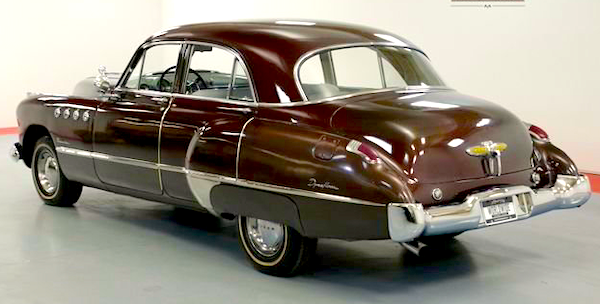
Harley Earl really liked large-radius curves, and there are plenty of them on '49 Super and Roadmaster sedans.  As mentioned in my previous post on the subject, curves are positioned so as to appear "cascading" downwards.  That is apparent in this rear-quarter view.

1949 Buick Roadmaster - Mecum Auctions photo
A partial side view showing fairly standard (for GM at the time) bustleback  roof and trunk lid curves.  Those are functional.  But the rear fender curves associated with the tail light assembly are decorative, echoing those functional curves.

1949 Buick Super - Mecum
Now for the walkaround.  Bold, vertical grille bars were a strong Buick theme for model years 1942-1954 and occasionally after.  The shape of the grille frame and related hood sculpting are carryovers of themes dating from the 1920s.

1949 Buick Super - Mecum
Supers had shorter wheelbases than Roadmasters, and had only three instead four "portholes" on front fenders.  Otherwise, Supers and Roadmasters looked the same.

1949 Buick Super
The fender design appeared across most of the GM line in 1949.

1949 Buick Roadmaster
The lighting for this photo shoot creates highlights that somewhat obscure the shape of the body.

1949 Buick Roadmaster
A massive bumper, but otherwise a pretty clean rear design.  Note the curves descending from the roof and trunk centerline.

1949 Buick Super
Basically an attractive design, though slightly fussier than 1948 Oldsmobile 98s that shared the General Motors C-body.

1949 Buick Super - Mecum
Curves everywhere -- the windshield, hood, grille bars and more.

Thursday, July 13, 2023

Generation 6 vs. Generation 5 Chevrolet Camaro

A reader wrote me to ask my opinion on the 6th (2016) generation Chevrolet Camaro styling versus that of the 5th (2010) generation Camaro.  Truth is, I hadn't paid much attention to the 6th generation design because it is superficially similar to that of the 5th generation.  And, especially, since I'm not in the market for a Camaro, I was only vaguely aware that there even was a 6th generation.  Mea culpa.

The Camaro Wikipedia entry discusses the various generations is here.  I wrote about the evolution of Camaro styling through the 5th generation here.

According to Wikipedia, the 5th generation cars were based on General Motors' Zeta platform of 2006-2017.  Given that 2017 phase-out, Chevrolet needed a new platform for its Camaro line.  So the 6th generation was based on GM's available 2012 Alfa platform used for smaller Cadillacs.  This platform is to be phased out, which is one reason why current speculation holds that future Camaro-type cars will be on electric platforms.

This Zeta-to-Alpha platform change meant that Camaros had to be redesigned for the 2016 model year or thereabouts.   Apparently, folks at GM thought 5th generation styling was so appropriate that the 6th generation cars should look pretty much the same in general, though differing in details.

As for these recent Camaros, wheelbases are: 2010 = 112.3 inches (2852 m); 2016 = 110.7 (2812 mm). Lengths are: 2010 = 190 inches (4826 mm); 2016 = 188.3 inches (4783 mm).  No important differences here.

All images below are via Chevrolet.

Gallery

2010 Chevrolet Camaro Coupe

2016 Chevrolet Camaro Coupe
Windshields look alike, hood bulges are similar.  Front impact area is more thin on the Gen-6 and the air intake zone taller, though widths are about the same.  Headlight-to-headlight sweep is much less tall, but the '10 character remains.


The '16 passenger compartment greenhouse seems a trifle shorter and its profile is more curved.  Door shapes are similar, but not the same, further implying the new structure.  The large, sculpted wheel openings help retain the '10's character.  Side sculpting differs, the Gen-6's lacking the Gen-5's mid-body carry-through crease.  The roughly similar window profile helps carry the Gen-5 theme.


The most noticeable change here is the shape of the tail light assemblies, though all the sculpting has been changed for 2016.  Given the small amount of carryover (mainly the backlight window and C-pillar area), the design still says "Camaro."

Monday, July 10, 2023

1940 LaSalle 52 Coupe Walkaround

The 1940 LaSalle was the last of that breed.  Even though sales were strong, Cadillac management decided to kill the brand, but continue LaSalles as Series 61 Cadillacs for the 1941 model year.

There were two General Motors body platforms used by LaSalle for 1940.  LaSalle 50s used GM's B-body that was redesigned for 1939.  The redesigned C-body appeared for 1940 and was used by LaSalle 52 Specials.  These were more attractive, more modern looking than the B-body versions.

For me, the best-looking 52s were coupes.  When I was growing up in Seattle, I often spied a two-tone green LaSalle 52 coupe parked in a driveway on 12th Avenue Northeast near Northeast 77th Street.  Loved it.

Today's post is a slightly abbreviated walkaround of a coupe of that design.

The images below are of a 1940 LaSalle 52 Special Coupe being auctioned by Mecum.

Gallery


Perhaps the main design flaw has to do with headlight assemblies.  General Motors was a laggard when it came to blending headlights into front fenders,  GM transitioned slowly, model year by model year, and it wasn't until 1941 that headlights were firmly set into the fenders.

Headlight assemblies aside, LaSalles's profile is nicely shaped.  The rear fender, trunk, and passenger compartment greenhouse profiles make a good composition.  The front fender is of the "suitcase" variety, but needed due to the door's front cutline and hinging.

The backlight window is small by today's standards, but was normal for 1940.

Perhaps the most striking thing is the lack of chrome ornamentation.  Not even a chrome strip below the belt line running from near the car's front to abaft of the C-pillar (common in those days, and found on 1940 LaSalle 50 series cars).  There are thin chrome strips between the fenders at the bottom of the body and on the window frames.  The most noteworthy chromed items aside from hubcaps are the three air vents below the hood cutline.

The body abaft of the cowling has a rounded appearance, whereas forward of that point it's more angular due to the narrow hood.  That had to do with LaSalle brand identification.

Brand identification is found primarily on the front end.  The narrow, vertical grille had been a LaSalle feature starting in the 1934 model year.  The 12 thin, vertical air intakes flanking the grille were LaSalle details initiated in 1939, yet their image is so strong that it cries out "LaSalle!" to this day.

Thursday, July 6, 2023

Unusual Views of a 1932 Chrysler Imperial Convertible Sedan

Today's post is a variation on those walkarounds you sometimes find here.  The subject car is a 1932 Chrysler Imperial CL Custom Convertible Sedan with the body by LeBaron.  Images are from Bonham's auctions.

By 1932 Chrysler products were beginning to benefit from its new, 1928 styling group that included such highly talented men as Buzz Grisinger and Herb Weissinger.  That probably accounts for the car's grille, hood and front fenders.  I assume most of the remainder of the design was by LeBaron, a subsidiary of Briggs Manufacturing Company, provider of mass-produced bodies for several American carmakers.

The featured car is a fine example of American classic cars of the early 1930s.  A Dual-Cowl Chrysler Imperial Phaeton has even more of the elusive mix of flash and sophistication, but the Convertible Sedan comes close enough to the ideal.

My main reason for showing the Bonham's images below is that they include several high or near-overhead perspectives, something not always found on the Internet.  The result is insight into how the major exterior automobile parts in that pre- integrated body era relate to one other.

Gallery

Establishment shot: that seriously long hood houses a long, inline eight cylinder motor.

Here's the normal viewer perspective of the car.

Now for a view from on high, but at the same angle.

This shows the spare tire mounts.  Unlike some mid-1930s designs, there's no catwalk between the fenders and hood.

A significant part of the car's width is taken up by the fenders and running boards -- the passenger compartment is narrow by today's standards.

The heavy brightwork framing for the windshield relates to the fact that each pane can be raised separately (pivoting from the upper frame).  Windshields that opened was a fairly common means of ventilation in those days.  What was unusual here was that Chrysler had two-pane windshields on its most expensive cars, whereas other 1932 American cars had one-pane windshields.  The heavy framing with brightwork on these two-pane windshields usually made such Chryslers and Chrysler Imperials appear shorter and heavier than they should have.  That was especially true when cars were painted in dark colors, making the brightwork stand out and becoming a focus point.  Fortunately, the car shown here has a light color, so the framing and brightwork are much less prominent.

The dashboard area.  Knobs for releasing the windshield panels are on the cowling.  A slider bar with a positioning knob can be seen on the A-pillar to the right.

Monday, July 3, 2023

Sunbeam-Talbot Prewar to Postwar Continuity

Like most carmakers in countries engaged in World War 2, Sunbeam-Talbot had to cease automobile production and convert to war-related work.  And like most of the rest, its early postwar cars were essentially prewar models with perhaps a touch of "freshening."  It wasn't until the 1948 model year that new designs appeared.

Brand identity in the era of tall, vertically oriented grilles was preserved in the design of those grilles, especially in England.  So Sunbeam's new 80 and 90 series cars feature grilles similar to those of prewar Ten and 2-Litre models.

Interestingly, also carried over was the basic shape of rear side-windows.  That is the continuity we're dealing with in today's post.

Gallery

1938 Sunbeam-Talbot Ten - Gallery Aalderling photo
First, some quarter-views.  Above is a prewar Ten, the entry-level model.  Its wheelbase is 94 inches (2388 mm).  The profile of the after side window includes a dog-leg reverse curve at its rear.  This is the shape seen on other prewar Sunbeam-Talbots, and carried over to the postwar redesign.

1939 Sunbeam-Talbot 2-Litre - via PreWarCar.com
Here is a '39 2-Litre saloon.  It's perhaps slightly larger than the Ten, having a 96.5 inch (2451 mm) wheelbase.  That side window is what the British called "pillarless."  The missing pillar is at the aft end of the rear side door.  Were it there, this would be what was called a "six light" (six-window) car.  You can see a white vertical line of the glass there, which is where the pillar would have been.  The main part of the window might have been partly retractable (I'm not sure) and opens with the door.  But the glass area to its rear is fixed in place.

1950 Sunbeam-Talbot 80 - for-sale-car photo
Postwar Sunbeam-Talbot 80s and 90s had the same body, the difference being that the 90's motor was more powerful.  Wheelbase is 97.5 inches (2476 mm).  Compare the grille with the prewar designs.

1938 Sunbeam-Talbot Ten - Gallery Aaldering
Now for side-view comparisons.

1946 Sunbeam-Talbot Ten - for-sale-car photo
The Ten was continued through 1948, essentially unchanged from prewar.

1946 Sunbeam-Talbot 2-Litre - for-sale-car photo
The 2-Litre model also was phased out after 1948, and like the Ten, retained the prewar body.

1948 Sunbeam-Talbot 2 Litre - unknown source
The 2-Litre led to the 80 and 90 models.  This is the best right-side image I could find, early-June '23, when this post was drafted: apologies for its miserable quality.

1954 Sunbeam-Talbot 90 - for-sale-car photo
Side window shapes are remarkably similar to those of the 2-Litre and Ten, though door-hinging differs.  The "pillarless" feature is retained.  Otherwise, body-shaping is smoother, more integrated.  Front fenders fashionably curve into the front doors.