Monday, January 17, 2022

1961 Pontiac Ventura Hardtop Coupe Walkaround

The Ventura was a mid-range Pontiac line for the 1961 model year.  Only two body types were offered, both hardtops (no full-height B-pillar) -- the Sport Coupe and Vista Sedan.  Today's post is a visual walkaround of a Sport Coupe Ventura.

General Motors brands all received essentially redesigned bodies for 1961.  A major difference from 1960 was the return to aft-slanting A-pillars from the panoramic (wraparound) windshields the corporation offered from 1954 or thereabouts through 1960.  Tail fins were in the process of being phased out in 1961 as well.

All GM divisions used the two-door hardtop body featured here.  The Pontiac Ventura version was not necessarily the most attractive (that might have been the Chevrolet Bel Air), but it's a nice-looking if slightly over-decorated machine.

All images bellow are via Mecum Auctions.

Gallery

1961 saw the return of Pontiac's two-segment grille introduced in 1959 but dropped for 1960.

The lower body isn't tall compared to what was common a decade earlier.  Its contrast with the tall, curved, airy passenger compartment greenhouse enhances that effect.

The beltline is horizontal, but the nearby flowing fenderline reduces a potentially static appearance.

Rear fenderline tops retain hints of tail fins.

The little V-shaped logo on the trunk lid is Pontiac's, the letters between the tail lights spell "VENTURA."


The sculpted side decoration hints of jet planes or space ships and probably should have been eliminated or perhaps replaced by something simpler.

End of walkaround.

Thursday, January 13, 2022

American Shovel Nose Grilles

A brief early-1930s styling fad in the United States was the so-called "shovel nose" grille.   I wrote about it here regarding the 1932 Packard Light Eight and elsewhere touched on it when discussing other marques. 

What shovel nose means will become obvious when viewing the images in the Gallery below.  It can be described as grille bars curving forward somewhere near the grille's lower edge.

Before shovel noses, most American grilles were either vertical and flat, vertical and V'd. or slightly raked back and V'd.  By 1936 shovel nose was passé and the new fashion was convex "fencer's mask" grilles.

Unless noted, the chronological images below are factory sourced or are of for-sale cars.

Gallery

1931 Auburn Model C Roadster - Hyman Ltd photo
Not really a shovel nose, but strongly hinting at it.  The grille itself is not curved at the bottom, but it blends with a grooved plate that serves as a forward extension creating a shovel nose effect.

1932 Packard Light Eight Roadster - RM Sotheby's photo
The following model year Packard's Light Eight model carried what I consider the bold, classic shovel nose design.  Light Eights were discontinued for 1933, and shovel noses disappeared with them.

1932 Hudson Terraplane Coupe
Another shovel nose launched for 1932 was found on Terraplanes.  The curvature was much less extreme than that of the Light Eight.

1933 Dodge Rumble Seat Coupe
Chrysler's Dodge brand introduced a strong shovel nose for 1933.

1933 Studebaker President Roadster
The '33 Studebaker shovel nose was more subtle.

1933 Hupmobile
Hupp also went shovel nose for 1933.

1934 Lincoln KA 3-Window Rumble Seat Coupe
1933 Lincolns had a similar shovel nose grille, though the bolder bars are horizontal, not vertical.

1934 Plymouth
Chrysler Corporation's Plymouth didn't get around to adapting a shovel nose grille (a mild one at that) until the 1934 model year.

Monday, January 10, 2022

Nash Rambler Body Type Additions 1950-1954

This post expands on material I wrote about here.

The Rambler's Wikipedia entry notes:

"Nash-Kelvinator's President George W. Mason saw that the company needed to compete more effectively and insisted a new car had to be different from the existing models in the market offered by the "Big Three" U.S. automakers.  Mason also realized the basic problem that had eluded others trying to market smaller-sized cars to Americans: low price was not enough to sell in large volumes, but 'also had to be big enough to appeal to families as their primary car.'  Therefore, the Rambler was designed to be smaller than contemporary cars, yet still able to accommodate five passengers comfortably."

"The decision to bring the new car out first in a higher market segment with more standard features was a calculated risk by Mason. Foremost in this strategy was the need to give the new Rambler a positive public image. Mason knew the car would fail if seen by the public as a 'cheap little car'...Americans would rather buy a nice used car than a new car that is perceived as inferior or substandard."

From what I've read elsewhere, although small cars required less material than standard-size cars, their labor cost of assembly was little different.  That is why small American cars of the late 1940s and early 1950s were priced not much less than entry-level standard-size cars, and sometimes more.

For example, the 1951 Henry J prices started at $1363, compared to Chevrolet's $1540.  The 1952 Aero Willys was $1731, the Chevrolet $1614.  The 1953 Hudson Jet was $1858, Chevy $1680.  And the Nash Rambler convertible's base list price was $1808 compared the the two-door Chevrolet sedan's $1403.

The first Nash Rambler was a convertible coupe, a type regarded as top-of-the-line by most American carmakers.  No two-door coupe with a spartan interior for Rambler.  Later in the 1950 model year appeared a two-door station wagon, yet another usual line-topper.  It wasn't until the 1954 model year that two-door and four-door Rambler sedans were marketed -- the reverse of what might have been expected.  George Mason's marketing strategy was a success.

Images below are of for-sale cars unless noted.

Gallery

1950 Nash Rambler Custom Landau Convertible Coupe - Mecum Auctions photo
Like regular Nashes, Ramblers had monocoque bodies -- unusual for American cars in those days.  Which helps explain the complete B-pillar and fixed structure above the windows, something also highly unusual in the USA.

Ramblers had 6-cylinder motors, so the hood was agreeably-looking long.

The canvas roof was pulled up along tracks in the window frame structure.  Note this simple rear end -- more 1930s than 1950s in terms of ornamentation and size of tail lights.

1950 Nash Rambler Custom Station Wagon
Nashes featured covered front wheels starting in 1949 with their "inverted bathtub" aerodynamic design.   That style continued until Nash's final year, 1957, when larger wheel openings were used.  Some Ramblers got exposed front wheels in 1955, and all had them when restyled for 1956.

I think the "wood" is actually decals.  Correct me if I'm wrong.

Rambler dashboards were spartan, but not much more so than standard 1949-51 Nash dashboards.

1951 Nash Rambler Country Club hardtop coupe - Barrett-Jackson Auctions photo
The hardtop coupe appeared for 1951.  Again, another top-of-the-line body style.

The backlight window had three-segment glass, also common on other American hardtops that year.

Side view from a publicity image.  Wheelbases were 100 inches (2540 mm) for two-door models.  Later four-door models had 108 inch (2743 mm) wheelbases.  That size was retained for all redesigned 1956 Ramblers.

1954 Nash Rambler DeLuxe Two-Door Sedan
Finally, a two-door sedan that for other entry-level brands such as Chevrolet, Plymouth or Ford would be the low-price model included in a model year introduction.

1954 Nash Rambler Custom Four-Door Sedan
The four-door sedan.

1954 Nash Rambler Four-Door Sedan
Side view: compare to the image below.

1954 Nash Statesman
The Statesman was the short-wheelbase, lesser, full-size Nash model.  It appears that a width-sectioned Nash body from the cowl aft to the trunk lid might have been used on 4-door Ramblers.  Note the common sculpting below the windows, among other details.

Rear quarter view of a 1955 Rambler four-door sedan.

1955 Nash Rambler Custom Cross Country Four Door Station Wagon
The four-door station wagon was introduced for the 1954 model year.

Thursday, January 6, 2022

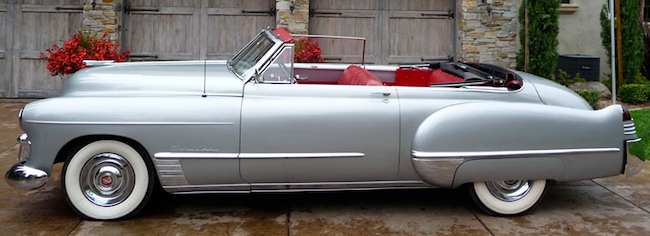
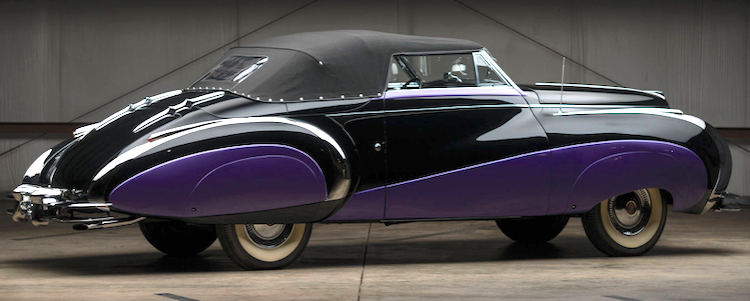
1948 Cadillac Convertible by Saoutchik

French carrossier Saoutchik, active 1907-1955, is best known for outrageously flamboyant designs.   Those were mostly built from the late 1930s onward.

Nearly all of Saoutchik's custom bodies were on French and other European platforms.  An exception is today's featured design: two bodies based on 1948 Cadillac convertibles (some background here.)

As the Sotheby's link states, one car was built for publicity purposes, being displayed at the 1948 Paris Salon de l'Automobile in October of that year.  The car shown in most of the images below was commissioned by a man who wanted a duplicate of the show car.  Both cars survive and are in the United States.

Gallery

1948 Cadillac 62 Convertible - Mecum photo
Cadillacs and Oldsmobile 98s received General Motors' first post- World War 2 redesigned bodies for model year 1948.

1948 Cadillac 62 Convertible - for sale photo
The famous Cadillac tail fins appeared for the first time.

A fine example of GM styling and the basis for Saoutchik's custom effort.

1948 Cadillac 62 Convertible by Saoutchik, Paris show car - unknown photo source
Saoutchik's version is totally changed.  Note the covered front wheels and the lack of tail fins.

Saoutchik show car Cadillac at dealer's shop in Los Angeles when new
Paint colors on both Saoutchik Cadillacs varied from restoration to restoration, though the basic scheme remained the same.

1948 Cadillac 62 Convertible by Saoutchik - via RM Sotheby's
This is the featured version.  Stock '48 Cadillacs had a two-piece curved windshield; here is a one-piece windshield that's flat or virtually so..

The Cadillac's practical bustle-back trunk now has a lower, less practical profile.

Very racy lines.  Though those large chrome accents would have been an improvement were they less wide.  At least they scream Saoutchik!!!, pleasing the coach builder's sales staff.

1948 Cadillac 62 convertible by Saoutchik - Mecum photo
Aside from the V shape at the top of the grille and what seems to be a crest, there is no visual clue that the basic car is a Cadillac.

Jazzy chrome and color panels aside, the body is nicely shaped abaft of the rather old-fashioned front end.

Overhead view.  Hard to see, but the Cadillac instrument panel is preserved.  The windshield seems flat from this angle.

Monday, January 3, 2022

Jack Telnack's "New Edge" Styling Theme

Jack Telnack (b. 1937) was Vice President of Design for Ford 1980-1997.  His brief Wikipedia entry is here.

Towards the end of his time at Ford, Telnack and his stylists came up with a visual theme they called New Edge.  It was mostly used on some European brands, though an echo found on a later USA Ford model.  So the theme never really caught on.  It was not seriously continued by Telnack's successor, J Mays.

New Edge is difficult to explain verbally, so view the factory-sourced images below for examples.  

Gallery

1997 Ford Ka
A dash of New Edge can be found on the Ka's front where the upper grille frame curve is carried over into the turn indicator lights and the hood cut line passes along the inner edge of the headlight assembly..

At the rear, there are New Edge curves associated with the aft door, tail lights and bumper cladding.

1998 Ford Focus Coupe
Here the theme seems to be expressed in the hood cut line and headlight assembly.

At the rear, it's most visible with respect to the tail light assemblies and their surroundings.

1998 Ford Focus Sedan (Europe)

The same applies to the European sedan.

2000 Ford Focus Sedan (North America)
Focus sedans for the U.S. and Canadian markets received bustle-back rear ends instead of fifth-door rears that for some reason were not popular here.

As a result, New Edge essentially disappeared in its true form.

2005 Ford Five Hundred
A faint echo of New Edge styling in Ford's J Mays era can be seen in the shape  of the Five Hundred's grille.