Thursday, July 16, 2020

Evolution of the Ever-Growing Honda Civic Four-Door Sedan

A while ago I touched on the growth of Honda's Civic model as found here in America.  Now I want to add more detail regarding that growth as expressed in wheelbase length.  Perhaps that's because for many years I was professionally a "numbers guy."

The second link above is Wikipedia's Honda Civic entry that, with sub-links, offers information on what the writer(s) contend are ten generations of Civics.  According to the data panels in the generation sub-links, some generations either did not vary in wheelbase length or such variation was trivial (one-tenth of an inch, three millimeters).  In one instance (2012 model year in the USA), wheelbase actually declined, but I will not treat that deviation here.

Below are images of Honda Civics for each generation showing a noteworthy length increase.  Ideally, I would present the cars facing the same direction and sized for comparative scale.  But that was not possible, given the images I could find via Google.

Gallery

1973 Honda Civic
The first Civics imported to America were coupés such as this.  Its wheelbase was 86.6 inches, 2200 mm.

c. 1976 Honda Civic Sedan
A four-door sedan entered the US market later, with a wheelbase of 88.9 inches, 2288 mm.  This is the benchmark for the overall growth comparison.  It styling, like that of the 2-door, has a slightly rounded appearance that was at variance from the emerging angular look of European cars.

1980 Honda Civic Sedan
The next generation had a 91.3 inch, 2320 mm wheelbase, and its styling was now in line with prevailing fashions.

c.1986 Honda Civic Sedan
Not a sharp photo (from an unknown source), this angular Civic sedan's hood curves downwards toward the front, a Honda theme for many years.  Wheelbase: 96 inches, 2438 mm.

1988 Honda Civic Sedan
Styling is similar to the car in the previous image, but the wheelbase is now 98.4 inches, 2500mm.

1993 Honda Civic Sedan
The following generation Civic shows some wind tunnel testing influence.  Wheelbase jumped to 103.2 inches, 2621 mm, where it essentially remained for the next two generations.

2006 Honda Civic Sedan
Now the wheelbase is up to 106.3 inches, 2700 mm.  The body shape is more aerodynamic.  Perhaps this length increase was due to aerodynamic considerations.  Or it was simply more of the length-creep trend due to marketing, packaging, and other factors.

2016 Honda Civic Sedan
A recent Honda Civic sedan.  Sleek, yet fashionably Japanese-fussy.  Its wheelbase is also 106.3 inches, 2700 mm, though the car is longer (182.3 inches, 4630 mm versus 176.7 inches, 4488 mm).  Its wheelbase compared to the initial Civic sedan is 17.4 inches, 420 mm longer.

Monday, July 13, 2020

New York City in 1965 -- Photos That Include a Few Cars

From time to time I do a post categorized as "Streetscapes," showing old views of cities or towns with cars.

This post differs a little because the photos (scanned slides) are mine, and not sourced from here and there on the Internet.  I took them in June of 1965 when I was in the city for a few days.  Another difference is that the cars are incidental to the scenes I was shooting.  However, you might find interesting the (mostly) American-make vehicles seen in those days.  Click on images to enlarge.

Gallery

Looking west along 42nd Street from Tudor City.  The Daily News building is the one with the vertical stripes to the left, and near the center is the Chrysler Building.

Farther along 42nd Street, across from Grand Central Terminal.  The taxi seems to be a 1964 Dodge.

Central Park South from 5th Avenue.  That's a Mercury in the foreground.

Also Central Park South.  The Plaza Hotel is at the left.  In the foreground are a Rambler and a Pontiac.

More Central Park South.  The car with the fins seems to be a 1957 Dodge.

Unloading a Cadillac on Central Park South.

Same area, but here is a Chrysler-based stretched limousine.

East 70th Street, an upscale townhouse neighborhood.  The cars are a Buick convertible, a Ford Mustang and a Ford Thunderbird.

Roosevelt Avenue elevated railroad station, Queens Borough.  An Oldsmobile is in the foreground and the gray car behind it appears to be a Rover.

Rolls-Royce in Rockefeller Center.

West 42nd Street, just west of Times Square.  Not a fancy area, though that's a Cadillac at the curb.

The TWA terminal at JFK airport.  Plenty of cars shown here.  The queue at the right is led by a Mercedes, followed by an Oldsmobile, a Ford, a Cadillac and a Pontiac.

Thursday, July 9, 2020

1950s Pontiac Tail Lights

One potential source of brand identification is the shape of an automobile's tail light assembly.  This use of tail light design is common today.  But not always so.  For example, I wrote here about rear styling of various brands for the 1936 model year, and all the tail lights shown were round -- almost no brand distinction at all.

It was only by the late 1950s that distinctive tail light assembly designs began to be common for American cars.  A counter-example of this is General Motors' Pontiac brand.  From 1949 through the 1956 model year, Pontiac's featured round tail lights.  I was slightly surprised by this, because I was aware that Fords used round tail lights for the 1952-1957 models years, but hadn't given Pontiac's longer run of that theme much thought.

Unless noted, images below are of cars listed for sale.

Gallery

1936 Pontiac with tail lights typical for that model year.

1941 Pontiac.  From the late 1930s through 1948 Pontiacs had rectangular tail lights.

1950 Pontiac, Mecum auction photo.  Pontiacs got their post- World War 2 redesign for 1949, and round tail lights returned, as can be seen on this lightly facelifted 1950 Catalina hardtop with Snohomish County, Washington license places.

Barrett-Jackson auction photo of a 1951 Pontiac.  My father bought one that was almost identical to this, though his lacked the sun visor.

1952 Pontiac, the final year for the body launched for 1949.

Pontiacs got new bodies for 1953, but round tail lights were retained.

1954 Pontiac, Mecum auction photo.

Pontiacs were drastically redesigned for 1955, but tail lights remained round.

Mecum auction photo of a 1956 Pontiac.

1957 Pontiac, where this Mecum auction photo shows that the facelift resulted in oval, not round, tail lights.  This geometric change was not large, but it broke an eight-year product identification tradition.

Then for 1958, redesigned Pontiacs featured paired round tail lights in a oval setting.

Pontiacs were redesigned again for 1959.  Here the tail light assembly is a stretched oval, far removed from the days of the round theme.

Monday, July 6, 2020

Chrysler Corporation's Early Thinking for Postwar Designs

American automobile production ceased in February 1942 on orders from the government due to the USA's entry in World War 2.  Before that time and even during the war years carmakers contemplated postwar offerings.

This post deals with Chrysler Corporation styling models from that era . The photos of styling studio models presented below suggest that Chrysler was thinking of offering a major facelift rather than a complete redesign once production could resume following hostilities.

Thanks to the postwar pent-up demand for new cars, most American car builders indeed marketed facelifted prewar designs until around the 1949 model year.

The images of styling models below are interspersed with production Chrysler Corporation cars so as to strongly suggest that the models were based on prewar rather than totally new bodies.

Gallery

Styling model from December 1941 that has a grille with some postwar Dodge detailing.  Compare the basic body with that shown in the following image.

1948 Chrysler New Yorker, Mecum Auctions photo.  This postwar car has a facelifted prewar body --  I selected this photo because it was taken from a viewpoint similar to that of the styling model in the previous photo.  The latter seems to feature a one-piece windshield, though probably does not.  The side windows, doors, etc. appear to be the same on both.

Rear quarter view of the December 1941 styling model.  Its right side features a flow-through fenderline, unlike the left side's fender design seen above.

A 1940 for-sale six-window Chrysler Royal sedan.  Again, the bodies excluding fenders and some lesser details seem about the same.

This possible Plymouth design from January 1944 is based on the models show above.  This windshield frame suggests one-piece glass.

A 1941 Dodge Custom Town Car Luxury Liner, RM Sotheby's auction photo.  Again, compare the side windows.

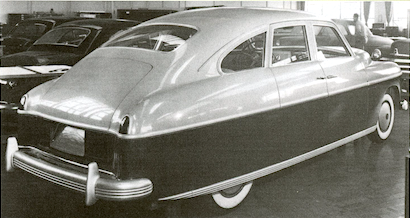
Rear view of the January 1944 model.  The fastback sculpting now deviates from prewar production shaping.  Also note that the fender line on this side is not the same as the left-side fender design in the above view.  The practice of full-scale styling models having differing side details was common then and perhaps even now.

According to Collectible Automobile magazine, this styling model photo is dated 18 July 1946.  Postwar facelifted Chrysler Corporation cars were already in production, so I think this was the January 1944 model, but updated before 1946.  Its front end and fenderline differ from 1944.  Another possibility is that this photo is indeed from 1946 and the model was being used to test possible grille designs for the 1949 Plymouth redesign (see following image).

1949 Plymouth Special Deluxe, for-sale photo showing the production grille design.

Side view of a 1941 Dodge Custom Town Sedan via Mecum.

A 1946 Chrysler Windsor four-door sedan for sale.  Although it has a longer wheelbase and front (forward of the cowling) than the '41 Dodge, this shows that the main postwar body differences on Chrysler cars (except Plymouths) had to do with front fenders extending over the front doors.  Grilles were also redesigned.

Thursday, July 2, 2020

Cadillac Catera's Siblings

One of the labels I attached to this post is "Badge Engineering" -- where different car brands are based on the same basic body and differences are trivial.  That's essentially true of two of the three cars discussed here, but slightly less true of the third.

That third car is Cadillac's Catera model that I wrote about here.  At the time I didn't show the Opel Omega that it was based on, hence the current post.

Further background on the Camera that offered by General Motors for model years 1997-2001 can be found here.

At the time, GM owned Germany's Opel firm and England's Vauxhall, the latter selling rebadged Opels with right-side steering. The Wikipedia entry on the Opel (and Vauxhall) Omega is here.

Cateras were based on the Omega B1 (1994-1999) and Omega B2 (1999-2003) that had few exterior differences.  Even though Cateras were built in Opel's Rüsselsheim factory, they were modified to satisfy presumed American tastes for a sporty Cadillac.  Unfortunately for GM, the basic Opel body was given only minor changes, and didn't strike potential Cadillac buyers as being enough like a "real Cadillac" to bother buying: sales averaged less than 20,000 per model year.

Gallery

General view of a Catera.

Rear quarter view.  Note the broad sweep across the trunk lid between the tail lights.  The tail light segments not on the lid are Opel's, but the chrome strip, reflector strip and brake light band are for the Catera only.

Front view showing the Camera grille.  The grille pattern and crest are Cadillac features, and the low, chin air intake zone is also Catera's.

Here is a similar view of an Opel Omega.  Very few differences from the Catera.

Rear Omega view.  The main difference is the simpler trunk lid features.

Front quarter view of a Vauxhall Omega.  Its grille fits in the Opel's opening.  Otherwise, there are no visible exterior differences: true badge engineering.

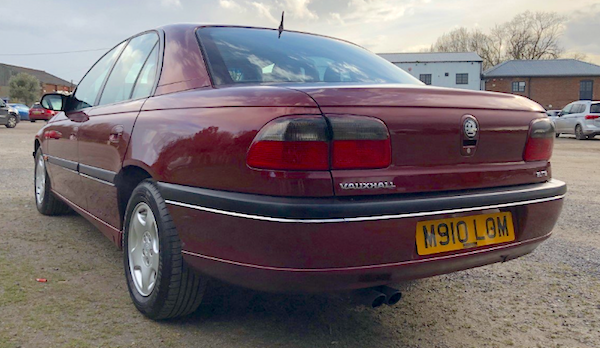
The same can be said for the Vauxhall's rear in this "for sale" photo.